Tag: nature

  • One Decade | Sanctum

    One Decade | Sanctum

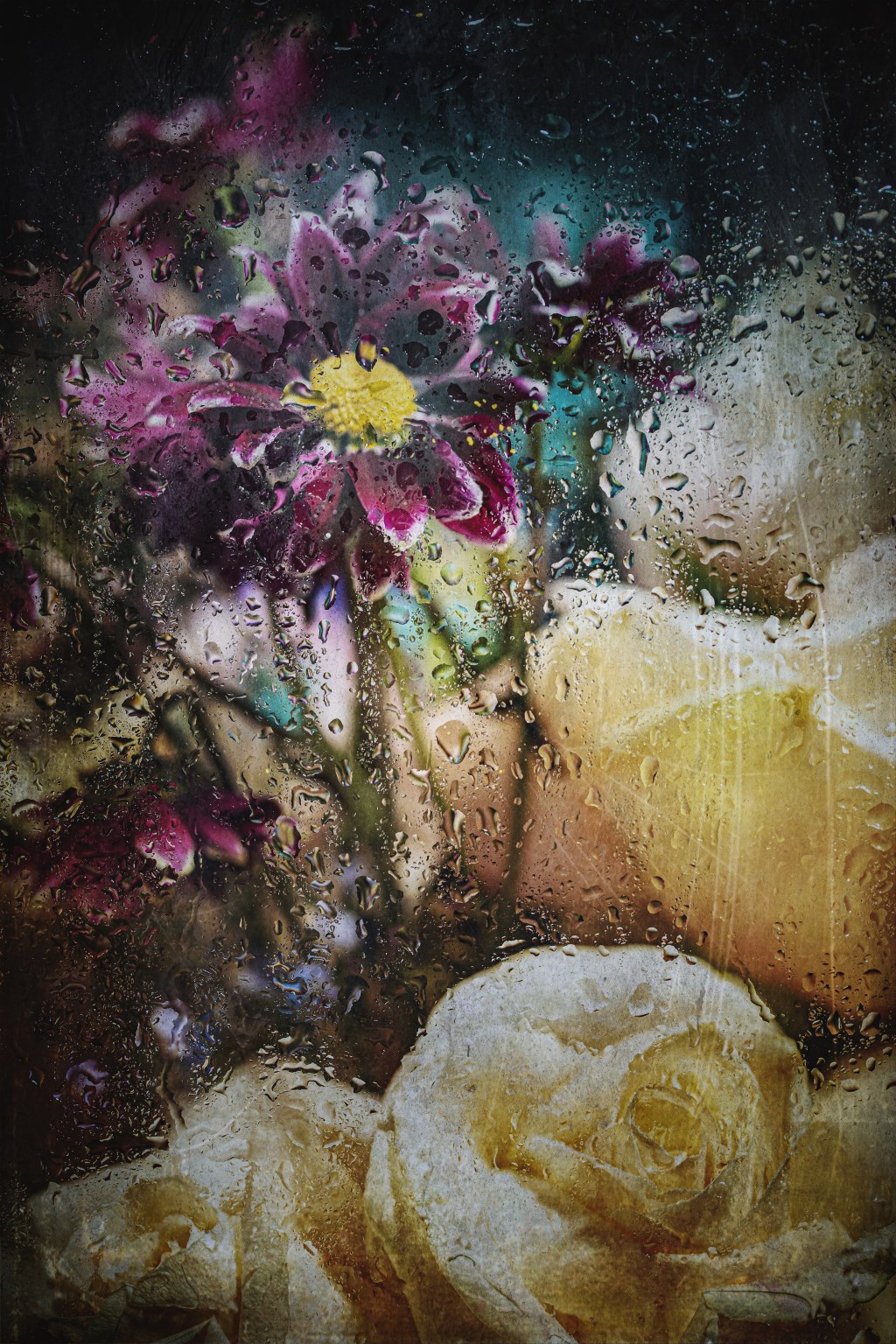
    This image wasn’t meant to carry all this, but tonight, it does. It holds the rupture I didn’t know I’d been tiptoeing around all week.

    A decade ago today, my father died. Not on the 13th, when the machines started breathing for him—that was just when I knew he was gone. On the 18th, at this hour, the veil broke open for real. And now here I am—ten years later—haunted by dreams I couldn’t explain and a sudden stillness in my creativity I couldn’t shake.

    Until now.

    I thought I was just tired. Distracted. Stuck. But it was grief. It was reverence in disguise.

    My soul remembered the date even when my mind forgot. That’s the strange thing about grief that matures—it doesn’t scream anymore. It hums, low and holy, beneath everything. It clouds the light, then sharpens it. It takes your voice, then gives it back with new timbre.

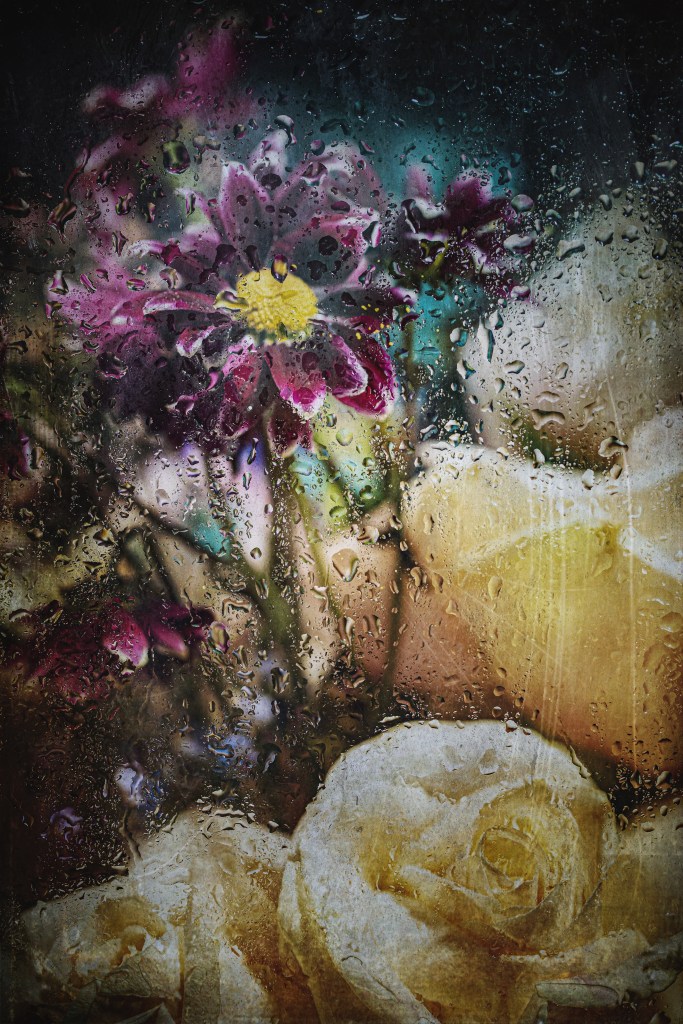
    This image—originally photographed by Mikhail Nilov—became a sort of altar. I edited it using Mextures, VSCO, DistressedFX, and Lightroom, layering texture over color, blurring presence and absence, trying to capture what it feels like when sorrow doesn’t knock—it just saturates.

    Sanctum.

    There’s chaos in this. Petals and light blurred through glass and rain. Beauty you can’t quite hold. A yellow rose—like the ones we laid at his grave—folding in on itself. A daisy, centered in clarity, yet surrounded by blur.

    That’s what this night feels like. Clarity in the middle of confusion. Stillness in the swirl.

    Earlier tonight, as I outlined these words in my head while I felt my way through the shift I felt in real-time in the energy, I said to myself:

    “You didn’t lose your creativity. You’re in holy pause. This isn’t numbness—it’s reverence. You were unconsciously grieving a resurrection-day anniversary, and your spirit bowed its head before your body could even name the loss.”

    And now, I feel it even more deeply: Tonight isn’t for making things happen. It’s for honoring what already did.

    Tonight is for prayer—prayer and intercession not only over the souls of loved ones who have already crossed over, but over one very important soul who’s still here. One who I know doesn’t understand why I had to go.

    The truth is, those crossed over souls didn’t leave to hurt me…even though it did. They left because it was time. That was my burden to bear. The lessons they left me with were my responsibility to sort through, clean up, and learn.

    Likewise, I didn’t leave the living out of anger or rejection, or even lack of love. I left because God Himself guided me in a different direction, even if they didn’t want to go that way, or grow that way, too. I will never have a choice above God. And I know that hurts…it hurts me, too.

    Forgiveness is an ongoing action, reflected not in words but in the quiet practice of letting go. The love is, and always will be, unconditional. “Anyway love” always is. And my soul will carry a piece of all of their souls within it. Always.

    A lot of things are coming full circle for me tonight. Invisible messages carried by unseen energies are releasing a kind of clarity within me—one of deeper substance and fuller understanding, puzzles pieces arriving and falling into place in a way I’ve never experienced before. The spiritual warfare, the dreams full of ghosts, the aching grief—none of that is new. But the understanding I have tonight…it reaches deeper than anything I’ve ever touched before.

    Tonight isn’t for sorting through the rubble, cleaning up the floors of my memory, or putting all the lessons learned into neat little compartments in my mind. After all, I’ve already been processing through that, and slowly overcoming it all, for some time now.

    No, tonight isn’t for being swallowed by the hauntings of my own heart. Tonight is for letting grief rain gently through the window, washing my soul—and watching how even the blur, when looked at with love and patience, can be textured out, shaped into a symbolic snapshot in time—capturing both the beauty and the chaos—and become art.

    It is the emblem of the closure of what has, all at once, been the most painful and the most beautiful decade of my life: the one where, in the end, I finally met God.


    I speak the name of Jesus over you
    In your hurting, in your sorrow
    I will ask my God to move
    I speak the name ’cause it’s all that I can do
    In desperation, I’ll seek Heaven
    And pray this for you:

    I pray for your healing
    That circumstances will change
    I pray that the fear inside will flee in Jesus name
    I pray that a breakthrough
    Would happen today
    I pray miracles over your life in Jesus name
    I pray for revival
    For restoration of faith
    I pray that the dead will come alive in Jesus name

    In Jesus name…

    -Katy Nichole, In Jesus Name (God Of Possible)

  • A Reminder to Self (But We ALL Need It)

    A Reminder to Self (But We ALL Need It)

    Reminder to self:

    Disconnection makes you stop reflecting and start reacting. It’s not because you’re a bad person. It’s because you’re lost in the noise.

    Disconnection from awareness breeds reactivity. Connection with awareness invites response.

    📷 Shot handheld with Lumix GX-7 + Panasonic-Leica DG Macro Elmarit 45mm f/2.8 ASPH.
    🛠️ VSCO (06, 2.5) + Lightroom (clarity +7 + watermark).

    When you’re connected, you pause. You listen, and ask better questions. You observe your own patterns, and stop attacking or blaming others for theirs.

    When you’re connected, you become a space of calm in a world of storms rather than another disruptive, destructive wave in a sea of chaos.

    When you forget how to listen inward, when you stop grounding in self-awareness, you lose your anchor.

    Check yourself before you wreck yourself. It’s not about being perfect. It’s about being aware.

    Pause, and come back to yourself.

    Reconnect, and become the clarity you’ve been searching for.

    Remain connected, and become the clarity that helps to guide others home.

    🕊️💜✨

  • Someday…or Night

    Someday…or Night

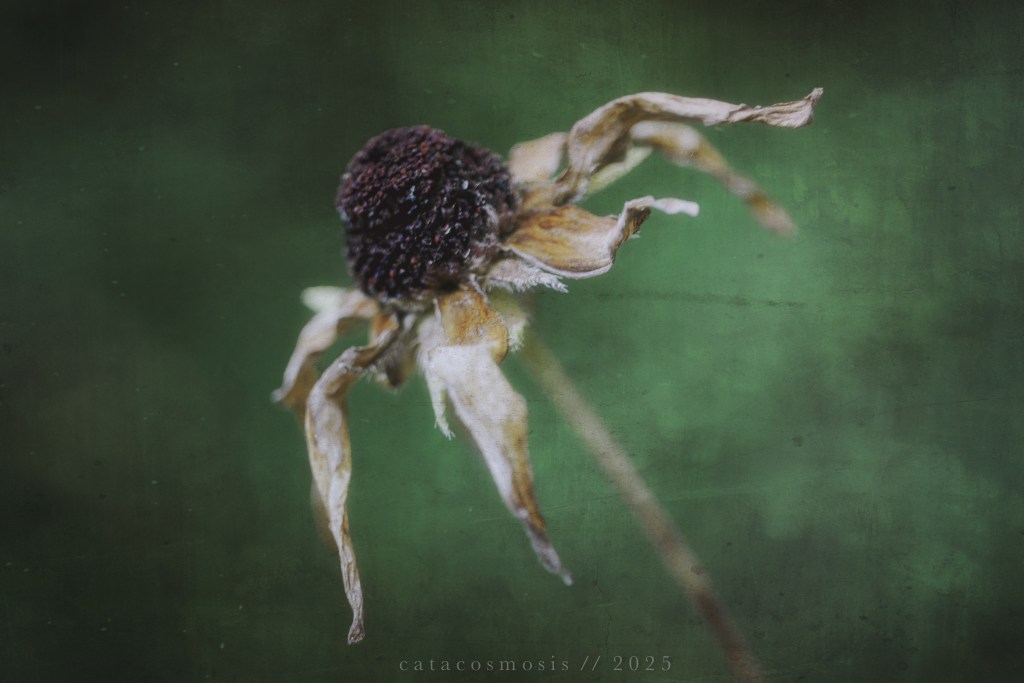
    entry ten — scattered light, fractured grace: a quiet archive of light, loss, and what remains.


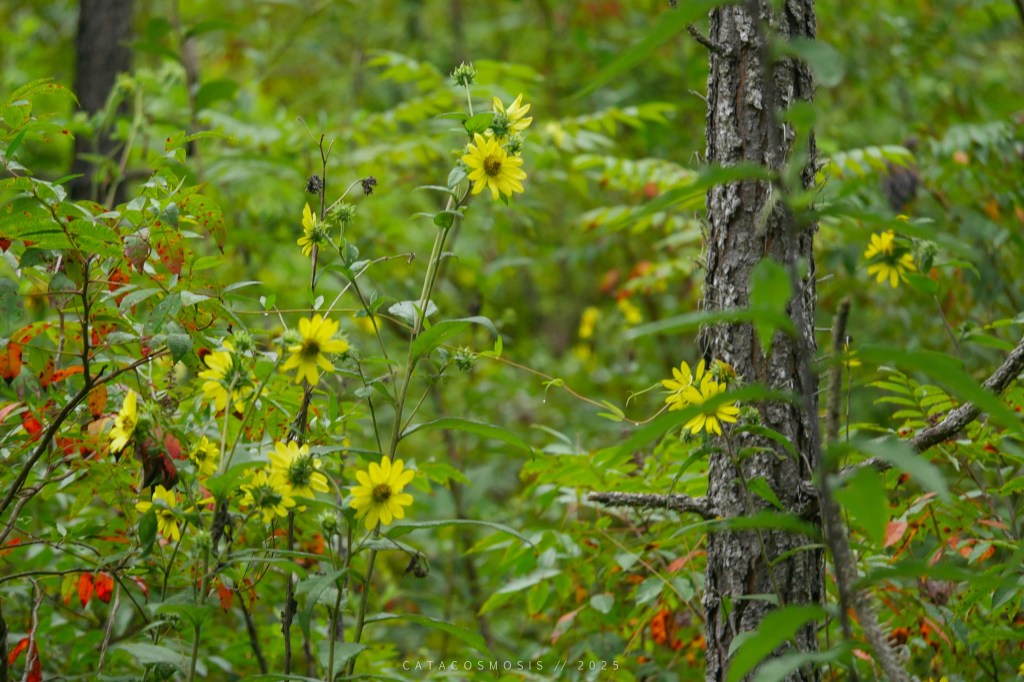
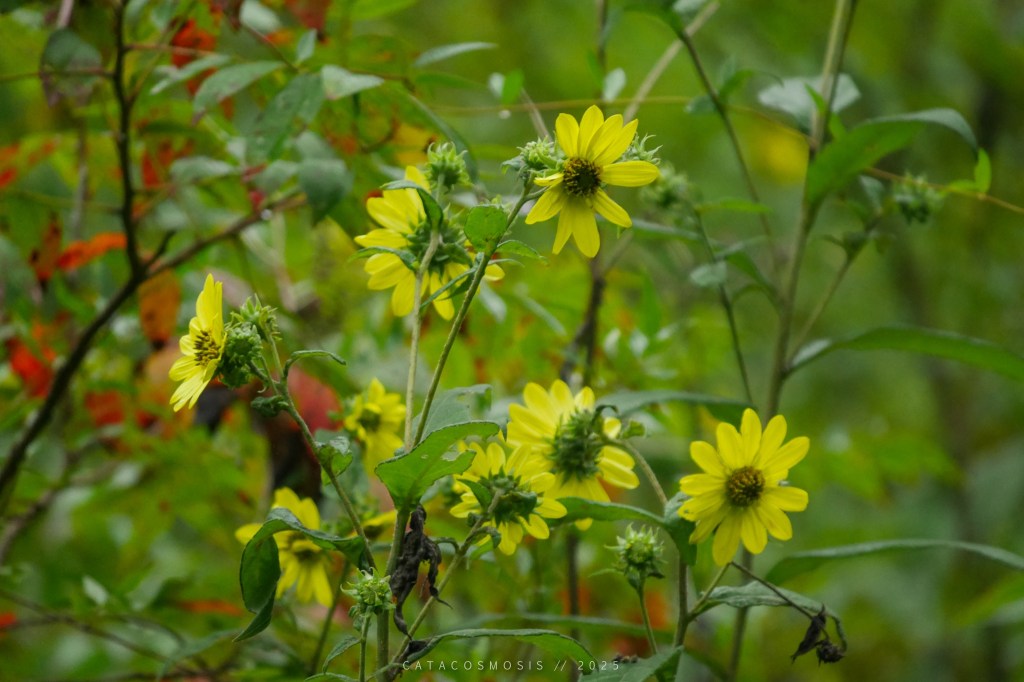
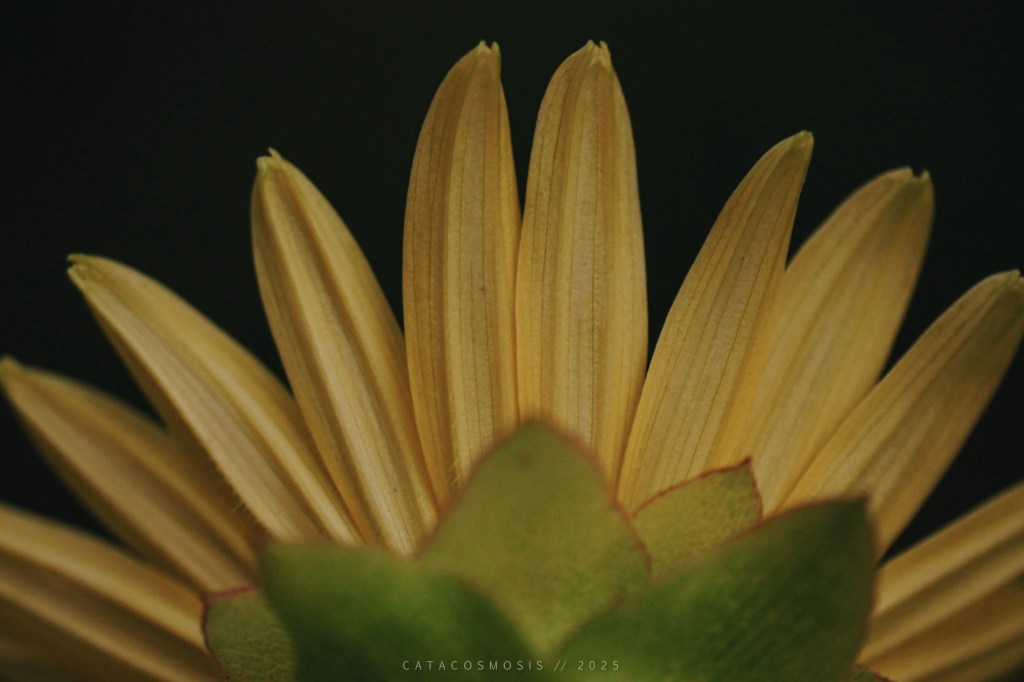
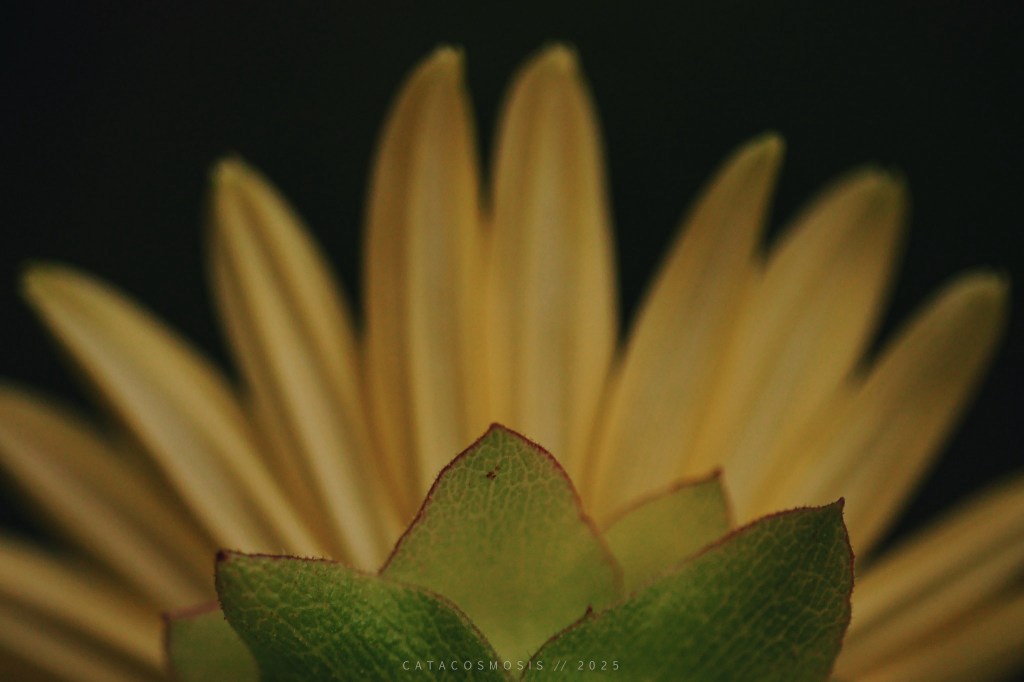
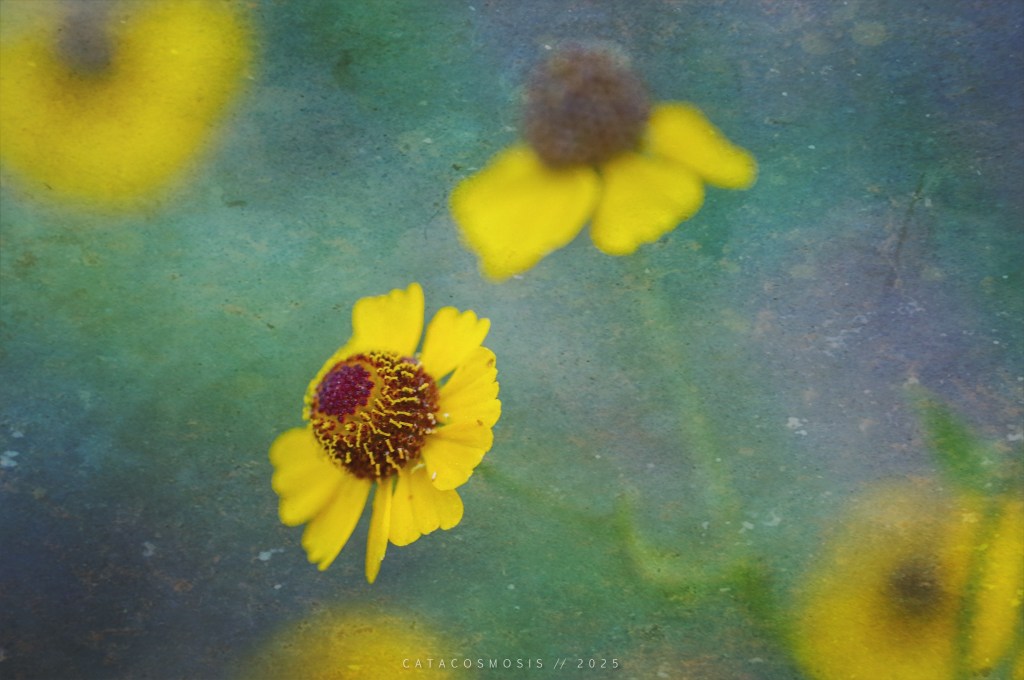
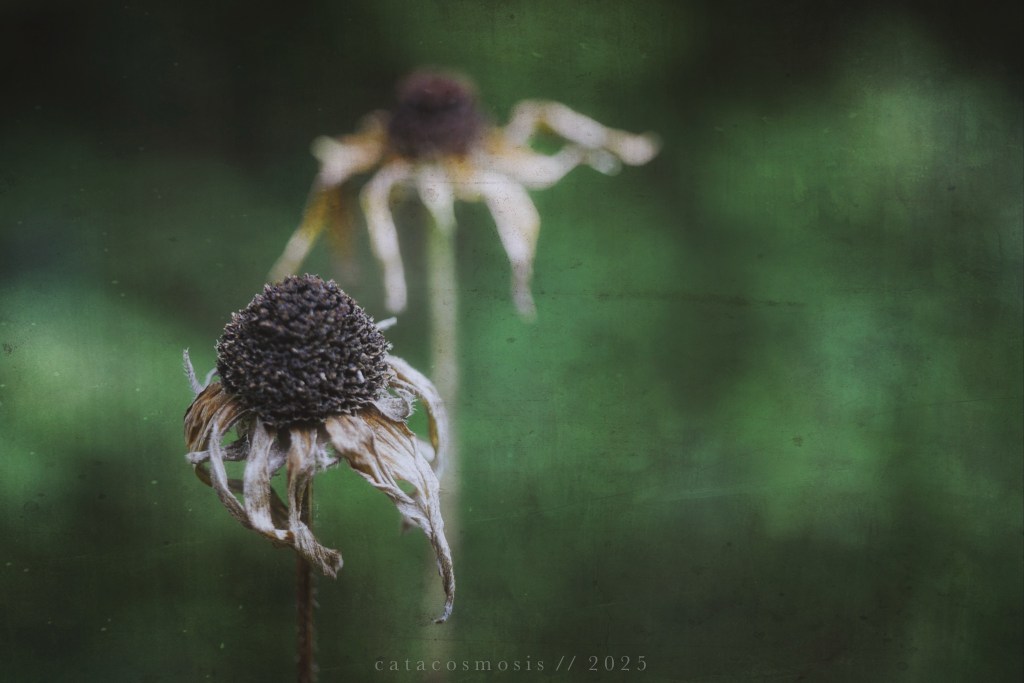
    Black-eyed Susan (Rudbeckia hirta),
    a fading ember of late summer—graceful even in decay, still holding the shape of sunlight after the bloom has passed.  Lumix GX7 + Panasonic Leica DG Macro-Elmarit 45mm f/2.8 ASPH. MEGA O.I.S., VSCO (A10PRO), Mextures (personalized texture formula: MEZPZZC), Lightroom Mobile (watermark only).

    My mother always told me, in every possible circumstance a child might ever need encouragement, “Do your best, and leave the rest. It’ll all come right some day or night.” 

    It was a line from “Black Beauty, by Anna Sewell.”  

    She was a third grade teacher, a grammar Nazi, and a mother trying her damndest to connect with me and, well, do her best. 

    And, as ornery and difficult a young person as I could often be, she never knew that I believed her…

    …even when I forgot I did.

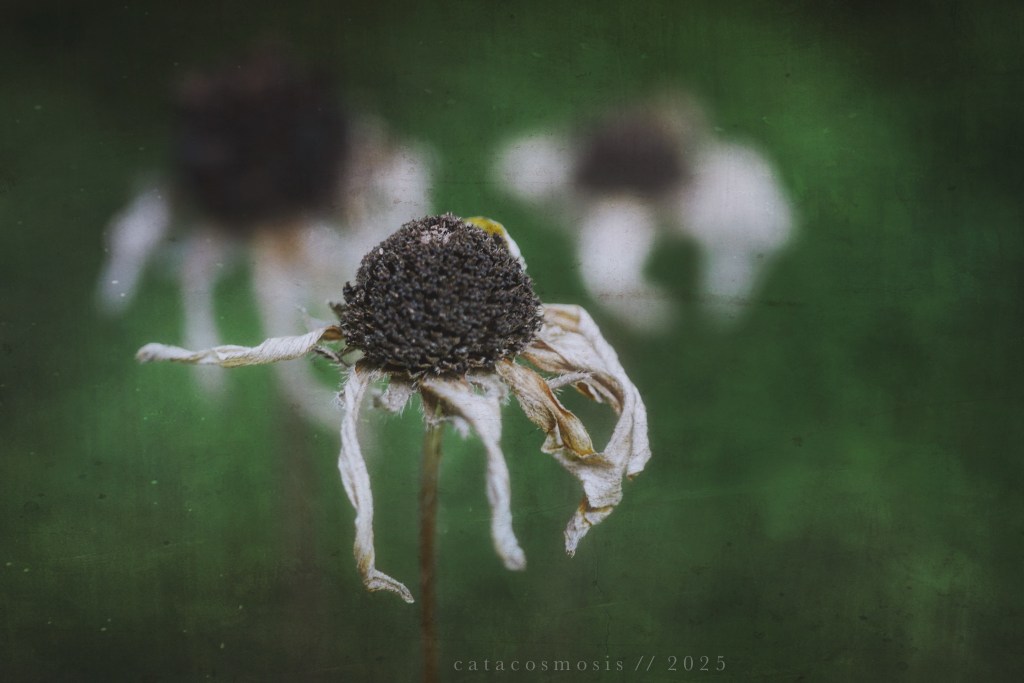
    Black-eyed Susan (Rudbeckia hirta),
    a fading ember of late summer—graceful even in decay, still holding the shape of sunlight after the bloom has passed.  Lumix GX7 + Panasonic Leica DG Macro-Elmarit 45mm f/2.8 ASPH. MEGA O.I.S., VSCO (A10PRO), Mextures (personalized texture formula: MEZPZZC), Lightroom Mobile (watermark only).

    There was so much distance between us as I struggled through high school with her overbearing “sin obsessed” guidance, and she struggled to save my soul. 

    Even when the days were so long, when they bled into each other, and when the nights felt like punishments I hadn’t earned, as her brain and body were swallowed by Alzheimer’s. 

    Even when the thread broke, or maybe I cut it, when she died…I honored and nursed a clean, holy wound in the shape of freedom for both of us, from past grievances, from debts yet unpaid, from fear, from tension, from aching hearts and confused minds and the evils of that horrific disease.

    Still, that line stayed, like a soft breath. Like a healing balm. Like the part of her that couldn’t leave, because it lived in me.

    Black-eyed Susan (Rudbeckia hirta),
    a fading ember of late summer—graceful even in decay, still holding the shape of sunlight after the bloom has passed.  Lumix GX7 + Panasonic Leica DG Macro-Elmarit 45mm f/2.8 ASPH. MEGA O.I.S., VSCO (A10PRO), Mextures (personalized texture formula: MEZPZZC), Lightroom Mobile (watermark only).

    Do your best. Not more than that. Not perfection. Just presence. I tried, truly. 

    Leave the rest… The story. The tragedy. The one who couldn’t stay.

    It will all come right…and maybe it already has.

  • Petalweight (Yield)

    Petalweight (Yield)

    entry nine — scattered light, fractured grace: a quiet archive of light, loss, and what remains.


    Weevil (Meibomeus musculus), a quiet laborer of the forest and the fields…carrying the weight of being, petal by petal. 
    Vision: Lumix GX7 + Panasonic Leica DG Macro-Elmarit 45mm f/2.8 ASPH. MEGA O.I.S.
    Tools: VSCO (KP3), Mextures (personalized texture formula: QBHASZK), Lightroom Mobile (watermark only).

    There is a kind of presence that doesn’t announce itself.

    No sound. No shimmer. No need to be noticed. Just a body doing what it does.

    Clinging to a petal, breathing the moment, belonging to the quiet. Sometimes, that is the work.

    Not saving, not proving. Just being.

    And somehow…it shifts the entire forest, the entire field.

    For some souls, there is a burden in being seen —not the fear of visibility, but the ache of being misread when presence itself was the offering.

    This is the shape of a soul made for stillness.

    This is the purpose of a hidden heart.

  • Crop

    Crop

    entry eight — scattered light, fractured grace: a quiet archive of light, loss, and what remains.

    Bicolor Bush Clover (Lespedeza bicolor), a humble member of the wild clover family. Lumix GX7 + Panasonic Leica DG Macro-Elmarit 45mm f/2.8 ASPH. MEGA O.I.S., VSCO (HB3 PRO), Lightroom Mobile (watermark only).

    Zooming in, pulling back, reframing…
    …it’s the practice of shifting perspectives.
    Cropping is discernment.

    It’s important in photography,
    and in life.

    Focusing closely.
    Examining the details.
    Leaning into the moment.
    Studying the layers.
    Trying different angles—
    then pulling back to take in the whole.

    I do this with my art, my edits, my healing…
    …and my priorities.

    Bicolor Bush Clover (Lespedeza bicolor), a humble member of the wild clover family. Lumix GX7 + Panasonic Leica DG Macro-Elmarit 45mm f/2.8 ASPH. MEGA O.I.S., VSCO (HB3 PRO), Lightroom Mobile (watermark only).

    Cropping, and discernment.
    Both are framing what matters—
    letting the noise blur into the background.

    It’s not just a gift,
    not just a tool.
    It’s a process.

    With practice, it teaches clarity through choice.
    Over time, it becomes discernment embodied.

    Cropping alters perspective.
    It is learning to see again…

    …as many times as it takes to actualize the vision.

  • Black-Winged Hush

    Black-Winged Hush

    entry seven — scattered light, fractured grace: a quiet archive of light, loss, and what remains.

    Black Bee (Melissodes bimaculatus). Lumix GX7 + Panasonic Leica DG Macro-Elmarit 45mm f/2.8 ASPH. MEGA O.I.S., VSCO (A8 PRO), Lightroom Mobile (watermark only).

    Even the smallest life—

    black-winged, humble, and intent on its task—

    carries beauty enough to hush the noise of the world.

    We rush past so many moments like this.

    Moments where grace is not loud, not dramatic, not grand or sweeping.

    Just… present. Quiet. Steady.

    Doing the sacred work of being alive.

    To sit still long enough to witness it is to remember.

    Not some distant, complicated truth, but a very simple one:

    The miracle is not in the event.

    It’s in the noticing.

    Grace doesn’t need permission to land.

    It only asks that we pay attention.

    💜✨

  • Beautifully Obsolete: Revisiting Roots

    Beautifully Obsolete: Revisiting Roots

    I’ve been wanting to go back to my beginner photography roots…back to the tools that first taught me how to see. Not the Leica fixed macro. Not the Sony or Tamron glass. Not even the newer body. None of my inherited equipment. Just…my roots.

    I used my fully outdated, beautifully obsolete LUMIX GX7—a replacement for my original GF3, long since gone—and its 20mm prime, with the same kind of macro filters that began and cemented my obsession with close-up work nearly a quarter century ago.

    A while ago, we cracked this geode open with a hammer. No fancy saws, just risk and dumb luck here.

    Original capture, using LUMIX GX7 + 20mm prime kit lens + stacked, simple macro filters (10, 4, 2, 1).

    I suppose one should be more careful with nature, but nature is often far more careless with itself (and with us) than we would dare to be.

    It takes that kind of recklessness to create rocks like this: extreme destruction, tons of pressure, and the long, drawn-out silence of time.

    The first shot is a 2×3 crop of the original, watermark added. It radiates stillness, but also origin. Not just a photo of a mineral, but the witnessing of an unveiling. Beauty born not of perfection, but of extreme heat and cold, of force and risk, of patience and faith.

    VSCO edit of original, using B5 Pro (further edits described below).

    The second is a black-and-white VSCO edit: a touch of clarity, a whisper of bloom, a cool tint in the lightly raised shadows, and a layer of grain like cosmic dust.

    But what is really there? What is the captured magic?

    In the first, I see the quiet unfolding of a secret. Light caught mid-breath, nestled in silence, not trying to perform, but simply to be observed. Crystals shimmering like they’re whispering, not shouting. Softness holding the sharpness in tension. Truth in the raw moment of becoming.

    In the second, I wanted to draw attention to the structure beneath the shimmer. The architecture of pressure. The monochrome strips away the sparkle to reveal something more elemental.

    Less about beauty, more about bones. A lunar map. The scar tissue of a planet. A meteorite’s grain. A deep-space scan. A memory of rupture, filtered through time. A chorus of diamonds at the end of becoming, born of charcoal and starlight.

    What do you see? Not with your eyes alone, but soul.

    Soul vision. That’s what I see with most often. Especially now.

    xo,

    c.

  • Aperture

    Aperture

    entry five — scattered light, fractured grace: a quiet archive of light, loss, and what remains.

    “He who has peace of mind disturbs neither himself nor another.” —Epicurus

    Lumix GX7 + Panasonic 14mm f/2.5 pancake lens + macro filter stack (QuantaRay +10, Bower +4, Bower +2) mounted w/46–52mm step-up ring.

    VSCO (SS1 Pro), Lightroom Mobile (watermark only).

    Aperture

    There is a kind of light that doesn’t just shine, but also fractures.

    It breaks open the moment with something softer than silence and more honest than certainty.

    You don’t chase it, you receive it.

    This image wasn’t planned.

    This frame wasn’t forced.

    There’s a stillness even the flowers seemed to know, and reflect back to me.

    It is not the stillness of silence, but of surrender.

    Not of bracing against beauty or the process of becoming-in-progress, or of apologizing for taking up space mid-bloom…but of letting the light have its way.

    I simply stood still long enough for the light to offer itself—scattered, wild, and full of grace.

    I saw what was really there:

    Buds preparing to bloom and light wafting in, yet also ambient and still.

    The entire moment was an aperture through which grace entered, unbothered and whole, needing no permission.

    And in that quiet moment, it became a mirror for all of us—one that perhaps none of us knew we needed, and that many would automatically overlook.

    How often do we chase clarity instead of becoming it?

    How often do we disturb ourselves, or disturb the world while attempting to distract ourselves, by blaming everyone else?

    How often are those moments merely us trying to be louder than what already speaks through us?

    There is no control in peace.

    No performance in healing.

    Only presence.

    And in that presence, we disturb no one—not even ourselves.

    We become the quiet offering.

    We become the still center in a world unraveling at the edges.

    Today, as I stood still in the midst of both internal and external war, peace didn’t arrive with fanfare.

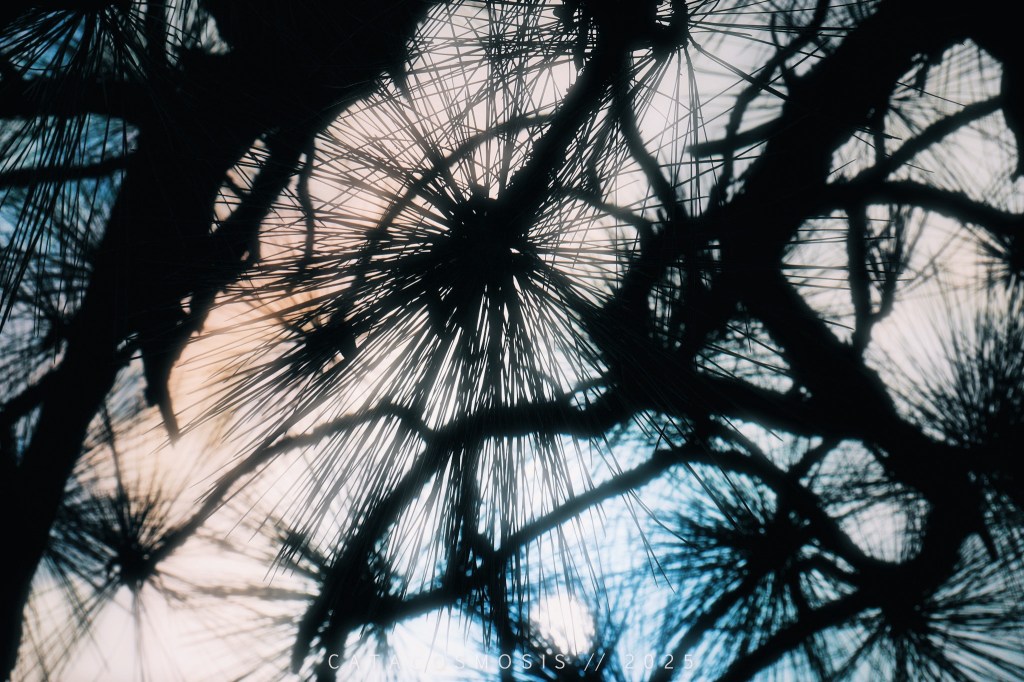
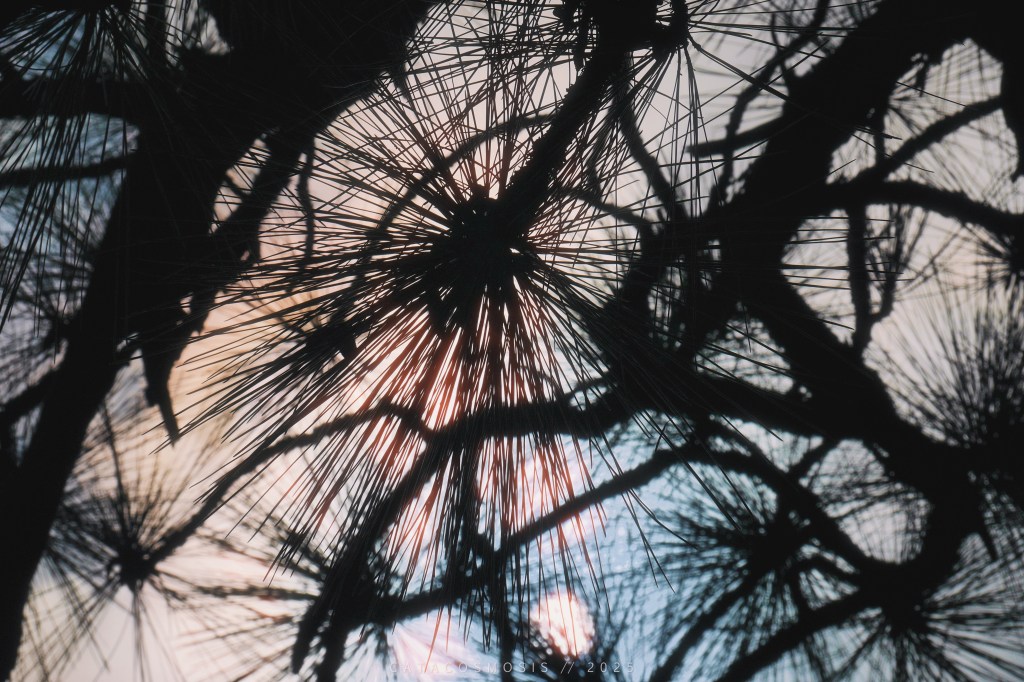
    It arrived as fractured light through pine trees.

    As a silent, oft unnoticed breath.

    As a reminder that maybe the most sacred work is not to act, but merely to remain open.

    Not to close.

    Not to harden.

    Not to explain ourselves into exhaustion, but to become aperture.

    To simultaneously remain wide enough to hold what’s real and narrow enough to let illusion fall away.

    And, to be balanced enough in both intellect and empathy to know the difference.

    This is the answer: detachment.

    Not from emotion, but from illusion.

    It is not denial, not distance.

    Rather, it is the quiet rerouting of both emotion and cognition back to stillness.

    A return to clarity, not an absence of care.

    And somehow, by not reacting, by not reaching, we find we are already held.

  • Fragrance, Memory, and the Air Between

    Fragrance, Memory, and the Air Between

    The Quiet Power of Things That Don’t Stay

    Mimosa (Albizia julibrissin). Lumix GX7, Panasonic Leica DG Macro-Elmarit 45mm f/2.8 ASPH. MEGA O.I.S., Lightroom Mobile (watermark), VSCO.

    Not everything soft is weak.

    Not everything brief is forgotten.

    The mimosa blooms like a passing thought—pink, feathery, fragrant, gone before you’re ready. But even in its short season, it rewrites the air.

    And maybe that’s the point:

    To offer sweetness without needing permanence. To make magic in the margins.

    💚🌿✨

    Mimosa (Albizia julibrissin). Lumix GX7, Panasonic Leica DG Macro-Elmarit 45mm f/2.8 ASPH. MEGA O.I.S., Lightroom Mobile (watermark), VSCO.

    The Mimosa tree (Albizia julibrissin) is commonly known as the silk tree or Persian silk tree. Albizia julibrissin isn’t actually a true mimosa—though it’s been lovingly misnamed for generations. Native to Asia, this delicate tree has made its way into southern landscapes with grace and stubbornness alike.

    Its blooms are light as breath—powdery tufts that attract butterflies, bees, and human daydreamers. They bloom at dusk, shimmer in the wind, and drop silently—often leaving a petal-scattered sidewalk like a love note no one signed.

    Mimosa (Albizia julibrissin). Lumix GX7, Panasonic Leica DG Macro-Elmarit 45mm f/2.8 ASPH. MEGA O.I.S., Lightroom Mobile (watermark), VSCO.

    Though it’s sometimes called invasive, there’s no denying its presence feels like a portal: part nostalgia, part perfume, part dream.

    Its scientific name, julibrissin, comes from the Persian gul-i abrisham—“silk flower.” A name that suits it perfectly.

    Mimosa (Albizia julibrissin). Lumix GX7, Panasonic Leica DG Macro-Elmarit 45mm f/2.8 ASPH. MEGA O.I.S., Lightroom Mobile (watermark), VSCO.

    In folk medicine—especially within Traditional Chinese Medicine—the mimosa tree is known as the “Tree of Happiness.” Its fragrant pink blossoms and bark have long been used to lift the spirit, ease grief, calm the heart, and quiet a restless mind.

    The flowers are brewed into gentle teas, while the bark is sometimes tinctured for deeper emotional support. Often given to those moving through sorrow or heartbreak, the mimosa is considered a natural ally for joy, resilience, and emotional rebirth.

    #Nature // #Mimosa // #TreeOfHappiness

  • Offline, On Purpose: Life Beyond the Algorithm

    Offline, On Purpose: Life Beyond the Algorithm

    There’s a quiet kind of healing that happens when no one is watching. It doesn’t perform. It doesn’t announce itself. It doesn’t need a platform. That is where I was when I was away—not just from social media, but from this space and this blog.

    A young woman named Jillian, in a YouTube video I stumbled across recently, captured this so simply and so beautifully: what life looks and feels like when you’ve stepped away from social media—and stayed away long enough to actually notice the difference. What struck me most, though, was hearing her perspective as someone going through this process for the first time.

    It’s lived in my thoughts and I’ve contemplated this post ever since. It was so interesting to me because I’ve taken breaks from the internet many times over the past two decades, always for the same reasons—and always with this same depth of understanding about the psychology of it, and why those breaks were necessary.

    This most recent (and longest) season of removal hit different. After the last caregiving stretch, after Roshi Ralph’s death, after the silence that came when others (who had no real understanding of the compound caregiving and loss I’d just lived through—and in many cases, never will) rushed in with attacks and projections and judgments, as if my grief was theirs to dissect—I pulled all the way back. And I’ve stayed back.

    I’ve stayed away from social media not because I needed a break, but because I reached the point where it just doesn’t matter to me. The truth is, it never really did. The performance of it all—the curated personas, the noise, the performative alliances, the hollow outrage, the likes-as-validation—means less than nothing. I never played the game anyway, and when I tried to be real, I was punished for it—called out for oversharing instead of respected for being honest. So now, I simply choose not to engage.

    That’s the decision, and it’s permanent. I stick to my own space—my blog(s)—now. I share some of my creative work on YouTube and Instagram, but I don’t engage socially. The work is there for anyone who wishes to enjoy it, just like my writing: simply because I’ve made it—and it feels like a waste to let it collect digital dust on my hard drive or memory cards. That’s it.

    And what I’ve learned—what I’ve earned—is this:

    Own your own thoughts. Own your own opinions. Stop looking to the crowd to inform you of what you feel, believe, or need. If you want to share your truth, explore your voice, or process your experience—do it in your own space. Even if that space is digital.

    Quiet is not the same as silent. Solitude is not absence. Privacy is not erasure. And just because the crowd isn’t clapping doesn’t mean the work isn’t working—or that it’s not sacred, necessary, and deeply alive.


    Mirrors, Screens, and Silent Knowing: Personal Reflections after Watching Jillian’s Journey

    Part One: The Slowness That Saves You

    Jillian talked about how, in the silence of that first year offline, she realized she wasn’t who she thought she was. That her sense of self had been filtered through algorithms and aesthetics for so long that she didn’t know what parts were her and what parts were just performance.

    She said she didn’t want to be a cottagecore girl, or a vanilla-beach-aesthetic girl, or even a tomato queen—she just wanted to be Jillian. And that’s what life offline gave her space to rediscover: the Jillian aesthetic. Not a genre. Not a trend. A person.

    That kind of reclamation doesn’t happen in front of a ring light. It happens when you’re still. When the feedback loop breaks. When your body and soul finally stop bracing for the next notification, the next birthday story repost, the next dopamine drip that doesn’t land right.

    She didn’t pretend her life suddenly looked different. In fact, she said:

    “Does my life look any different from this… to this? No. But how I live is what’s different.”

    That line stuck with me because it’s the same thing I’ve experienced. The world outside didn’t change. The people didn’t change. The pain didn’t vanish. But something in me stopped handing over power to what others might think—or worse, what they might not think if I didn’t stay visible.

    Part Two: The Real Cynicism Is a Smile That Lies

    There was a comment I wrote recently in response to someone who was tired—tired of being called negative for telling the truth. Tired of being cast as cynical for not dressing pain up as purpose. I told them this:

    “People will call the truth pessimism and negativity because they’ve either never seen true rock bottom—or they’ve never experienced it (yet).”

    Because the people who have known real loss, real chaos, real collapse?

    We don’t need false light. We need real clarity.

    That’s why toxic positivity is so insidious—it masquerades as hope, but it’s really just fear dressed in bright colors. It says: Don’t go there. Don’t feel that. Don’t name it. But the truth? The truth sits with the mess. The truth makes a chair for the grief and the rage and the complexity and says: stay as long as you need.

    “It’s madness to try to be sane in this crazed world… You can just quietly speak your truth.”

    That’s it right there. That’s why I’m not interested in “engaging” anymore, and why I’ve stopped posting where people feel entitled to misunderstand. This world has enough noise. Enough image management. Enough hollow back-patting in the name of “support.”

    Part Three: Stillness Is Not Stagnation

    Jillian said she thought she was going to return to social media after a year. She even looked forward to it. She imagined her big return, her “look how I’ve changed” content. But then the new year rolled around… and she didn’t want to go back. Because the more she paid attention to her real life—the one where she wasn’t performing for anyone—the less she needed to curate it.

    That’s a shift I understand at a soul level.

    Sometimes we don’t need reinvention. We need to not be witnessed for a while, so we can see ourselves clearly again.

    And no, it doesn’t mean becoming some pure, evolved aesthetic monk who never has insecure days. Jillian was honest about that too—she still compares timelines, still feels the pressure. But she said something I think most people miss:

    “I still have those moments. But I’m learning. And that’s enough. I’m having a great time.”

    A great time—not because everything is perfect, but because she’s present. Because she’s not outsourcing her attention, affection, or identity anymore. And because she gave herself the gift of being nobody for a while, so she could become somebody real again.

    Closing Thoughts: Your Life, Your Lens

    So no—this isn’t a how-to guide. This isn’t a five-step digital detox plan. This is just a reflection on what it means to live inward in a world obsessed with being outward.

    It’s a reminder that your worth isn’t measured in visibility. That your healing doesn’t have to be documented to be real. That privacy isn’t a lack of connection—it’s a form of spiritual hygiene.

    Social media isn’t evil. But it’s not sacred, either. Use it if it serves your soul. Leave it if it steals your peace. And if you ever wonder whether your absence would be noticed, ask this instead:

    “Would I still feel whole if no one saw me for a while?”

    If the answer is no, then maybe it’s time to come home to yourself—quietly and on purpose.