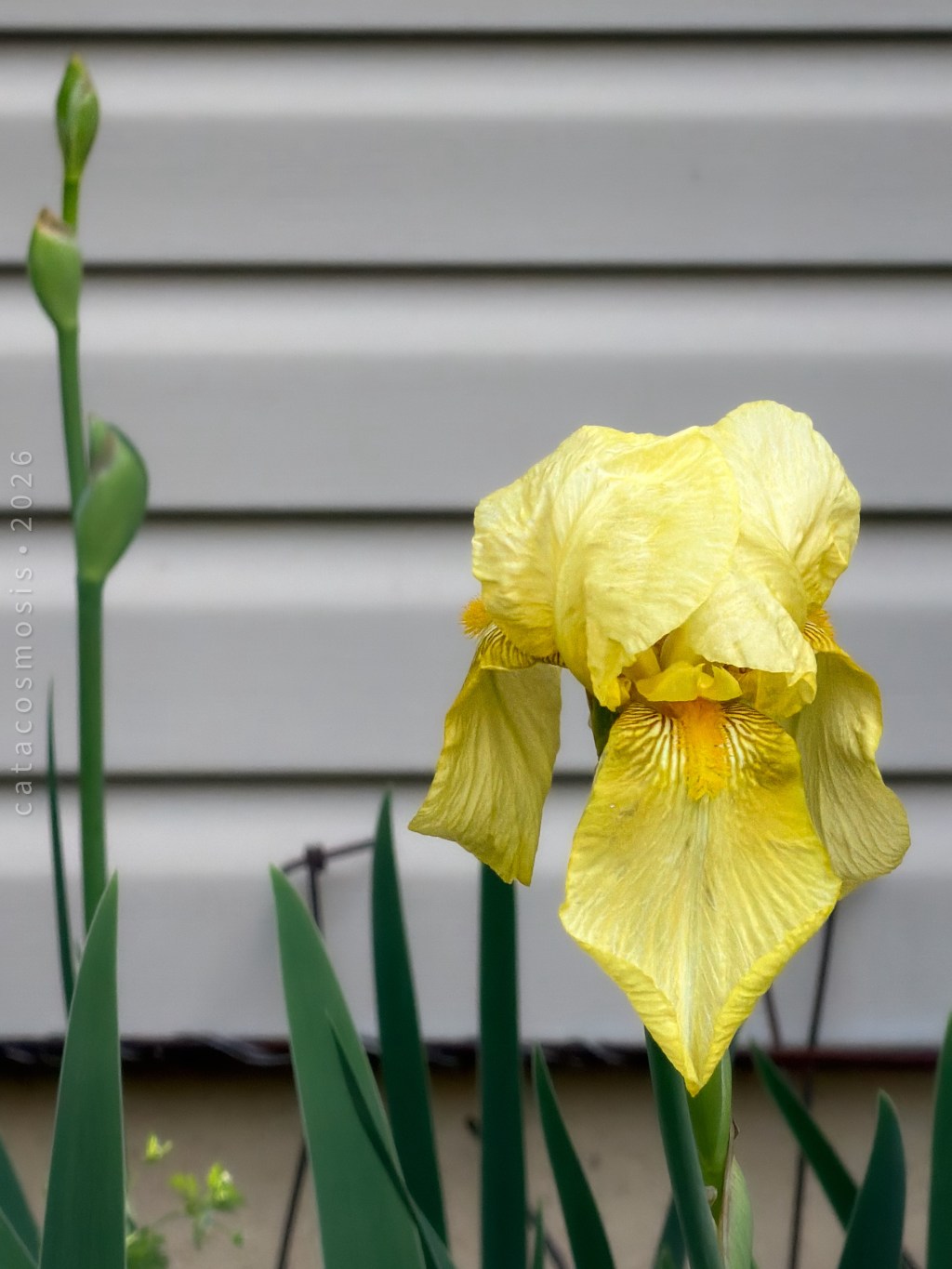
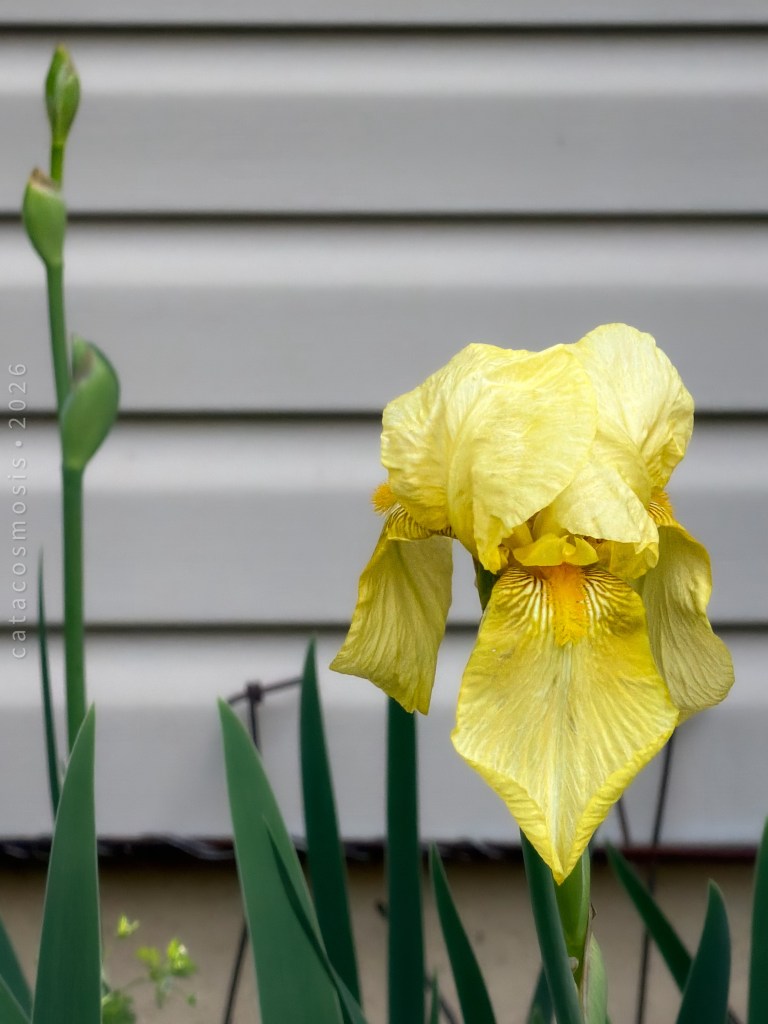
In an unassuming corner of the yard, this yellow iris has unfurled like a quiet epiphany. What was once a tightly wound promise, rhizome buried deep through winter’s long hush, now opens fully to the light. Its ruffled petals now catch the sun with an almost reckless joy. The veins of deep gold trace a map of quiet persistence, while the orange heart glows like an inner fire that refused to go out.
Beside it, younger buds wait in patient green, still curled in their own contemplative silence. They teach their own lesson: not everything must bloom at once. Some wisdom arrives early; some lingers in the stalk, trusting the season will call when it is ready.
There is something profoundly philosophical in this annual resurrection. The iris does not bloom for applause or permanence. It blooms because that is its nature, with its brief, brilliant way of saying yes to existence, and it does so right here, against the ordinary creamy beige siding of daily life, proving that the sacred never waits for perfect conditions. It simply returns, year after year, not asking permission or requiring validation, reminding us that we too carry rhizomes of possibility beneath the surface of our ordinary days.
Seasons of dormancy give way to moments of vivid becoming, if only we pause long enough to witness it. Perhaps every ordinary moment holds the potential for a quiet epiphany. The question is whether we slow down enough to notice.
He has made everything beautiful in its time. He has also set eternity in the human heart; yet no one can fathom what God has done from beginning to end. (Ecclesiastes 3:11)
I wrote that on January 8 when I shared this edit of an iPhone shot I captured in my back yard to Vero and VSCO, and then just… moved right past sharing the image or the words here. I’ve been becoming.
I’ve been lost in introspection, peeling back layers, observing, feeling it out, integrating it – all of this over and over in this time non-adjacent, beautiful cycle of infinity, that I kind of forgot… most everything lately. I used to think it was just the caregiving and/or the surgical menopause. I thought for a short time, when I surrendered the last earthly thing I had left that had for so long been the treasure of my heart, that I’d finally just overloaded and lost my mind.
In reality, ultimate surrender to God, truly following where He leads, had removed and continues to remove me from everything, and evolved me into this extremely quiet girl who just stands under the sky and lets it undo her. Not just in posting, but at every level, including who I remember myself to be.
Coming to Christ – not just saying the words but the evolution itself – hasn’t just been “I believe.” I have believed since I was a child. It hasn’t just been, “I accept, I surrender, I heal, God changes my heart and I change my habits.” It’s been this slow, surgical unmaking down in the deepest parts, and I’ve been metamorphosing through it since the night Ralph died.
It’s been soaking in depths even I never imagined. And that’s saying something. It’s been being truly alone, except for His presence, and the Holy Spirit’s, and it’s been… excruciatingly, exquisitely beautiful.
It’s not trauma, it’s not grief. It’s not even grief-induced – not wholly. That’s all nonsense, at least in the way the Western world and Western medicine and psychology and new age and new thought belief systems tell it. It’s more real, more spiritual, more invisibly tangible, than all of that ever thought about being. It was just… time.
It’s been about the things I thought I understood, the places where I thought I had to earn worth, the parts of me that were performing the gifts of the spirit – the discernment, the temperance, the hard-earned wisdom, the surrender – that I was so desperate to truly embody. It’s been no longer sharing or trying to grow and evolve that with anyone else. It’s been walking into the desert, embracing solitude instead of simply being in it by circumstance, and just… belonging to Him.
Somewhere in that process, I lost track of a lot of things. A lot of people. Somewhere in the slow, surgical unmaking of solitude, I lost track of almost everything I used to believe was real. I’ve been letting Jesus have the layers, not just the words. Letting Him name me again, in the dark, where nobody’s clapping, where it’s just me and the sky and the God who knows my real name, and actually treasures, doesn’t just hold, my heart.
I’m not sure what this post really is. I’m returning this scrap of sky to this quiet place, in part because I hope it helps someone else, as always… but also because I don’t want the girl who stares up and ultimately surrenders to the peace of solitude and to the Creator Himself to be a footnote in her own story. I don’t want the becoming to swallow the one who simply is. This is me remembering me, and thanking God for the long, slow unmaking that made room for the becoming in the first place.
Even if it meant losing almost everyone I ever loved, I’ve found a love within myself I never could have imagined, and it all comes from and returns to Him.
Catastrophe in osmosis. That’s where catacosmosis began. And the name won’t change, though the person has, because that’s the entire point of that journey.
Tetelestai (ܬܫܠܡ). John 19:30
And yet, for me, it feels like it’s only just begun.
entry twenty three — scattered light, fractured grace: a quiet archive of light, loss, and what remains.
iPhone 17 Pro + VSCO (wb) + Lightroom Mobile (noise, watermark)
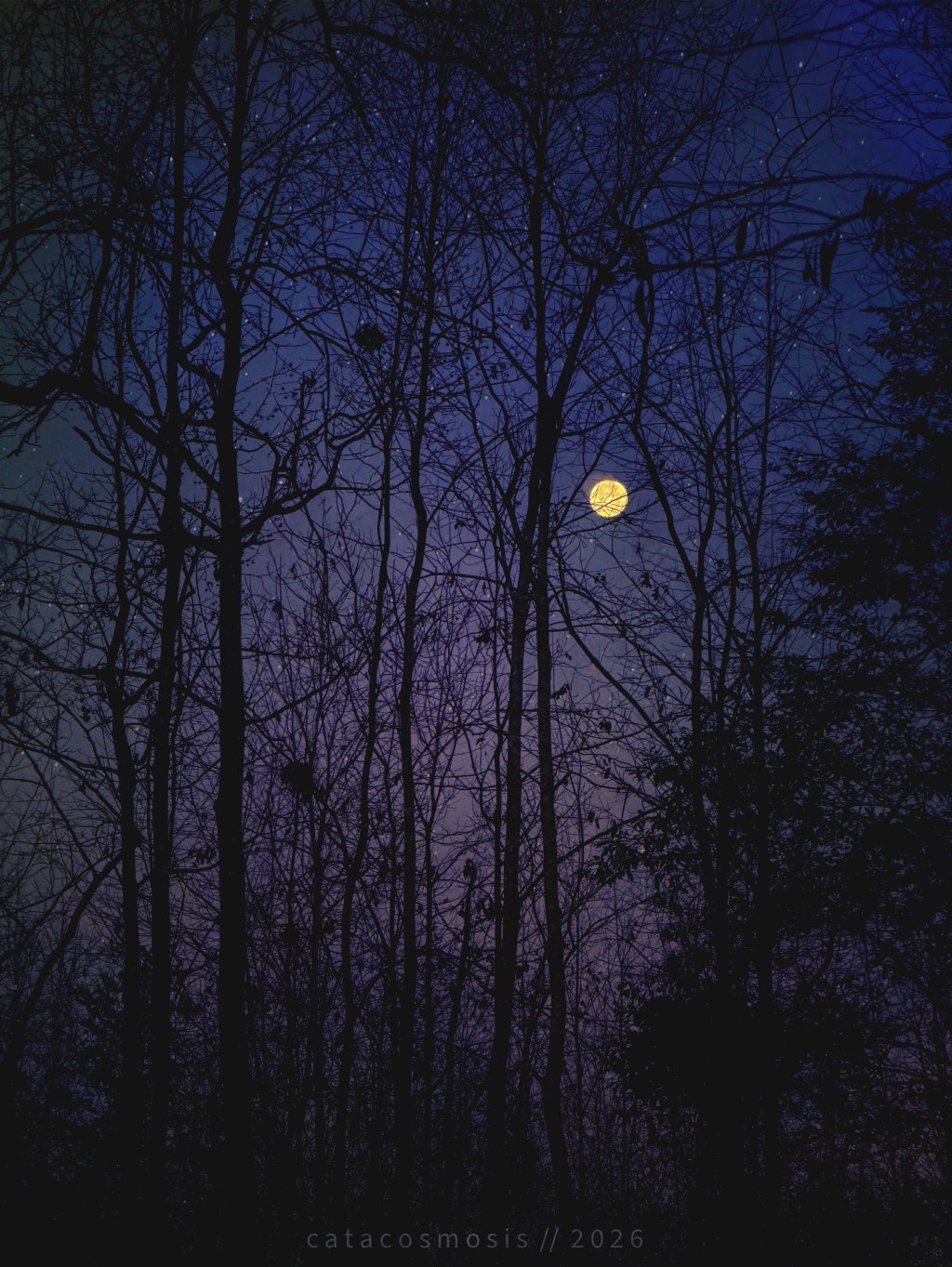
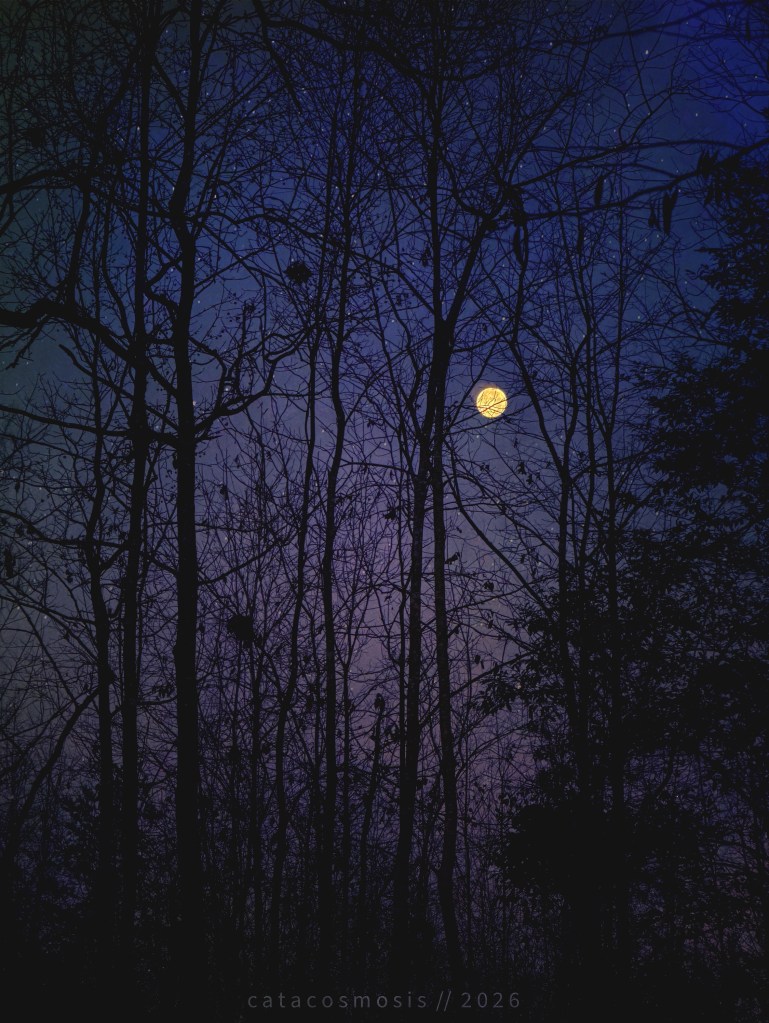
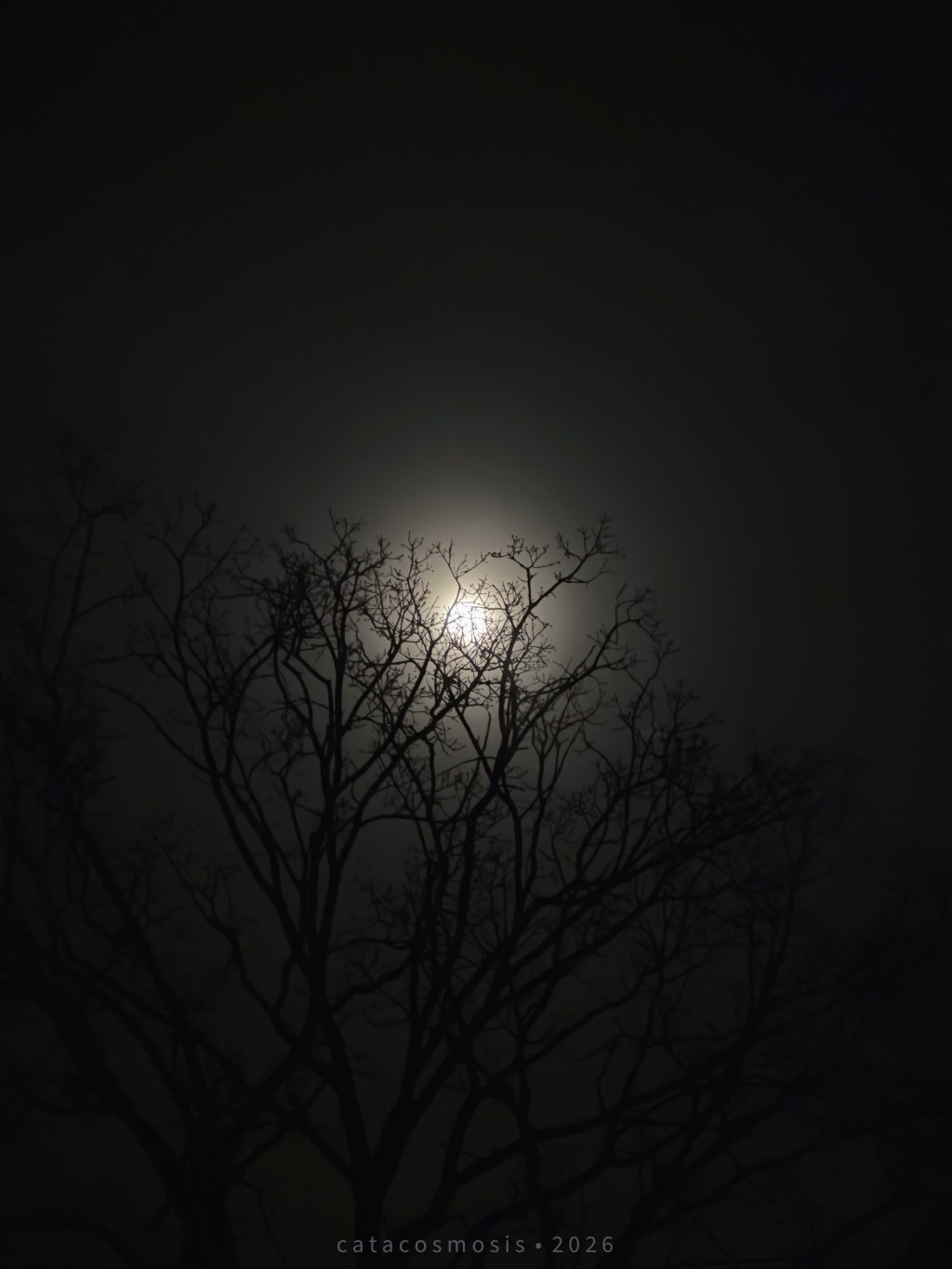
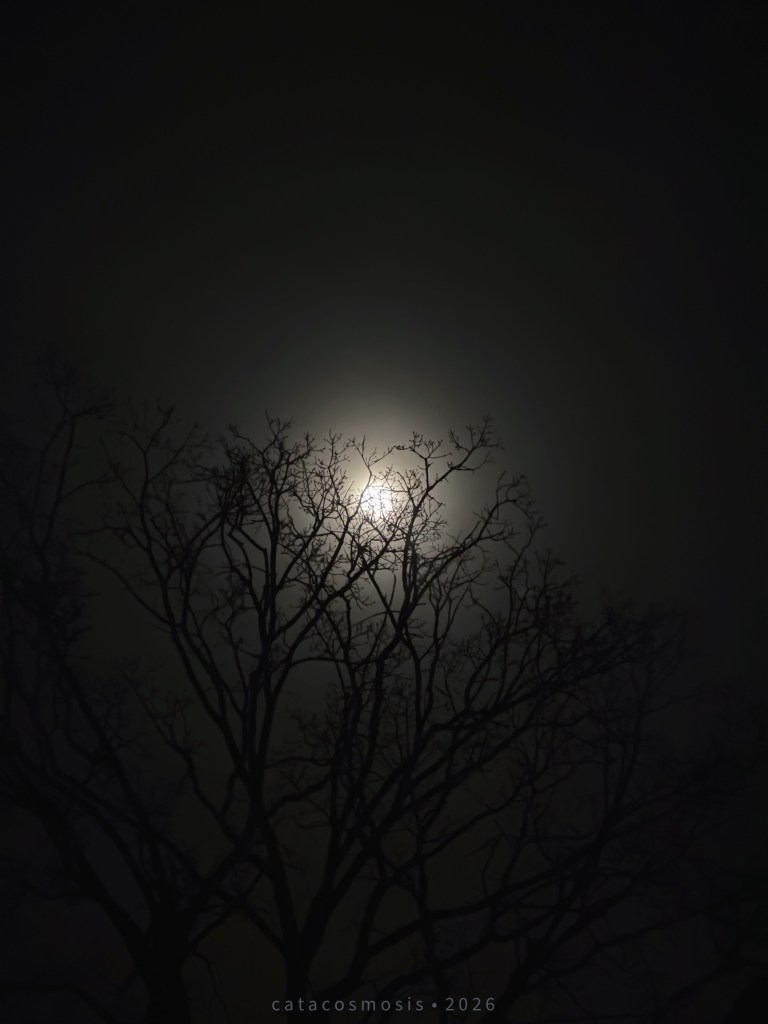
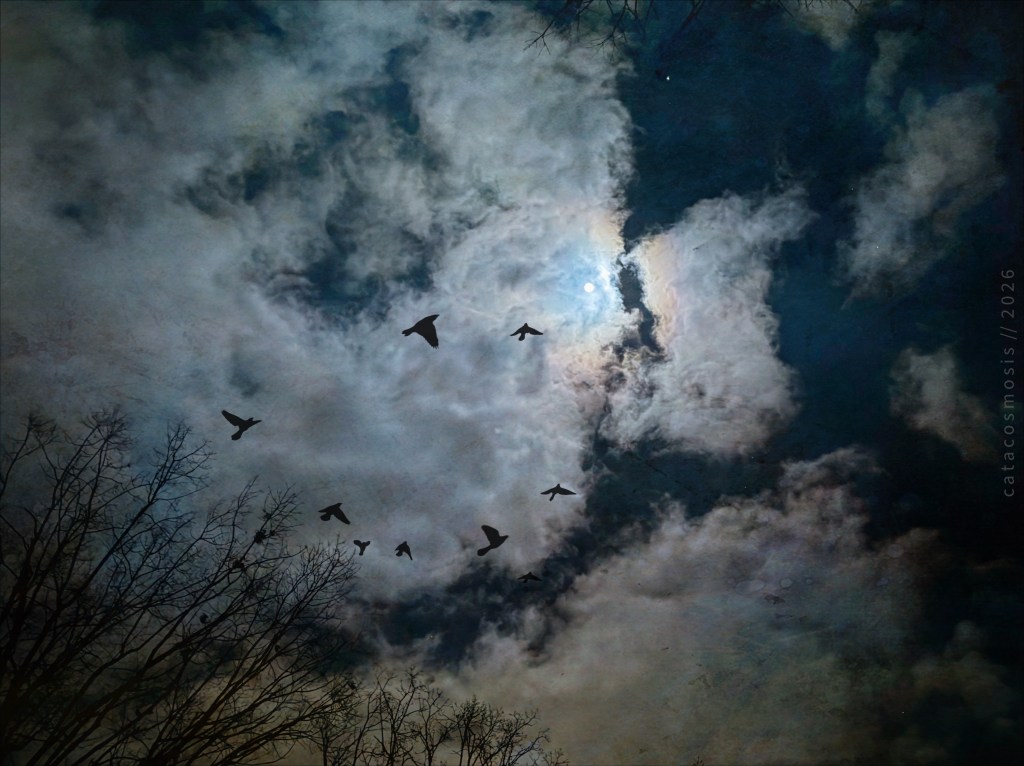
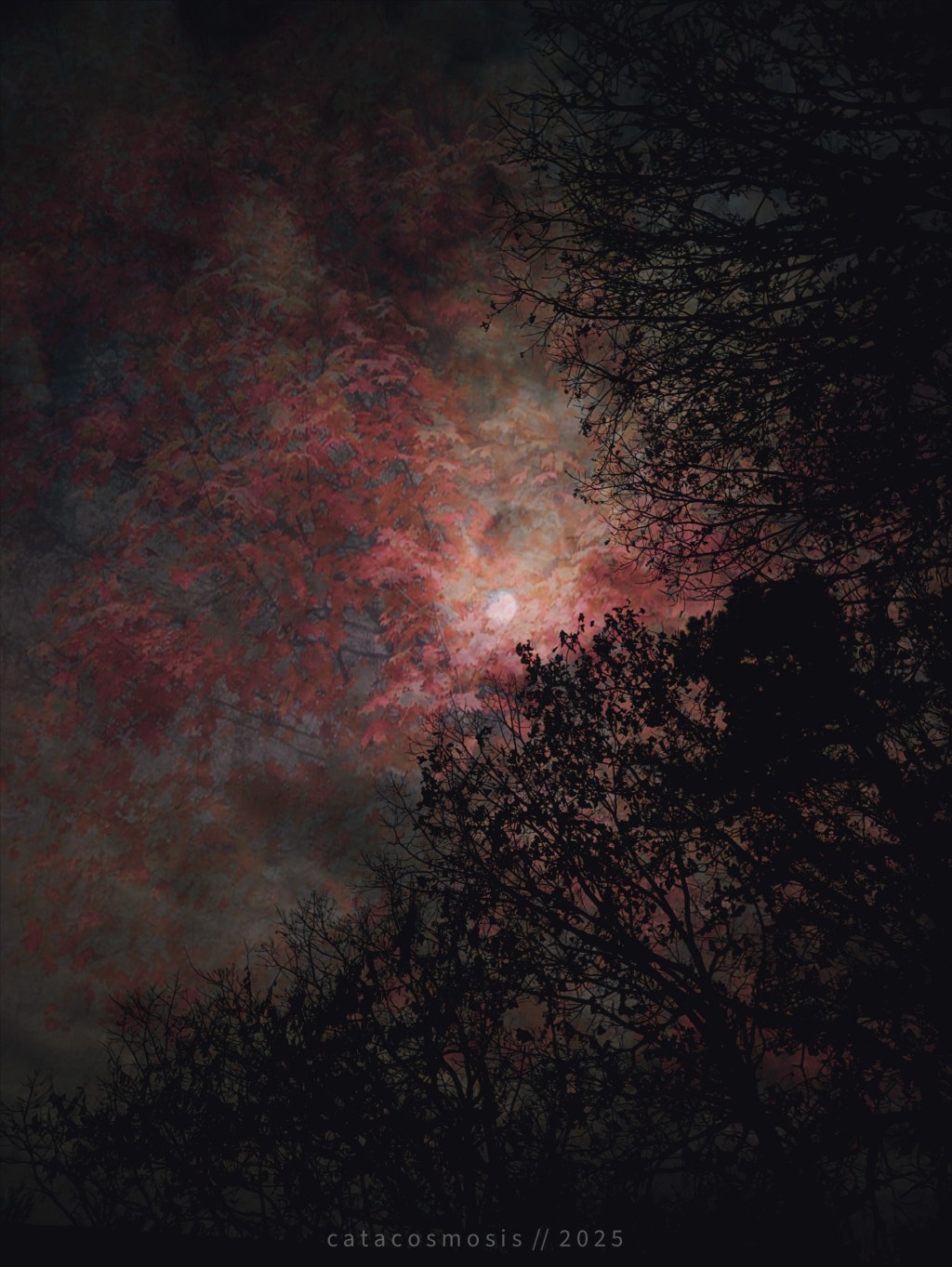
The moon is a small, stubborn wound in the dark, haloed and patient. Branches reach like remembered names, skeletal and exact against the hush.
The light slips through their fingers and leaves a trail of familiar ache. Not sharp, not new, just honest and unblinked.
I stand where the tree lives in my knowing, and for a breath the world narrows to that thin halo and the soft geometry of limbs. There is comfort in the way memory and sky overlap, how absence can be a kind of company.
Home again feels less like a place and more like the presence that arrives when light finds the places you thought were empty.
entry twenty two — scattered light, fractured grace: a quiet archive of light, loss, and what remains.
iPhone 17 Pro + DistressedFX (Final Edit)
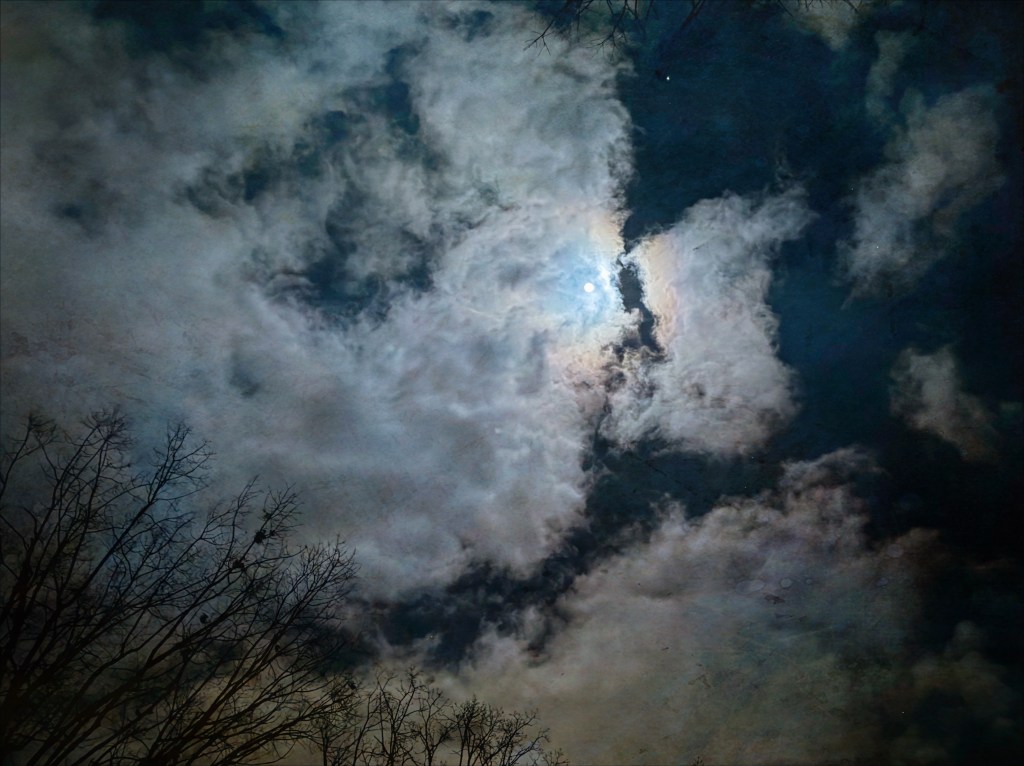
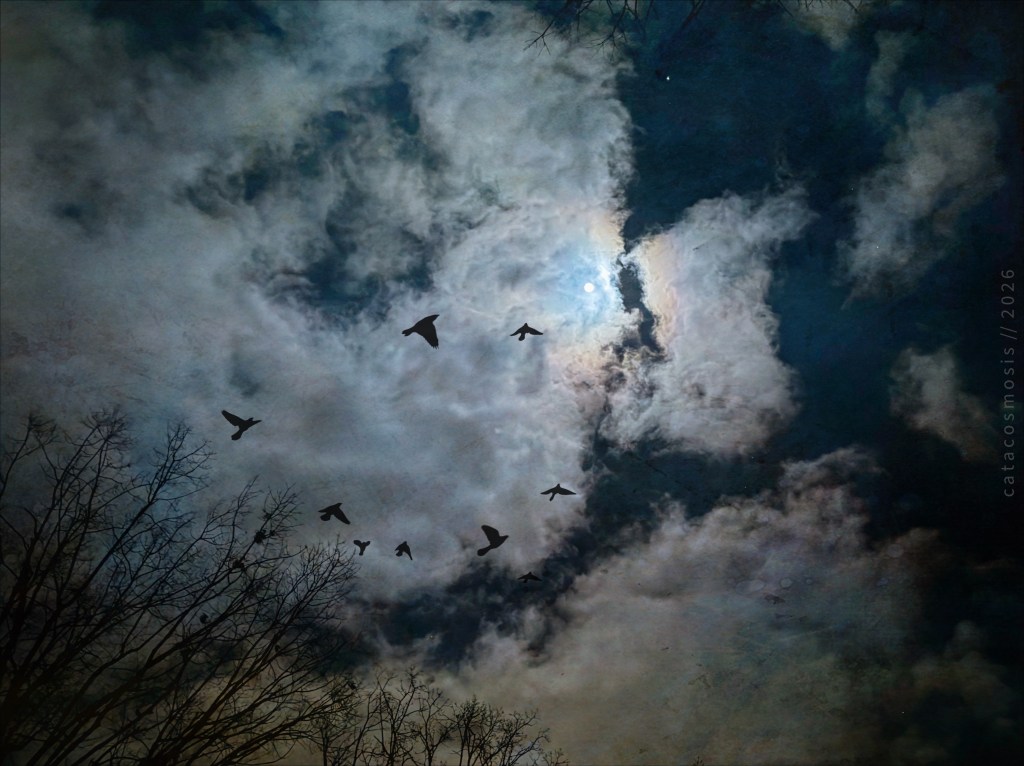
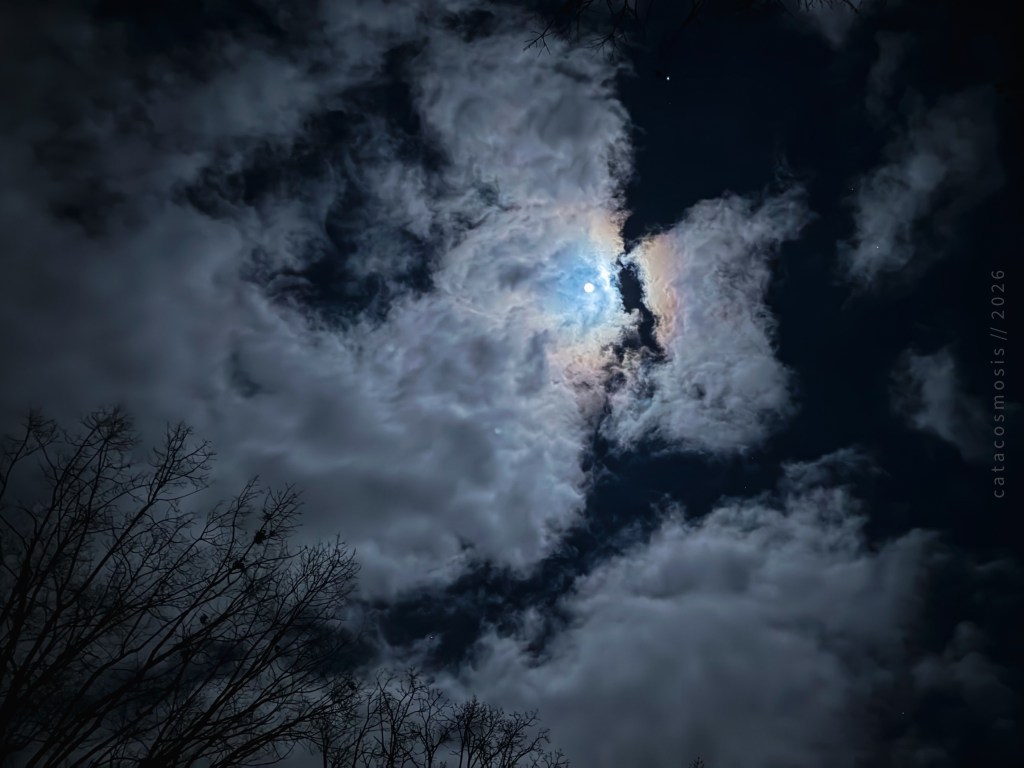
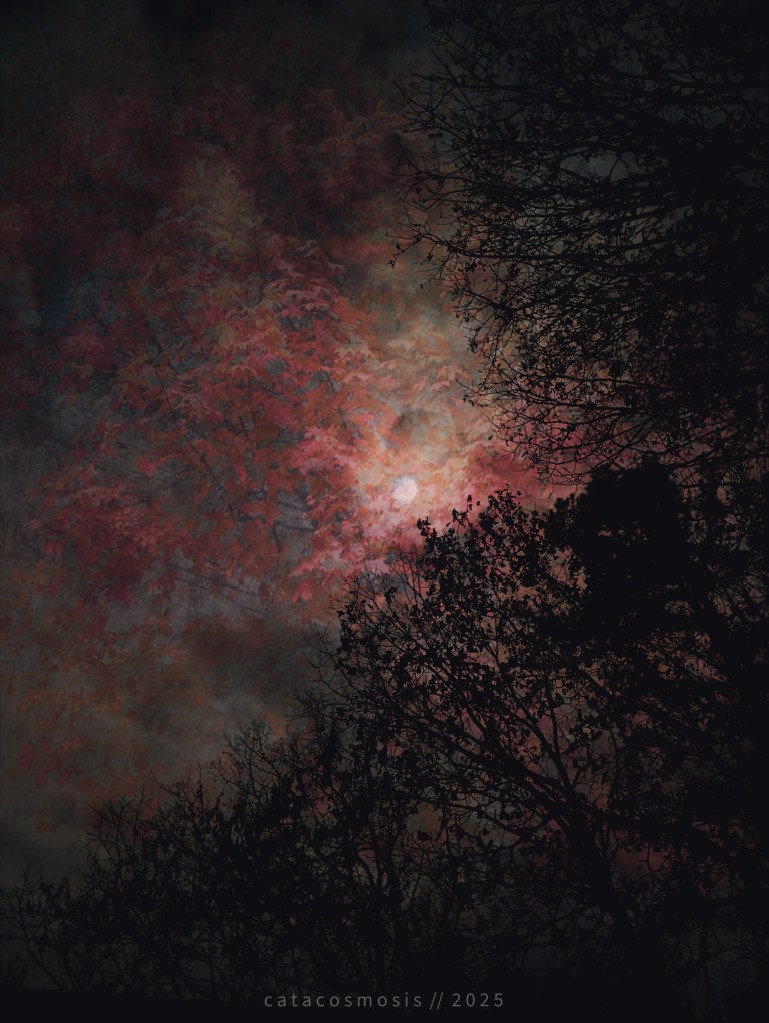
Sometimes it feels like there is a different, almost literal space between seconds. A pause the world does not announce.
There is intimacy in those spaces. Love. Beauty. A kind of quiet permission.
There is me, and the moon, and what I remember without remembering. Something about home. Something about spirit. Something about soul.
In those spaces, which turn into a place, then into awareness, then into something conscious without warning, I find myself again. Not arriving. Not searching. Just remembering how to be.
It feels like standing in a doorway I have crossed a thousand times but cannot name. Familiar without history. Known without proof.
And always, even when I wish it were not so, there she is too.
There are all of them. The pieces of my life that have already returned to Source, leaving me here to feel them but never hold them, to love without helping, to remember without any hope of their human realities returning.
Home, not as a location, but as a frequency. And for a moment, I am inside it.
catacosmosis // 2026
iPhone 17 Pro + DistressedFX (Final Edit)iPhone 17 Pro + DistressedFX (Textures Only)iPhone 17 Pro (Original, shot with ProCamera)
entry twenty one — scattered light, fractured grace: a quiet archive of light, loss, and what remains.
Lumix GX7 + DistressedFX + VSCO
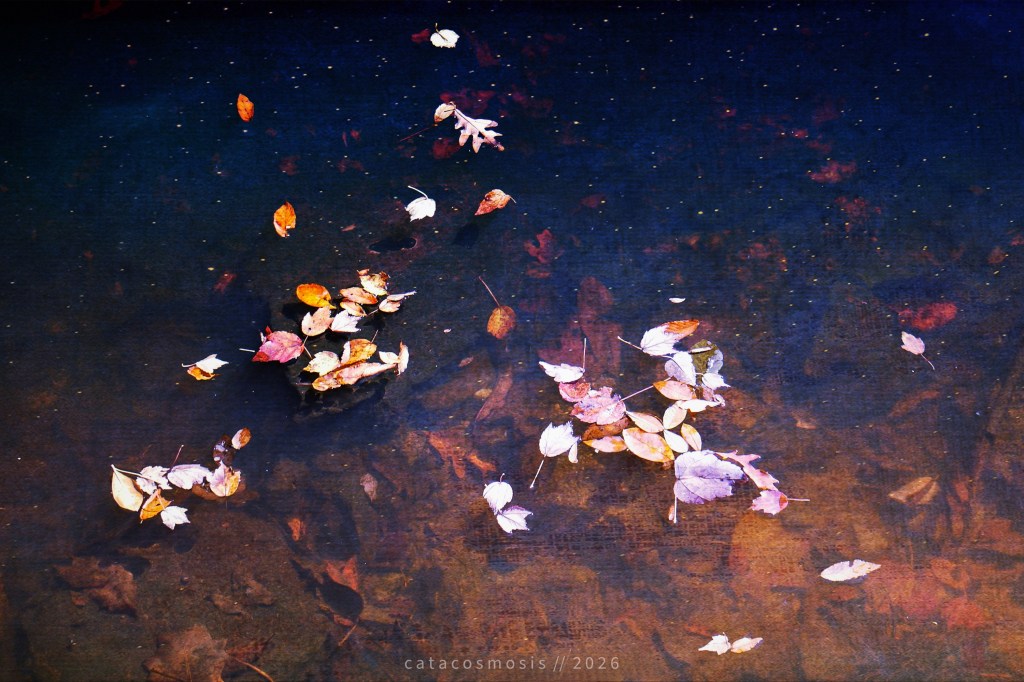
At first glance, it looks like the night sky. Stars caught in dark water, light splintered and scattered across a depth that won’t quite give itself away. But it isn’t the sky.
It’s dead things in the night, drifting on reflections. What’s beneath them still visible in places, obscured in others, the creek bed watching quietly through the murk.
This is what avoidance looks like.
We tell ourselves we are being practical. Responsible. Efficient. We say we can’t afford to stay. That we don’t have the time. That the weight would crush us if we lingered too long in the place where everything ended.
Sometimes those things are true. But truth has layers, and there is always another one underneath the one we say out loud.
I didn’t leave because I couldn’t manage it. I left because staying would have required me to face the finality of it all… and I wasn’t ready to let it be final unless I controlled the ending.
So I doubled down.
If this was the last chapter, I would slam the book shut myself. Sell the house. Let it go. Never look back. Shut myself away from it in the fullest, most tangible way that I could. And I did.
Except that isn’t how grief works. Not in real life. Not in spirit. Not in the psyche or the heart.
What we try to bury doesn’t disappear. What we try to drown learns how to breathe underwater. The things we refuse to look at don’t stop existing. They just wait.
They become shapes beneath the surface. Creek monsters tucked under rocks. Ghouls that don’t announce themselves, only shift when the light hits the water just right.
Running feels like relief at first. It masquerades as strength. As forward motion. As survival.
But it isn’t courage. It isn’t healing. And it certainly isn’t wisdom. It is postponement.
Eventually, the piper comes.
This winter has been that reckoning for me. A season of stillness I didn’t choose, where the water stopped moving long enough for everything to rise.
Regret. Guilt. Shame. The ache of what I didn’t tend to when I still had the chance.
It has been heavy.
But I am here. And I am mid-process of the exhumation.
Instead of running, I am learning (again) to release. To let what I tried to sink float to the surface. To watch it drift, or linger, or soften and break apart with time. To observe rather than flee. To witness rather than erase.
Because drowning it never made it disappear. It only darkened the water.
There is grace even here. Fractured, scattered, refracted through loss, but still light. Still honest. Still mine, in memory and in soul.
I sold my childhood home, and I regret it. Not because it is gone, but because I believed distance could undo what shaped me. It couldn’t. I didn’t forget it. I didn’t erase it. And now I face the ghost of it… even if I must do so from far, far away.
Haze blurs his profile. I grip the thin stem of hope. Current keeps moving.
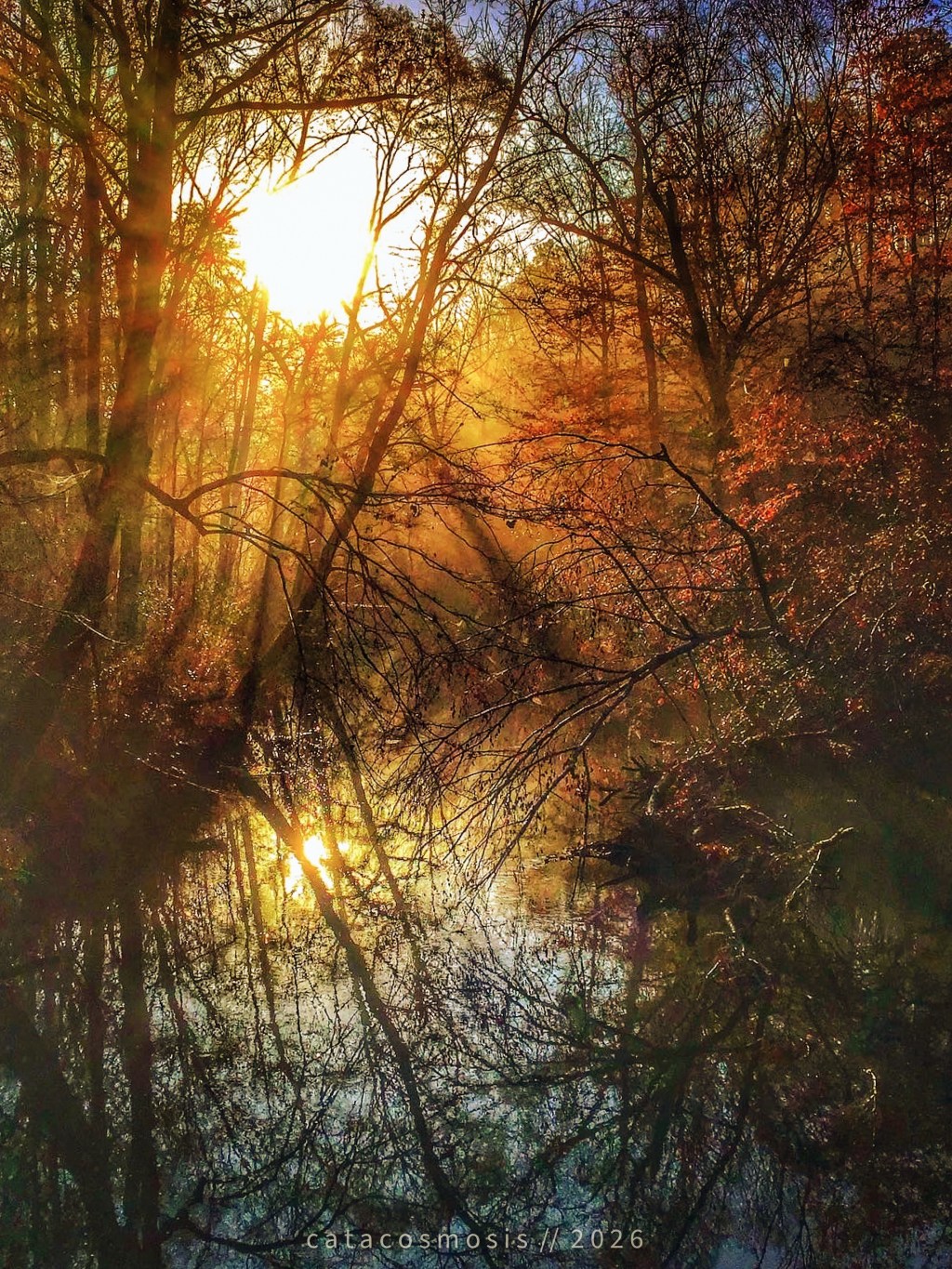
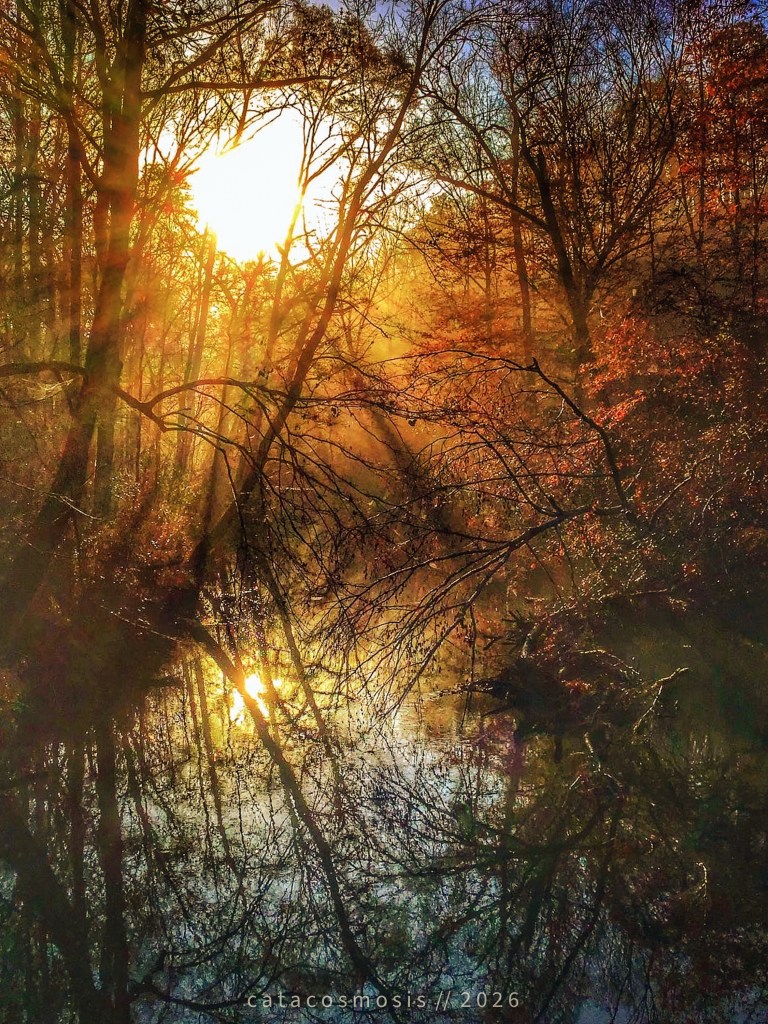
I came across this photo from a camping/hiking weekend in December 2018 this morning, and it opened something in me… or awakened it.
In the photo, the woods are one giant lens flare: the late-fall sun punches clean holes in the canopy, throws every leaf into over-saturated neon, while the creek becomes a mirror so sharp you feel you could step through it into another forest.
That’s what this last year with my son has been doing to the dial inside me. Faith cranked so high it hums, reality just as loud, and me caught in the bright slash between. I used to soften one side or the other: pray the hard parts dimmer, work until the wonder felt manageable. But the creek refuses to choose between glare and reflection; it holds both, lets them ricochet until you can’t tell which side of the surface is real.
I can see now that I am – or prefer to be – the creek. I practice that same double exposure of my roles, but it has all blurred and blinded me in recent days. In reality, all it adds up to is the fierce mother part of me – scheduling therapies, ordering visual timers, and trying to learn an entirely new language that has no words – and the gentler, whole me. The part of me that still leaves room for hope and comfort in the impossible color of his laugh when a dragonfly lands on his sleeve.
Balance isn’t compromise; it’s letting the light stay blinding and the shadows stay knife-edged, trusting the picture only makes sense when neither is edited out.
entry nineteen — scattered light, fractured grace: a quiet archive of light, loss, and what remains.
iPhone 17 Pro + DistressedFX + Mextures + VSCO
There’s a softness to this kind of morning light… the kind that slips in without ceremony and still manages to uncover what the heart has tried to tuck away. The silhouettes stand like witnesses, thin and unassuming, yet somehow they hold the whole ache of the season.
And maybe this the truest gift of December: that almost nothing blooms, yet everything speaks.
The sky daily turns itself into a quiet oracle, whispering that even in the stripped-back places, even in the stark-cold bare and in-between, there is still beauty gathering itself at the edges, waiting to rise every morning with the sun.
entry eighteen — scattered light, fractured grace: a quiet archive of light, loss, and what remains.
iPhone 17 Pro + DistressedFX + VSCO
The full moon always finds me in that thin place between ache and awakening. The heart softens, the past stirs, and the light insists on touching what I thought I’d hidden.
It doesn’t shout. It simply rises. And in rising, it reveals.
This full moon of these last few days felt like a mirror tilted by something wiser than me: clear, unguarded, almost tender in the way it offers back the truth of who I am becoming.
Every full moon asks for release, but this one asked for understanding. It offered an opportunity for a quiet recognition of what’s been shed, what’s been carried, and what still longs to be held with gentler hands.
Under its glow, my fractures stopped pretending to be wounds. Instead, they shined… faint, but deliberate. And grace slipped in when I wasn’t looking.
entry sixteen — scattered light, fractured grace: a quiet archive of light, loss, and what remains.
iPhone 17 Pro + VSCO + DistressedFX + Lightroom Mobile (watermark only).
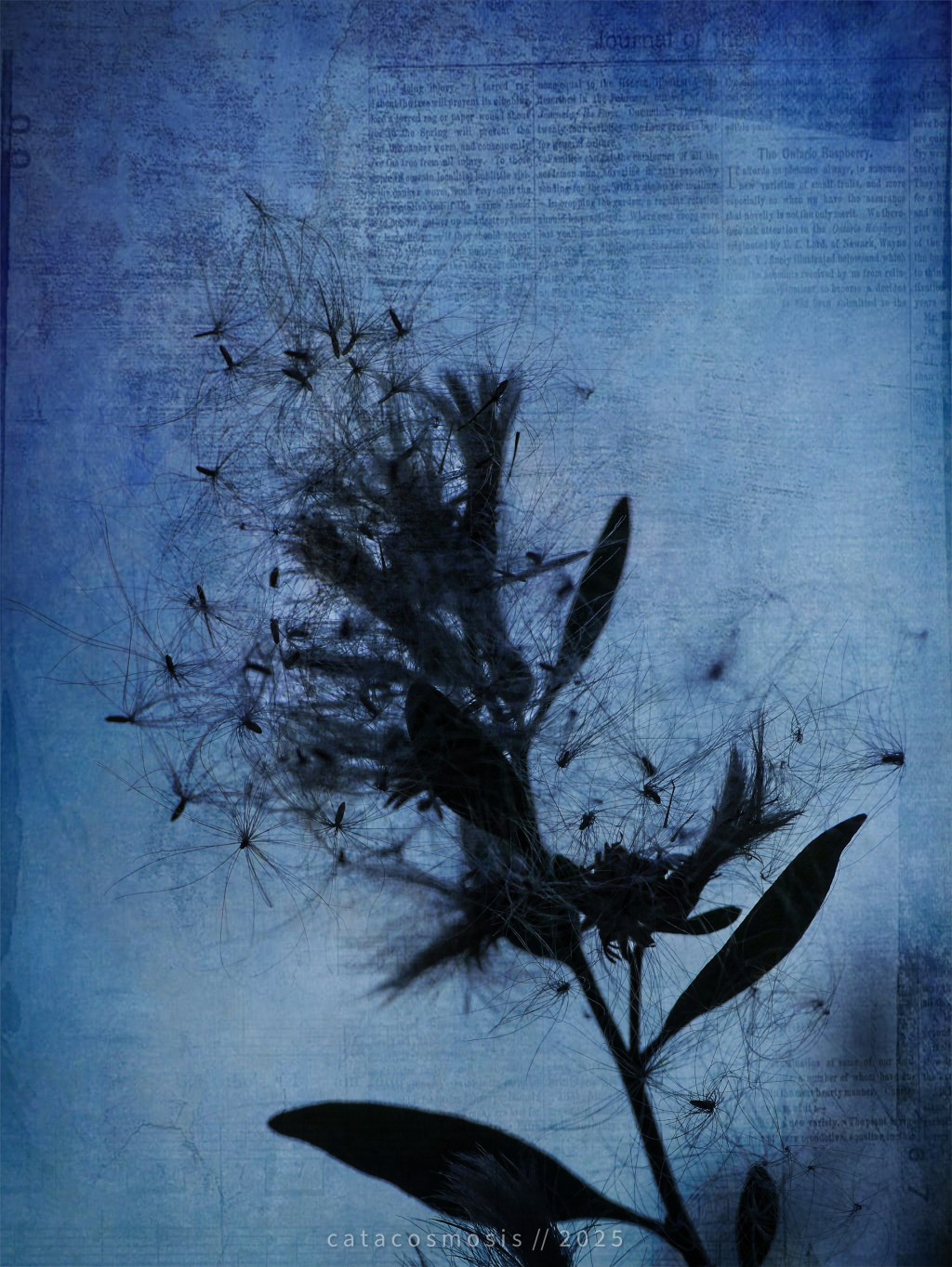
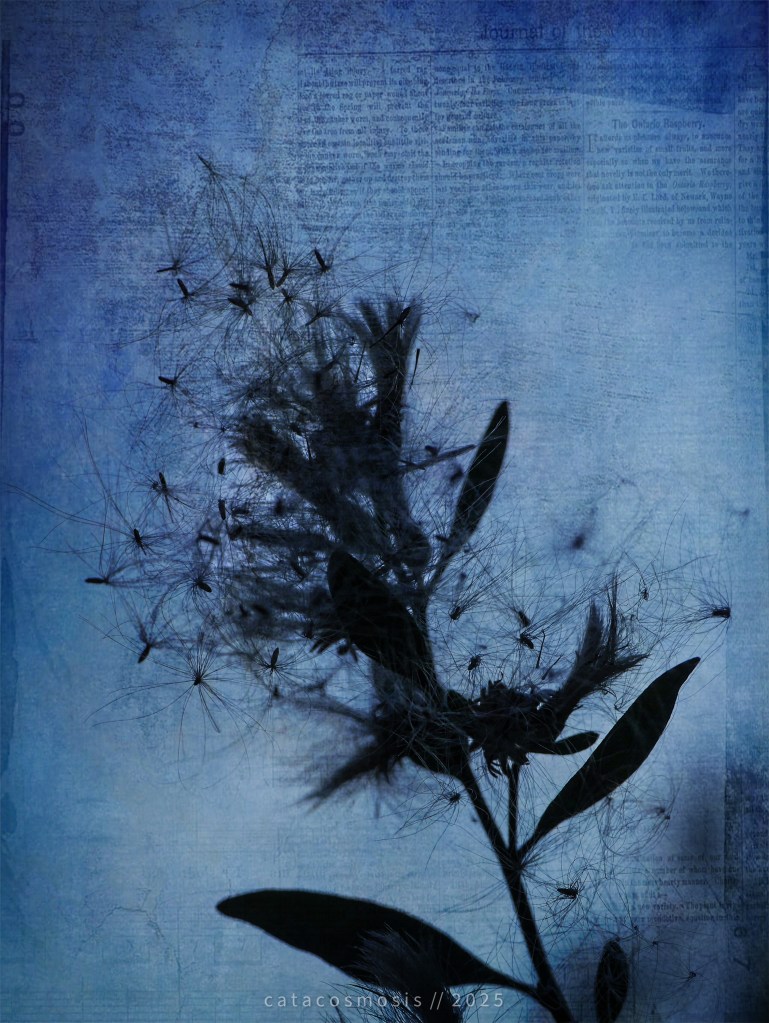
Evening gathers in a bluish-purple hush, and the crunch of dirt and rock seems to echo around me. Steadily and with intention, I put one foot in front of the other.
The birds fall silent, and the wind begins its quiet work. Loosening what I’ve held too tightly. Lifting the thin, trembling pieces of me that never settled into place.
They rise like seeds learning the shape of their own release, drifting out of me in a soft unspooling. The silhouette remains. Stem, leaf, the stark line of what endures. Everything lighter unthreads itself into motion.
What once felt like a tangle becomes a brief choreography, a small mercy in the dimming light. Loss, I’m learning, is sometimes only a shifting of weight.
The wind carries the rest. The jumbled thoughts. The old ache. The unspoken sentences that kept circling my ribs. Let them scatter. Let them drift beyond reach.
What stays is quieter, but honest. A rooted shape against the fading sky, held together not by certainty, but by the simple grace of letting go.
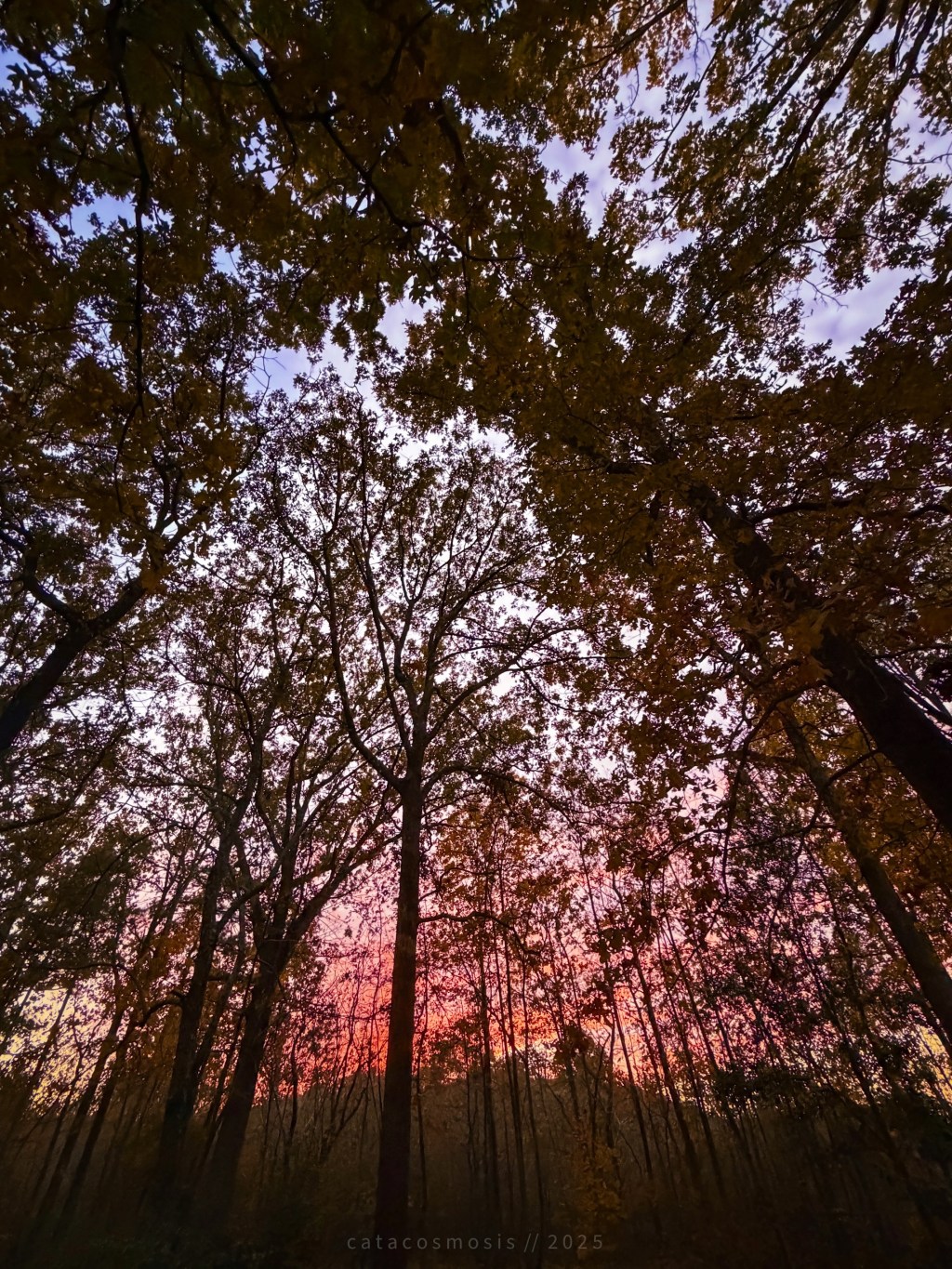
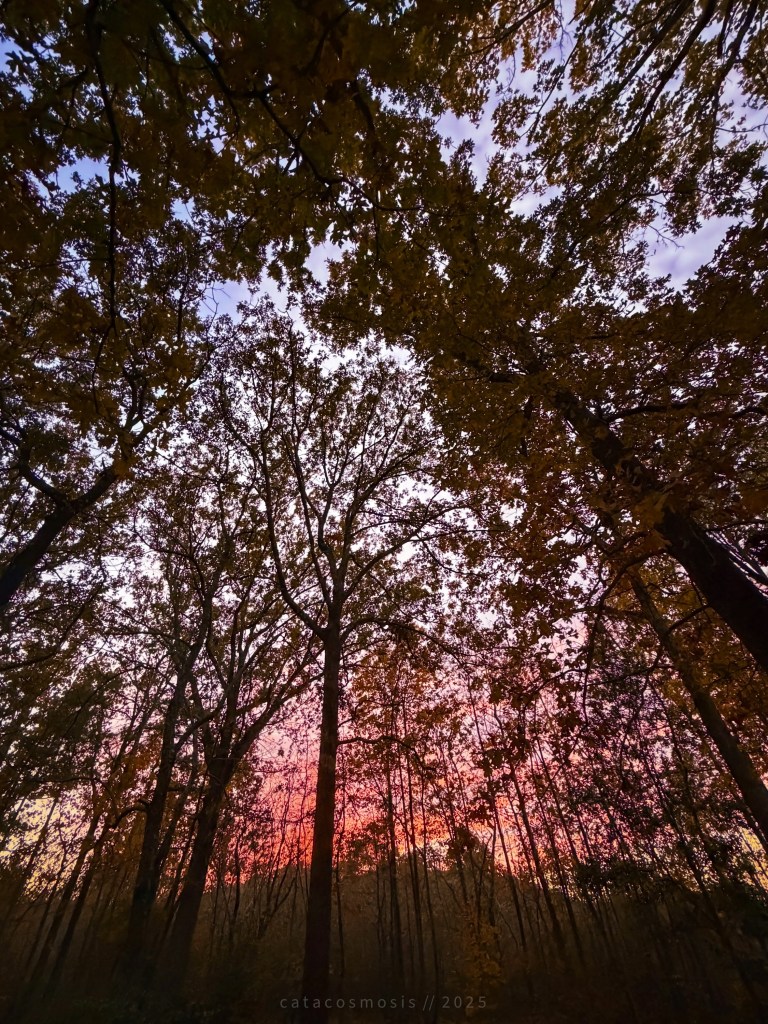
The sunset this evening caught my eye as I glanced up from the command prompt to rest my eyes.
“cmd —> DISM /Online /Cleanup-Image /RestoreHealth” be damned, I forgot the problematic machine.
I gravitated outside as though an unseen force beckoned me… and instead of me capturing a backyard moment, the moment froze me in place and then swallowed me whole.
It happened quietly, the way revelation always does: when the day was no longer sure of itself.
The horizon drew one long, trembling breath, and the sky exhaled light like a confession, soft and burning all at once.
For a few heartbeats, the forest became a cathedral. Oaks turned to stained glass, every vein of every leaf catching the final ember of the sun’s breath.
The air itself seemed to glow with a kind of surrender, as though heaven was remembering how to let go and reminding me all over again.
I stood beneath it, small but aware, suspended in that thin seam between the living, the leaving, and the memory of the already gone.
The colors didn’t ask to stay; they simply poured through the cracks of the canopy and into me, as if to say, “grace doesn’t vanish when the light fades. It only changes hue.”
When the sky went gray again, it felt less like an ending and more like an exhale finished.


 catacosmosis