
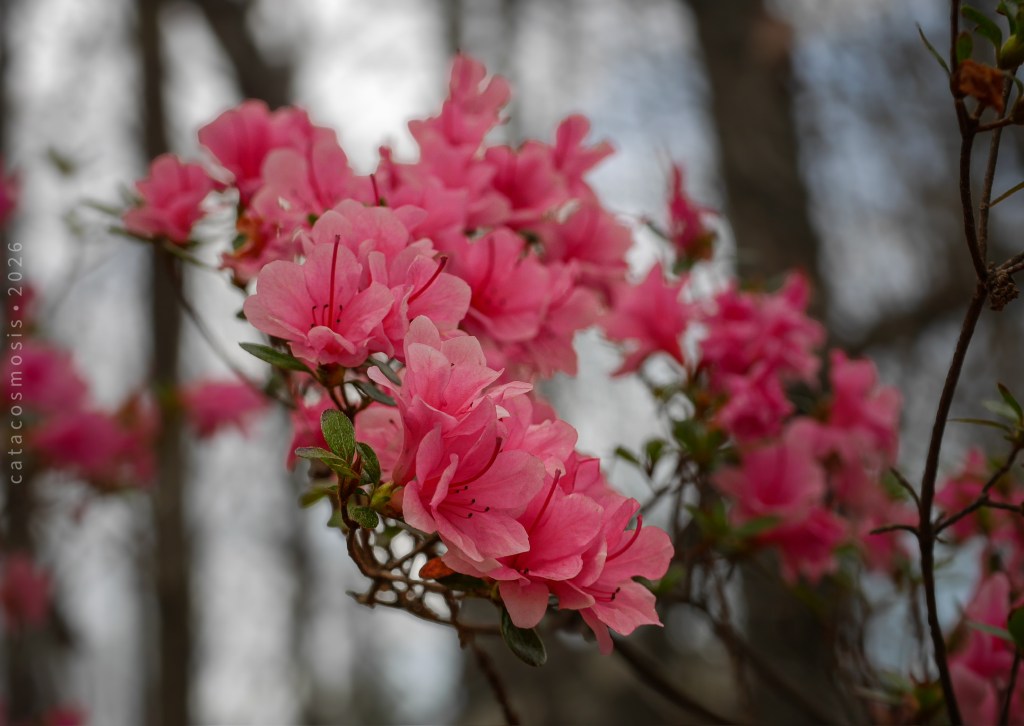
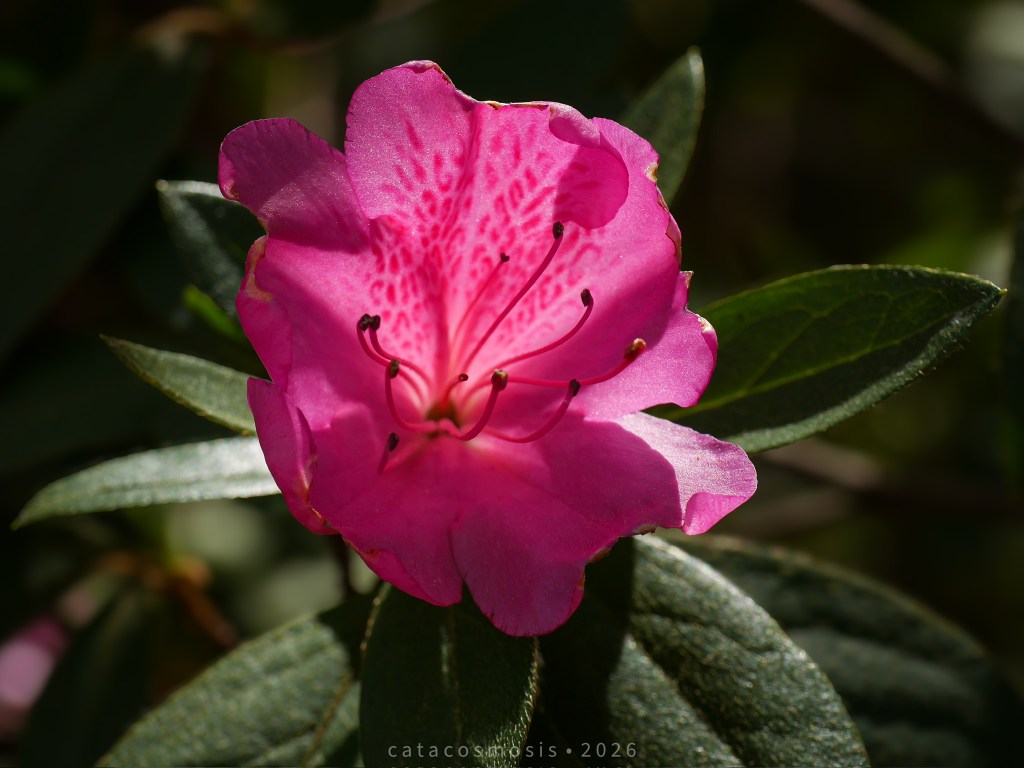
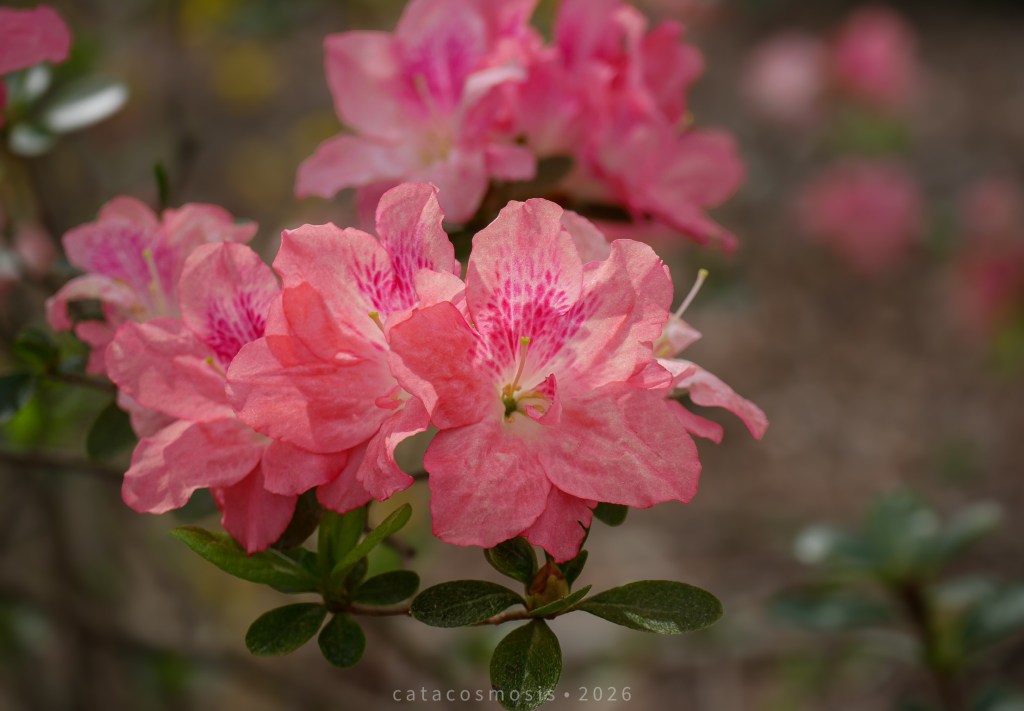
Tucked into the quiet corners of my yard and spilling along the back fence — where wild grass gives way to the shadowed woods and, beyond them, the familiar silhouette of my mountain — the azaleas have erupted this spring in an almost audible riot of pink, purple, and white.
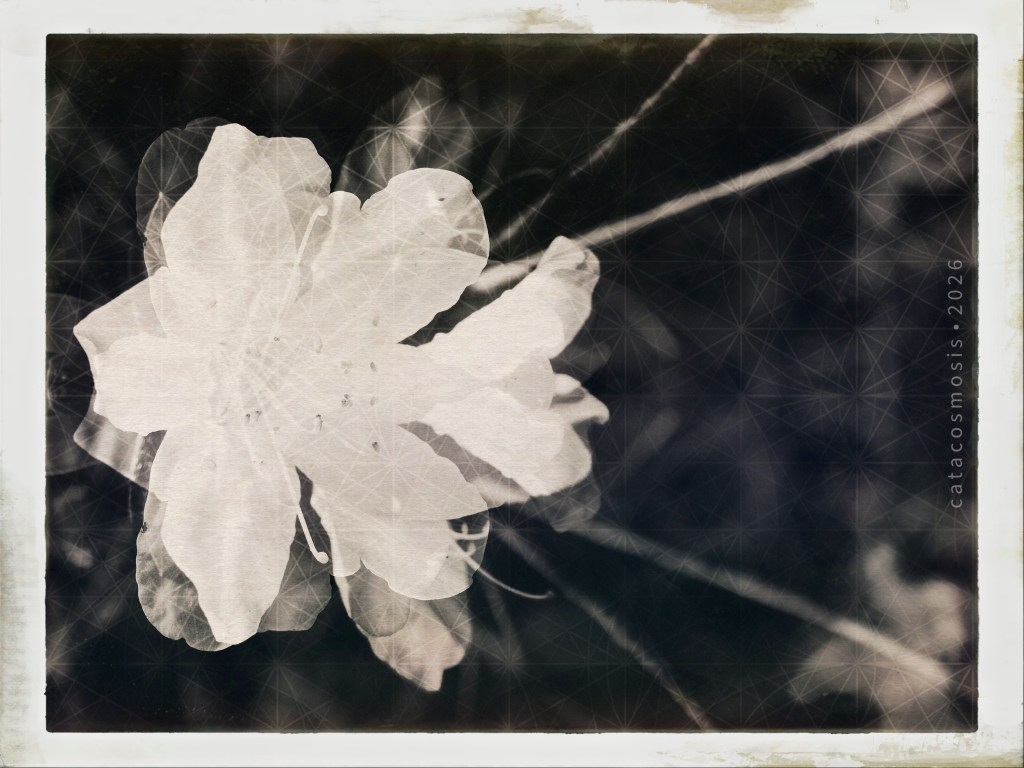
Two bushes a deeper rose at the edges, softening to a pink like the first blush of dawn on cotton-candy clouds; the purple one as deep as twilight shadows pooling in the underbrush, veined with richer amethyst; the handful of white ones pure and luminous, like scattered moonlight caught on petals. On several of them, the blooms crowd the branches so thickly that the dark green leaves vanish beneath waves of color, the bushes a generous bouquet bowed gently under its own abundance.
⚒️ VSCO + Lightroom Mobile
I stand at the fence line with my camera, breathing in the faint, sweet honey of their fragrance carried on the breeze, and it pulls me straight back to childhood. Growing up in the valley just across from my current, adult home, right at the base of that mountain, I’d watch for the wild azaleas and mountain laurel to appear along the wood’s edge, tiny beacons at the pasture’s far side. Each warming degree and every minute longer the day became — yes, I counted the minutes — felt like permission: one more day to explore before the snakes woke fully from their winter sleep.
With each passing day I’d step more carefully, heart racing with equal parts thrill and caution — head on a swivel, eyes scanning for copperheads or rattlers coiled just out of sight. The early days of spring were my favorite. They were the most relaxed. But the flowers made even the hot summer days worth the risk, with the promise of wild bursts of color rivaling my grandmother’s carefully tended, cultivated bushes next door, proof that beauty could thrive untamed.
⚒️ VSCO + Lightroom Mobile
Funny the things we fear and the things we don’t. Bobcats and mountain lions hunted those slopes, yet I never once worried about them — until the story my father told years later. At three years old, toddling the forty yard path to Grandmother’s a couple of hours after nightfall, my father watching and guarding intently — something I’d, we’d, done dozens of times before without consequence — a mountain lion perched on the cellar roof five feet above me, eyes fixed, body still. Daddy watched it watch me, praying silently, knowing any sudden move or cry might trigger instinct. It never pounced. I reached the house safe, unaware. When I was safely inside my grandmother’s screened-in back porch, he scared it off with a shotgun blast into the air, and we never saw one that close again.
I’ve thought about that story more often since losing him. He’s been gone eleven years now, and there are many things I never thought to ask, or wish I hadn’t been afraid to ask, while I still could… but this one he told me himself, more than once. I think it meant something to him that I should know it.
What I understand now, standing on this side of parenthood, is the cost of that stillness. The discipline of it. To watch a predator watch your child and not move, not cry out, not run — to trust that motion or sound might break whatever fragile restraint was holding that animal in place, and be so steady and rooted in your faith that you pray. Just… confidently pray. Whatever else he did or didn’t get right in his life, in that moment my father was made entirely of love and terror and faith, and none of it showed on the outside. That kind of stillness cost him everything. It was paid for in utter surrender, and he surrendered to fate, and to faith, beautifully.
⚒️ Hipstamatic X (Salvador 64 Lens + Uchitel 20 Film + Spiro Pop Flash
I think about that when I think about my own son. Sixteen, navigating a world that doesn’t always make room for the way his mind works, walking through invisible dangers I can’t always name or intercept. And I understand something about the helplessness of parenthood now that I couldn’t have grasped as that oblivious three-year-old toddling through grace.
You can’t always throw yourself between your child and what’s coming. Sometimes the most faithful thing is to stand still, breathe, and trust the hand that’s bigger than yours.
⚒️ VSCO + Lightroom Mobile
These azaleas have had quieter seasons. A few years back they were sparse, almost reluctant, with a handful of blooms where there should have been abundance. I watched them without much comment, the way you watch things when your own life has gone quiet in ways that don’t invite easy conversation.
Loss has a way of muting everything: the yard, the mornings, the impulse to pick up a camera at all. Grief and illness and the particular exhaustion that comes from giving what you have left to people you love… all of it settles like a kind of winter that has nothing to do with temperature. I’ve had a few of those winters. Longer than I’d like to admit.
So this spring, when every single bush along the fence erupted like they were making up for lost time, I stood there and felt something catch in my chest. That’s part of why I photograph at all — not just to capture beauty, but to bear witness to it. To say, with the deliberate act of framing a shot, I see this. This is real. This happened. The camera makes me slow down enough to actually look, and looking is a form of gratitude I can access even when words fail me.
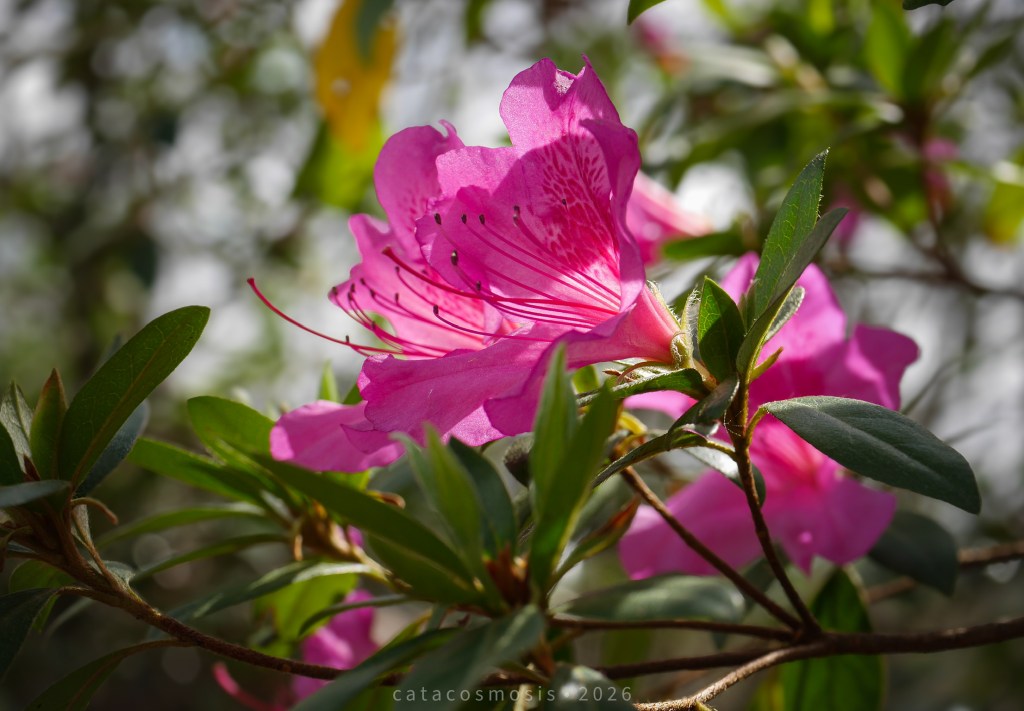
⚒️ VSCO + Lightroom Mobile
As a child, maybe I sensed some invisible shield, or maybe I was just young enough to believe in magic. As an adult, looking at these cultivated echoes of those wild blooms now thriving in my own yard, I know the truth: protection was there all along. Not arrogance, but grace.
God’s hand has turned aside far greater dangers than I ever knew were there. The mountain lion I never saw, the losses I somehow survived, the moments where the math shouldn’t have worked out in my favor and it did anyway. These azaleas, blooming so fully this year after quieter seasons, feel like a quiet reminder of that mercy, a gift unfolding right where the tame meets the wild, the past meets the present, under the watchful gaze of my mountain.
I don’t take that lightly. I don’t take it for granted. I take photographs of it, and I tell the stories that go with them, because that’s how I know to say thank you.
Mere backyard glory doesn’t begin to cover it. It’s memory, wonder, and gratitude all tangled in petals.



 catacosmosis