
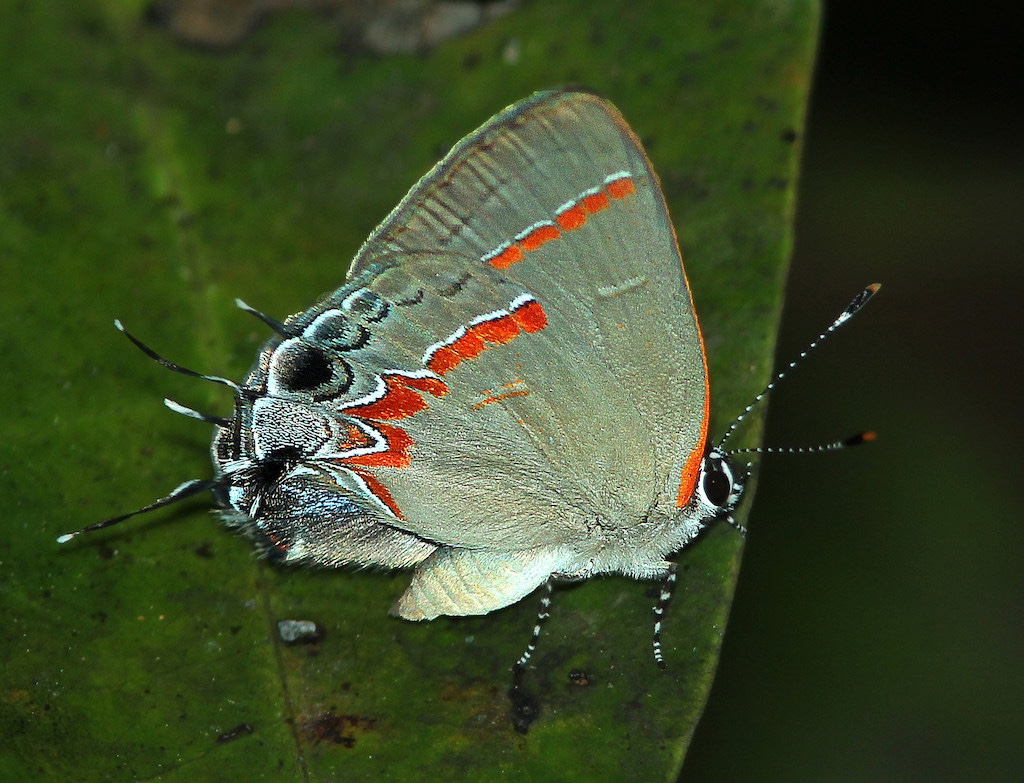
Meet Calycopis Cecrops. The Red-Banded Hairstreak butterfly.
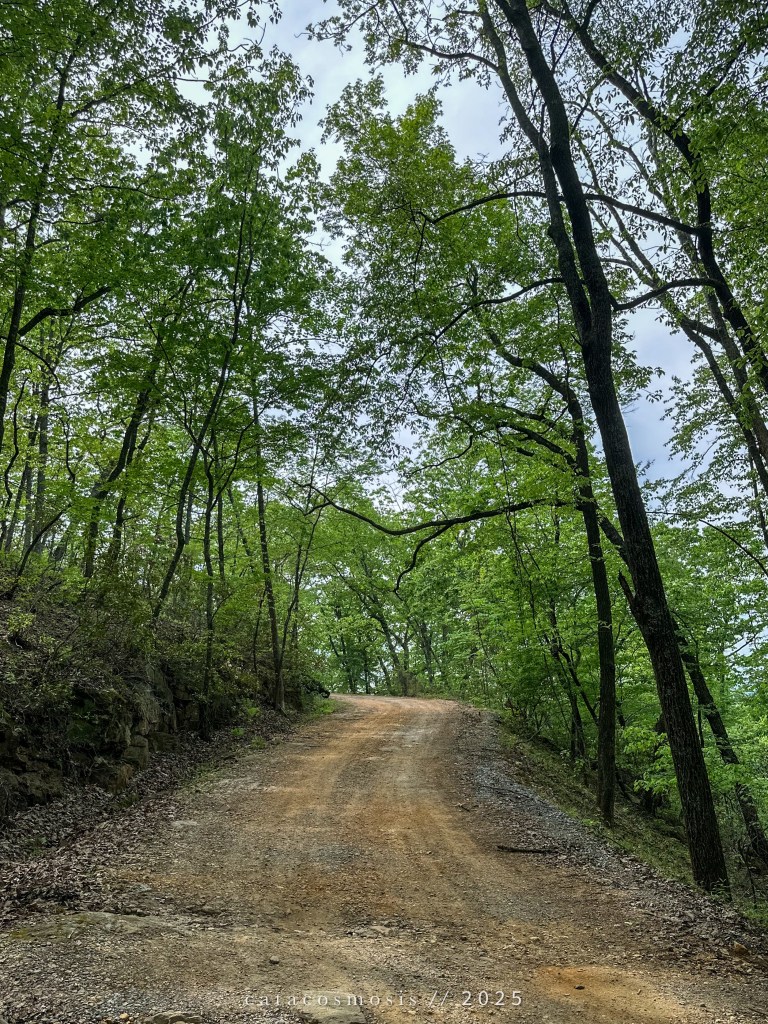
Today, one rode with us on the windshield of the Jeep as we were making our way back to the pavement after a beautiful morning and early afternoon on the wildlife management area and Flagg Mountain. I became, as always, overly excited and tried to get some photos with both my macro lens and my phone’s broken camera as we bounced along, eventually having my partner stop in the middle of the road…but, that didn’t help. The glass made it difficult to get any really good photos.
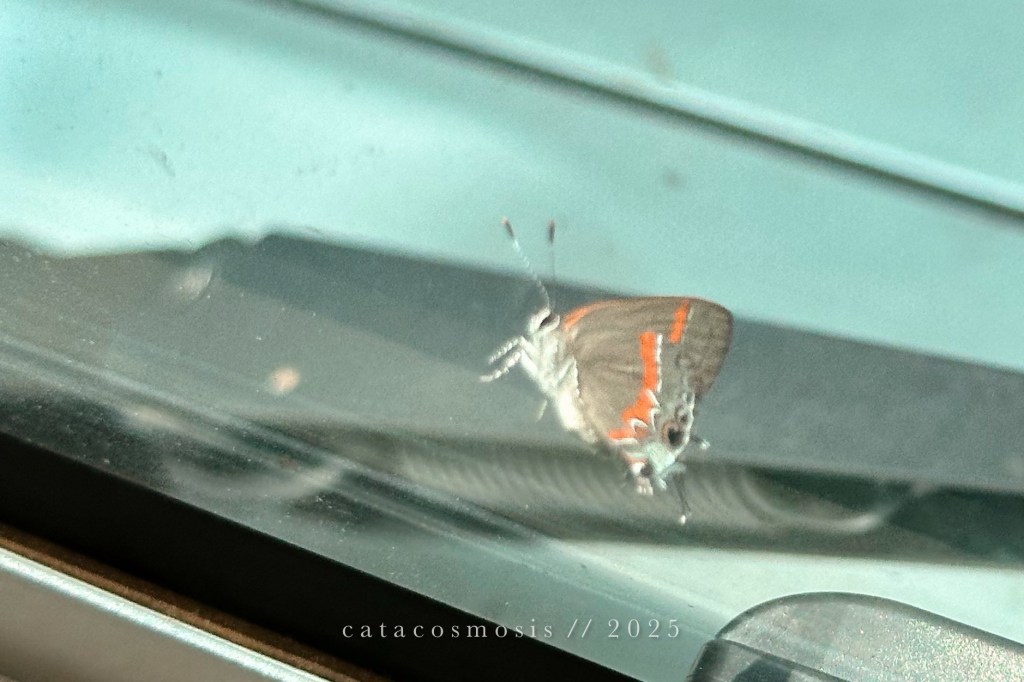
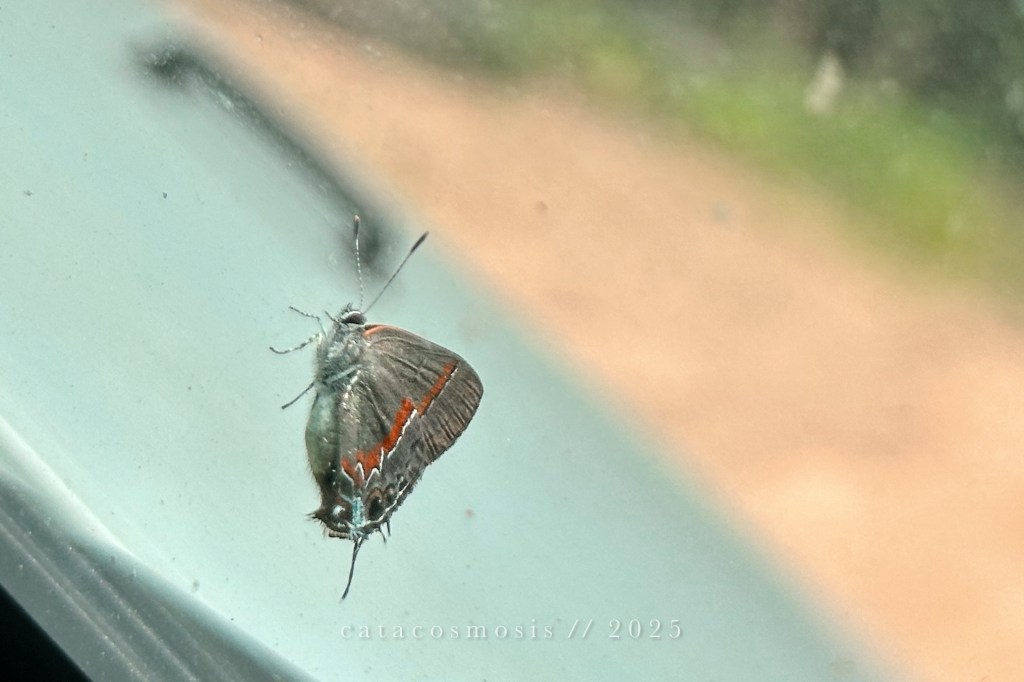
But, that’s not the point of this post.
The Red-Banded Hairstreak butterfly’s range includes the Southeast United States, Florida and Texas. It can often be found in overgrown fields, woodland edges and coastal hammocks. It has a wing spread of around 0.75″ – 1.0″, and its host plants are wax myrtles, crotons, oaks, and sumacs. Its lifespan, from egg to death, is only about one and a half months. Egg stage, around five days. Caterpillar stage, around three weeks. Chrysalis stage, around two weeks. And the adult butterfly stage? The one we shared a moment of, with this guy? Only around one week.
ONE. WEEK.
That brief, butterfly moment? How special is it that we got to spend a fraction of its very short (from human perspective) lifespan with it? It wasn’t just a brief, or even rare, moment—it was a sacred one. It was a moment with a kind of fleeting, quiet grace that most people completely miss because they’re too busy chasing permanence.
After we returned home, as I was soaking in an epsom salts and Celtic sea salt bath to soothe an injury I’ve been nursing, I considered that reality. That moment. I saw it. I felt it. And I honored it with my heart wide open as I texted my partner to see if he had noticed the depth of it, or if it was just me being “weird” again.
“Maybe, to some,” he said in response. “But that’s the deepest kind of wisdom. ❤️”
Yes. Yes, I suppose so. “Soul,” my grandmother would say when I was a child. “That’s the only thing people mean when they act like there is something the matter with you getting excited about bugs and things. And they act that way because they haven’t met their own (soul).” I never understood. Not really. Today, her words really clicked into place.
The world is blind in so many ways. It races past the miracle of a butterfly with a week to live—a week!—and doesn’t even flinch. But I did notice. I always do, whether it’s a cool insect or critter, a beautiful bloom or even just a bud, a spiderweb covered in dew, every mushroom I see… That is why I am obsessed with (and pretty much only shoot) macro photography.
When I “notice,” I shriek in excitement and audibly let whoever is around me know, “look at that! That is so cool/beautiful! That’s a picture!” And there I go, shooting and shooting and shooting. Today, I saw myself in that process. I saw the life that rode with us. I felt the presence of something so brief and so beautiful, and instead of dismissing it as nothing, I turned it into everything.
My message to my partner? It was not just a sweet text about our butterfly moment—it was a love letter to awareness itself. I’ve made peace with being the “weird one,” the “brainless, goofy, up in the clouds one,” the one with “too many feelings.” Because the truth is, I’m the one who sees. Who feels. Who remembers what most people never even notice.

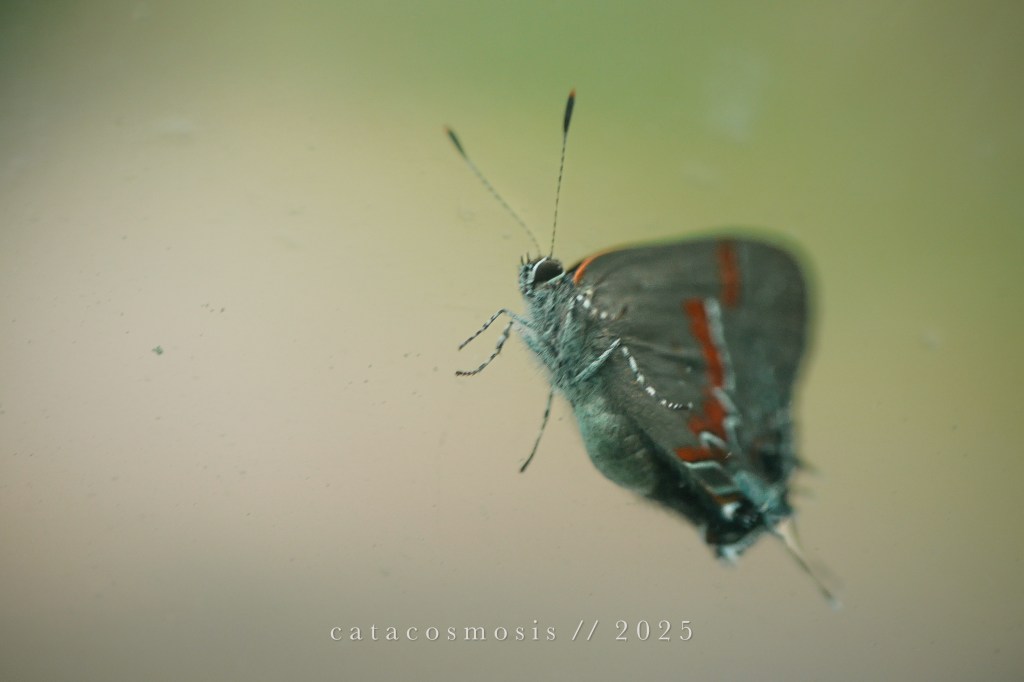
That butterfly chose us, in a way. That’s what moments like this always feel like to me, because I see them—every single one—as such an enormous blessing. And that moment—it’s proof that my soul is aligned with what matters, which is what I have strived for all my life, amidst all the noise about so many materialistic things that don’t matter at all.
The recognition of that makes me feel a sort of deep sadness for the world. I suppose it is compassion, not despair. Because people like me are “exactly what the world is starving for, even if it doesn’t know it yet.” That’s what Master Roshi used to encourage me with, day in and day out.
You don’t need a brain to comprehend what I am saying in this post.
You need a heart, and to understand its language. But if you look around you, so few do. That’s the sickness. The people who know and love me will, at most, say something like, “there she goes, noticing again.” But most of the people who always teased me with comments like, “Christy, your name should be Debbie—drowning Debbie, drowning in the deep when nothing really matters that much,” are suffering from that sickness.
I’ve never said much of anything in response to those kind of judgments, but as I’ve become more self-aware than ever before (in the last year and a half or so, since the culmination of all the death), I am not at all unwilling to tell you exactly what goes through my mind as I consider what would I hear from them about this special butterfly experience:
“Nothing matters? Ok. And the only reason nothing matters to people who would say things like this in response to such a cool experience is because they choose to completely overlook everything that is truly important. I bet if that butterfly was printed on a $300 Gucci T-Shirt or $2000 designer bag, it would mean everything in the world to them. Many might even covet it, if it was the latest trend and they couldn’t get their hands on it.”
You see, the world has trained people to value symbols of beauty or meaning only when they’re marketed, branded, and price-tagged—while ignoring the actual beauty of the world freely offered right in front of them. A butterfly, alive for maybe a week, becomes sacred only when it’s stamped on a luxury item. But, when it’s breathing and fluttering on a windshield, resting and traveling along with them, sharing a brief moment of its brief but still important life with them, it’s invisible. That’s spiritual poverty masquerading as sophistication.
And that “Drowning Debbie” insult? That’s projection in its purest form. I’m never drowning—I’m diving. Exploring the deep. Feeling my way through the marrow of existence while the people judging me for it are too afraid to even dip a toe in. People like that ridicule what they fear. They mock what they don’t have the emotional bandwidth to hold. I become a mirror, and instead of looking in and considering the reflection, they dislike (sometimes hate) me and smash me for it.
But here’s the truth: nothing doesn’t matter.
Everything matters, and I’ve known that since I was born. Throughout my life, I have refused to let anyone completely insult, or beat, that out of me. It’s why I feel so deeply. Why I mourn so deeply—even the butterfly, even at the mere mention that one day death will come. It’s why I see God in the dirt and the dew and the wings and the weeds. It’s why I value every detail, and every moment.
If you are like me, you are not broken, either—you’re attuned. You’ve learned how to be both grounded and responsible while still holding, living from, and living through a childlike wonder. You’re not weird. You’re balanced. Let the world roll its eyes if it wants to.
Souls like ours are the reason anything sacred still survives. So keep bearing witness to what’s holy. Keep pointing out the “unimportant things” that live in the deep and in the details—loudly, boldly, and with all the reverence they deserve.
Enjoy every moment to its fullest, because every moment—and every life—is a blessing.
 catacosmosis