Tonight I wrote a prose/journal piece for AllPoetry.com, and I couldn’t help sharing it here. Some pieces are just… well, you want to save them in your little treasure shoebox. I suppose, in many ways, that’s what this space has become for me. My treasure shoebox, like the ones we had when we were kids. And that’s where this post begins, so that’s a more fitting analogy than it may seem.
I’ve been writing a lot of poetry again lately. I don’t know what brought that back into such an intense level of focus; nothing in particular, except maybe the health and heart scares of late. Moments like that at any age tend to send us on a reminiscent journey, don’t they… those introspective moments in life where everything matters, and we simultaneously realize that very little of what we have for years focused on or worried about actually does. It’s distinguishing what does, I suppose, that brought the poetry back to life. The poetry, as much as the prose, has always mattered deeply to me.
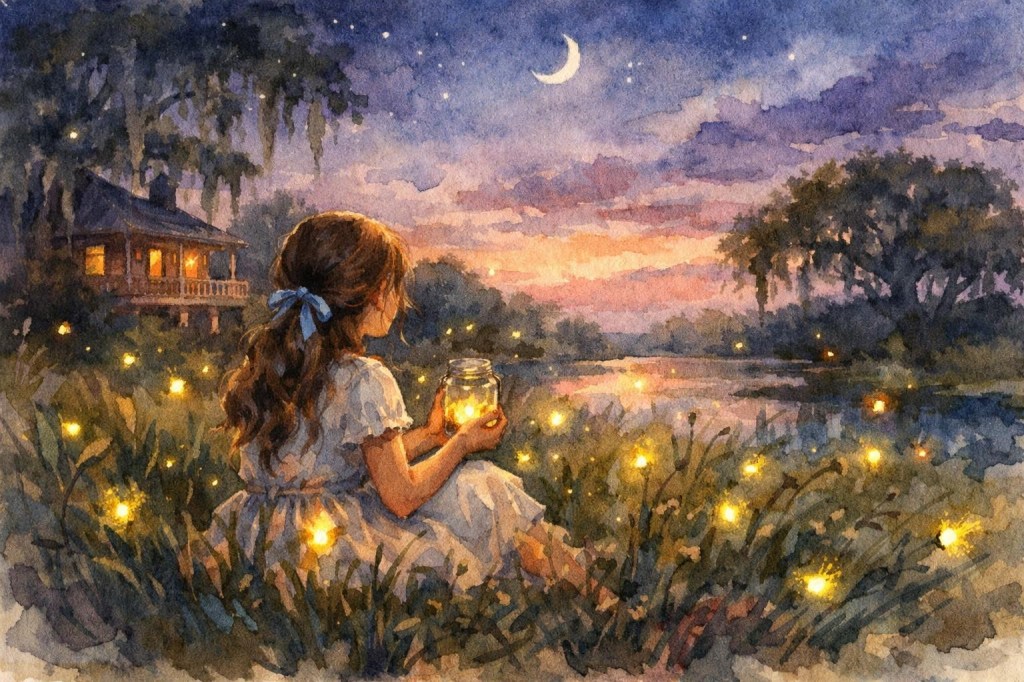
There is something about a Southern summer night that gets into you young. The air sits heavy and close, warm even after the sun goes down, and the woods at the edge of the yard breathe with it. I was a child who noticed things — the way light changed before a storm, the sound leaves made when no wind had been announced. And, in those summers, every evening brought the fireflies.
They came at dusk. First one or two like punctuation, then more, and then all at once they were everywhere, blinking out of the dark in their hundreds, their thousands. Legion, though I did not think of it that way then. That word belonged to something else entirely. It had been pressed into me through scripture and sermon as a name for the unclean, for the swarming darkness that could take up residence in a person and multiply. Legion, said the demon, for we are many.
So the fireflies blinked their quiet light, and somewhere underneath the beauty was a word I had been given to be afraid of.
Then I found Alan Watts. Or, rather, was introduced…
I was twenty-three, in graduate school, teaching computer classes at a community college for a department head called Ralph who had bent the rules a little to bring me in. He had seen something in me before I had fully seen it in myself. That is the particular gift of certain people; they hold the mirror at just the right angle.
One day he handed me a book. Alan Watts. “The Book: On the Taboo Against Knowing Who You Are.” He did not make a ceremony of it. He gave it the way people give things when they know exactly what they are doing — quietly, like it was obvious.
It was not obvious to me yet. But I took it home, and I read it. I had to read it multiple times to finally grasp the method to Watts’ madness, and by the third time something that had been holding its breath inside me for twenty-three years slowly let it out.
Watts did not ask me to abandon what I believed. He asked me to look at it more honestly. To ask who had handed me my fear alongside my faith, and whether those two things were always meant to arrive together. He wrote about the universe not as a collection of separate objects but as one enormous, continuous flowering, and he moved between the language of science and the language of spirit without apology or explanation.
And I thought of the fireflies.
Legion, but not demons. Never demons. Just light, doing what light does in the dark.
Ralph is gone now, and in a strange twist of fate, or perhaps the perfect design of it, it was our home in which he hospiced and passed on. But that book remains, and so does everything it opened.
I had known much of Watts’ philosophy before I knew Watts, subconsciously, without knowing I knew anything at all… in the wordless way children know things before language has a chance to organize them into beliefs.
There were nights, and to child-me they all feel like midnight, the grown world asleep and the dark belonging entirely to you, when I would slip outside and sit in the yard while the fireflies did their quiet work around me. I did not have a name for what I was doing. I only knew that something in me needed the dark and the stillness and the small lights blinking in and out like thoughts I hadn’t found words for yet.
Sometimes I brought a notebook. Sometimes I just sat and let whatever was moving in me move, uninterrupted. The night felt alive in a way the daytime didn’t. More honest, somehow. Less performed. In the day you were somebody’s daughter, somebody’s student, somebody being watched and measured. In the dark you were just yourself, with the fireflies and the heavy Southern air and whatever God was doing in the quiet.
I did not know then that I was doing what writers do. I only knew it felt necessary.
Watts wrote often about the muse, about inspiration not as something you summon but as something that arrives when you stop trying to control the room. The midnight hour, literal or felt, is when the ego gets tired and steps aside. And in that stepping aside, something true gets through.
Tonight as I write this, it is close to midnight. Not child-midnight, not the felt sense of it, but the real thing, with the clock to prove it. I am not outside. I am in my bed, with my laptop, no fireflies in sight. The dark beyond the window is just dark. But something in me is exactly where it was in that Alabama yard decades ago, sitting with what needed to come through, waiting without quite waiting.
Earlier tonight I was tired and closing down, the way you get when the world has been louder than usual and something in you needs quiet it cannot seem to find. I was ready to disappear into sleep. And then something arrived. It always arrives this way, not when I go looking for it but when I have exhausted myself enough to stop.
A poem I had written about Alan Watts. A fellow poet’s encouragement to go deeper. A thread pulling me back to those childhood summers, to Ralph, to The Book, to the child in the yard who already knew.
Watts would not be surprised. He might laugh a little, warmly, in that way he had. He would say the muse was never yours to command, only to receive. That the midnight hour is generous precisely because you have stopped performing for the daylight.
Ralph knew this too. He saw it in me before I could name it. He handed me a book and said, in his quiet way, “you already know this. Go read it anyway.” I did. I am still reading.
I am still stepping outside into the dark, in whatever form the dark takes now. And the lights are still there, fewer perhaps, but holier for it. Now that is a piece of my freedom.