When you’re connected, you pause. You listen, and ask better questions. You observe your own patterns, and stop attacking or blaming others for theirs.
When you’re connected, you become a space of calm in a world of storms rather than another disruptive, destructive wave in a sea of chaos.
When you forget how to listen inward, when you stop grounding in self-awareness, you lose your anchor.
Check yourself before you wreck yourself. It’s not about being perfect. It’s about being aware.
Pause, and come back to yourself.
Reconnect, and become the clarity you’ve been searching for.
Remain connected, and become the clarity that helps to guide others home.
entry ten — scattered light, fractured grace: a quiet archive of light, loss, and what remains.
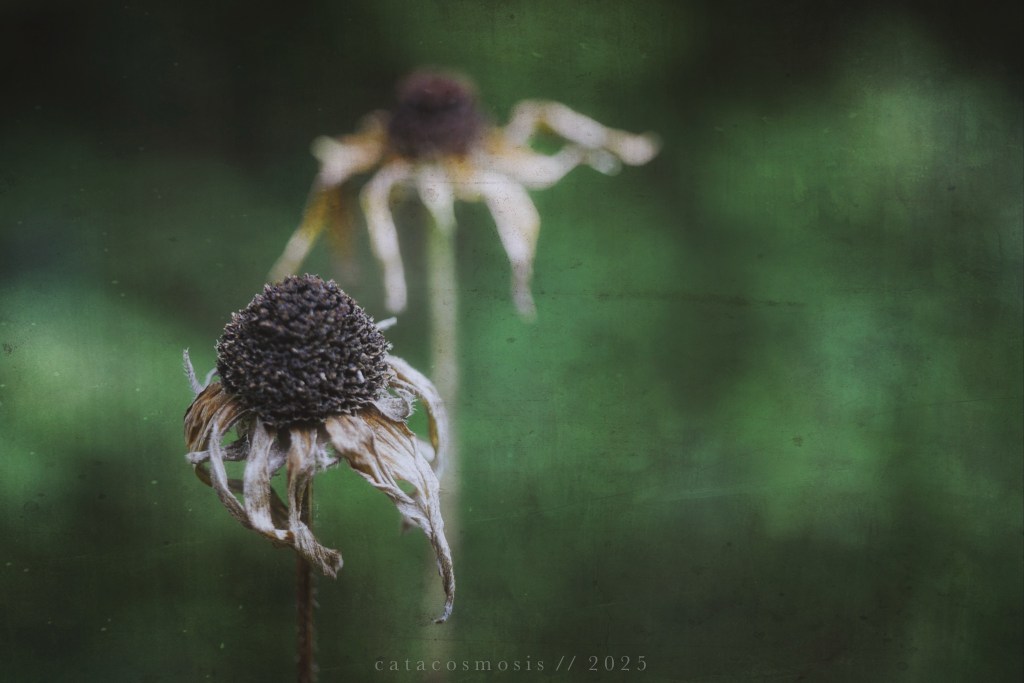
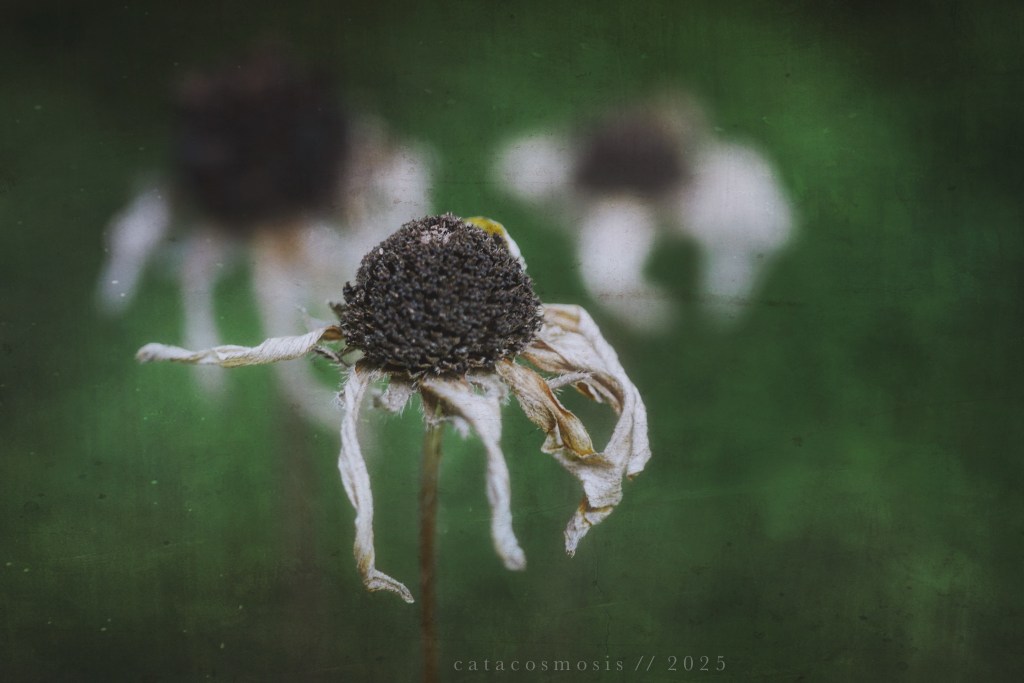
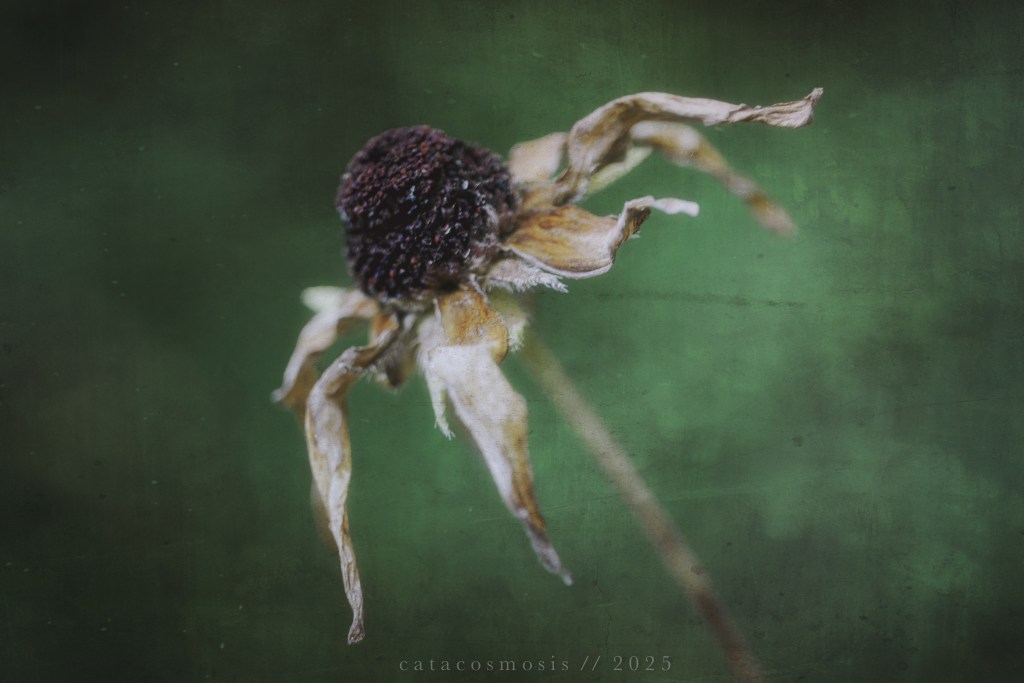
Black-eyed Susan (Rudbeckia hirta), a fading ember of late summer—graceful even in decay, still holding the shape of sunlight after the bloom has passed. Lumix GX7 + Panasonic Leica DG Macro-Elmarit 45mm f/2.8 ASPH. MEGA O.I.S., VSCO (A10PRO), Mextures (personalized texture formula: MEZPZZC), Lightroom Mobile (watermark only).
My mother always told me, in every possible circumstance a child might ever need encouragement, “Do your best, and leave the rest. It’ll all come right some day or night.”
It was a line from “Black Beauty, by Anna Sewell.”
She was a third grade teacher, a grammar Nazi, and a mother trying her damndest to connect with me and, well, do her best.
And, as ornery and difficult a young person as I could often be, she never knew that I believed her…
…even when I forgot I did.
Black-eyed Susan (Rudbeckia hirta), a fading ember of late summer—graceful even in decay, still holding the shape of sunlight after the bloom has passed. Lumix GX7 + Panasonic Leica DG Macro-Elmarit 45mm f/2.8 ASPH. MEGA O.I.S., VSCO (A10PRO), Mextures (personalized texture formula: MEZPZZC), Lightroom Mobile (watermark only).
There was so much distance between us as I struggled through high school with her overbearing “sin obsessed” guidance, and she struggled to save my soul.
Even when the days were so long, when they bled into each other, and when the nights felt like punishments I hadn’t earned, as her brain and body were swallowed by Alzheimer’s.
Even when the thread broke, or maybe I cut it, when she died…I honored and nursed a clean, holy wound in the shape of freedom for both of us, from past grievances, from debts yet unpaid, from fear, from tension, from aching hearts and confused minds and the evils of that horrific disease.
Still, that line stayed, like a soft breath. Like a healing balm. Like the part of her that couldn’t leave, because it lived in me.
Black-eyed Susan (Rudbeckia hirta), a fading ember of late summer—graceful even in decay, still holding the shape of sunlight after the bloom has passed. Lumix GX7 + Panasonic Leica DG Macro-Elmarit 45mm f/2.8 ASPH. MEGA O.I.S., VSCO (A10PRO), Mextures (personalized texture formula: MEZPZZC), Lightroom Mobile (watermark only).
Do your best. Not more than that. Not perfection. Just presence. I tried, truly.
Leave the rest… The story. The tragedy. The one who couldn’t stay.
entry nine — scattered light, fractured grace: a quiet archive of light, loss, and what remains.
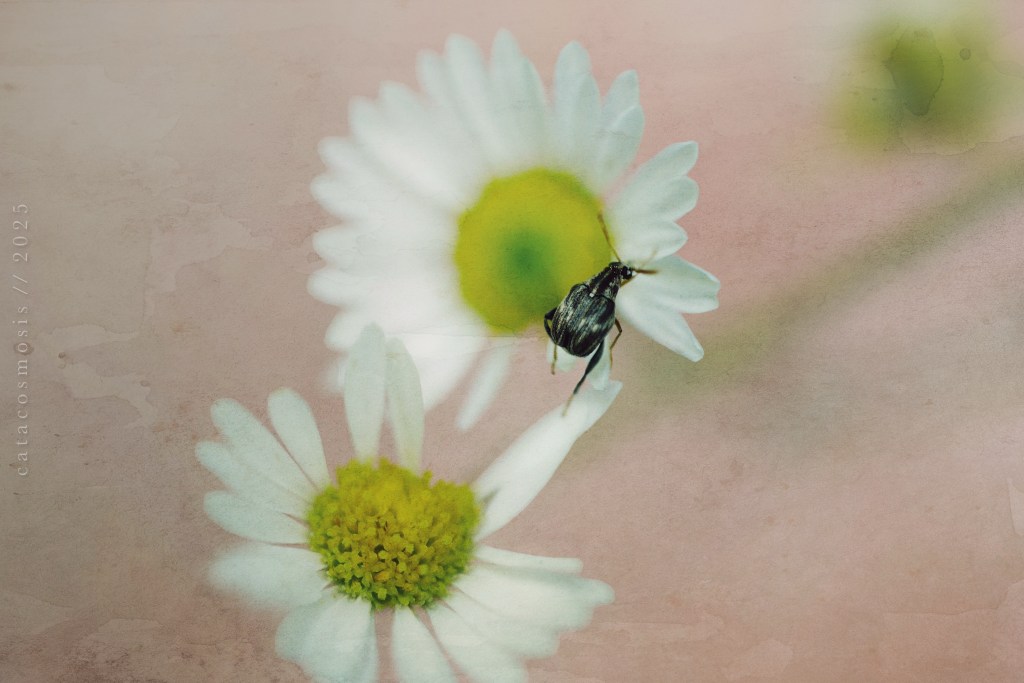
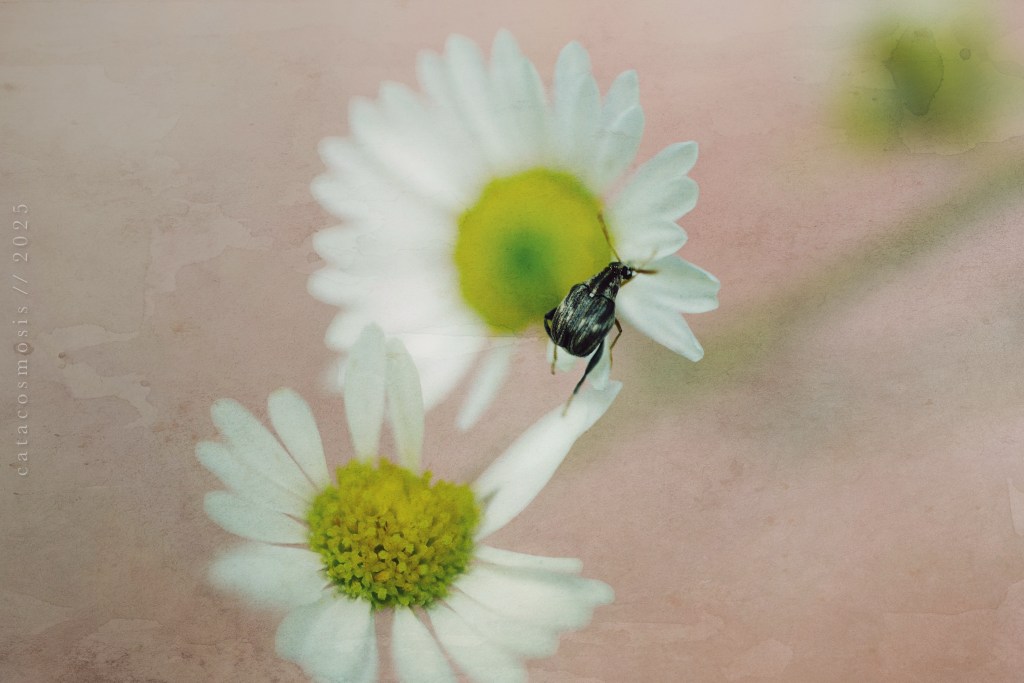
Weevil (Meibomeus musculus), a quiet laborer of the forest and the fields…carrying the weight of being, petal by petal. Vision: Lumix GX7 + Panasonic Leica DG Macro-Elmarit 45mm f/2.8 ASPH. MEGA O.I.S. Tools: VSCO (KP3), Mextures (personalized texture formula: QBHASZK), Lightroom Mobile (watermark only).
There is a kind of presence that doesn’t announce itself.
No sound. No shimmer. No need to be noticed. Just a body doing what it does.
Clinging to a petal, breathing the moment, belonging to the quiet. Sometimes, that is the work.
Not saving, not proving. Just being.
And somehow…it shifts the entire forest, the entire field.
For some souls, there is a burden in being seen —not the fear of visibility, but the ache of being misread when presence itself was the offering.
entry eight — scattered light, fractured grace: a quiet archive of light, loss, and what remains.
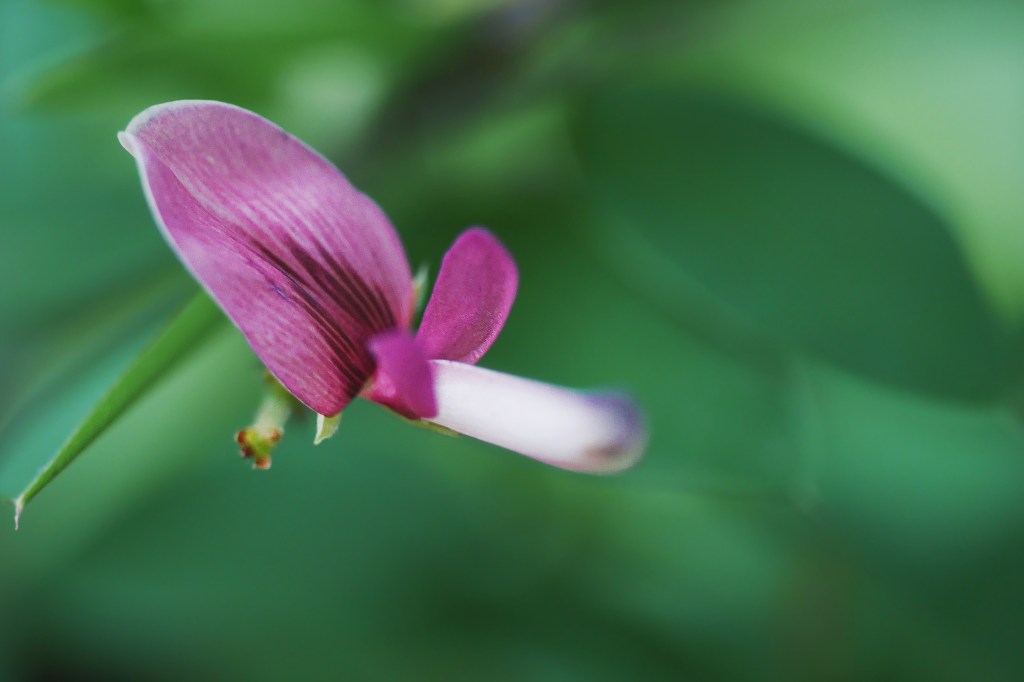
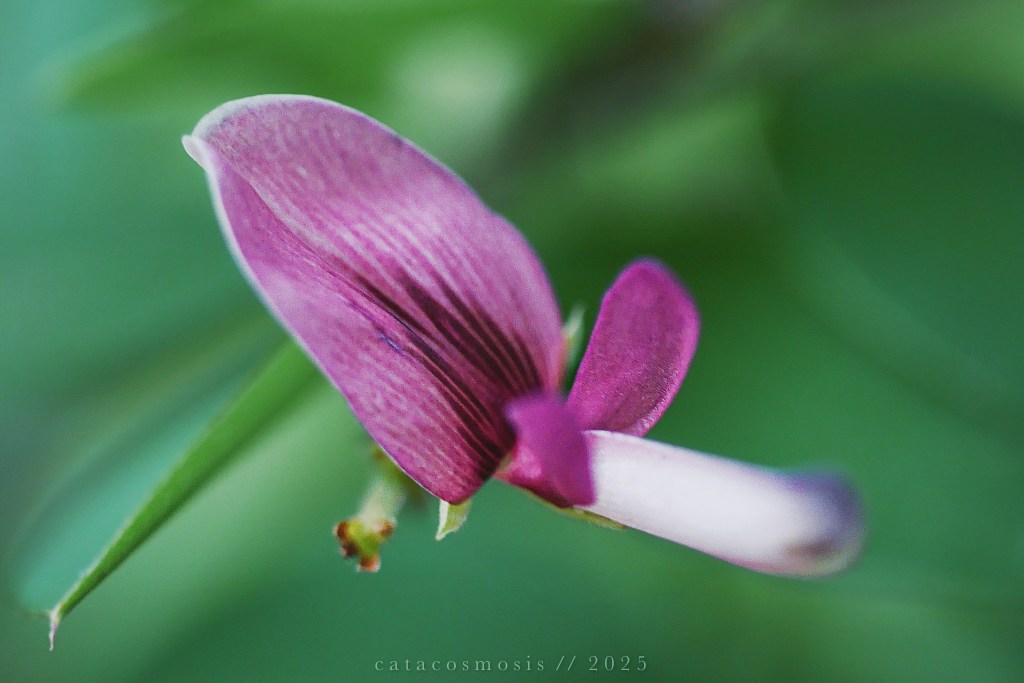
Bicolor Bush Clover (Lespedeza bicolor), a humble member of the wild clover family. Lumix GX7 + Panasonic Leica DG Macro-Elmarit 45mm f/2.8 ASPH. MEGA O.I.S., VSCO (HB3 PRO), Lightroom Mobile (watermark only).
Zooming in, pulling back, reframing… …it’s the practice of shifting perspectives. Cropping is discernment.
It’s important in photography, and in life.
Focusing closely. Examining the details. Leaning into the moment. Studying the layers. Trying different angles— then pulling back to take in the whole.
I do this with my art, my edits, my healing… …and my priorities.
Bicolor Bush Clover (Lespedeza bicolor), a humble member of the wild clover family. Lumix GX7 + Panasonic Leica DG Macro-Elmarit 45mm f/2.8 ASPH. MEGA O.I.S., VSCO (HB3 PRO), Lightroom Mobile (watermark only).
Cropping, and discernment. Both are framing what matters— letting the noise blur into the background.
It’s not just a gift, not just a tool. It’s a process.
With practice, it teaches clarity through choice. Over time, it becomes discernment embodied.
Cropping alters perspective. It is learning to see again…
…as many times as it takes to actualize the vision.
VSCO (SS1 Pro), Lightroom Mobile (watermark only).
Aperture
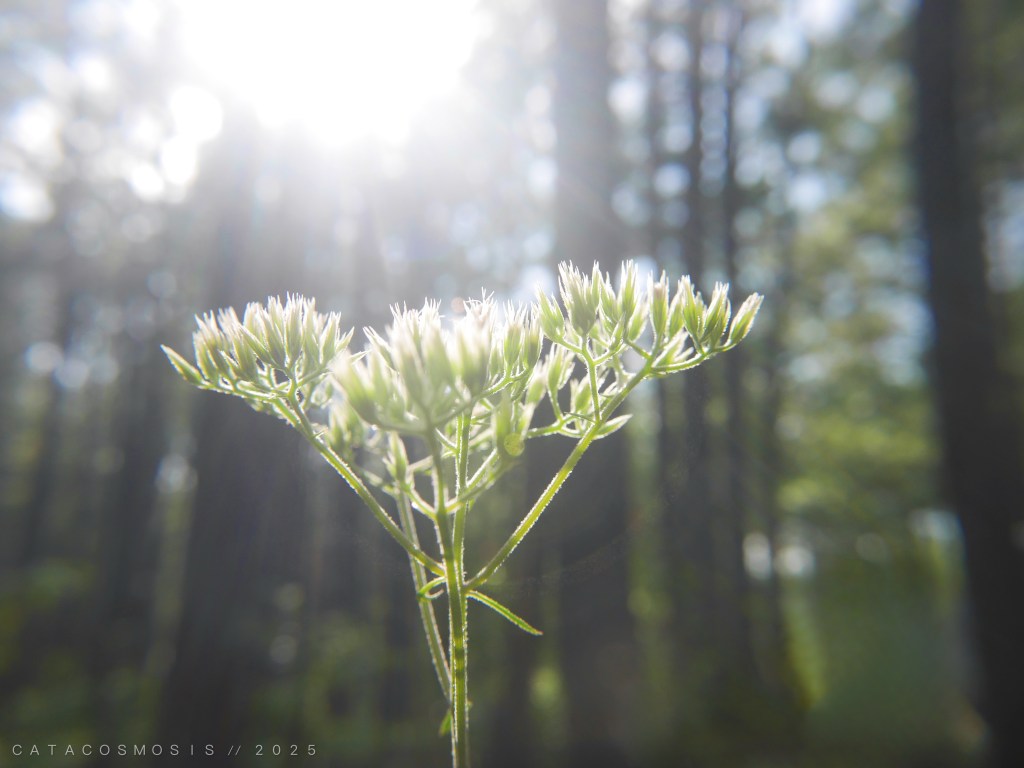
There is a kind of light that doesn’t just shine, but also fractures.
It breaks open the moment with something softer than silence and more honest than certainty.
You don’t chase it, you receive it.
This image wasn’t planned.
This frame wasn’t forced.
There’s a stillness even the flowers seemed to know, and reflect back to me.
It is not the stillness of silence, but of surrender.
Not of bracing against beauty or the process of becoming-in-progress, or of apologizing for taking up space mid-bloom…but of letting the light have its way.
I simply stood still long enough for the light to offer itself—scattered, wild, and full of grace.
I saw what was really there:
Buds preparing to bloom and light wafting in, yet also ambient and still.
The entire moment was an aperture through which grace entered, unbothered and whole, needing no permission.
And in that quiet moment, it became a mirror for all of us—one that perhaps none of us knew we needed, and that many would automatically overlook.
How often do we chase clarity instead of becoming it?
How often do we disturb ourselves, or disturb the world while attempting to distract ourselves, by blaming everyone else?
How often are those moments merely us trying to be louder than what already speaks through us?
There is no control in peace.
No performance in healing.
Only presence.
And in that presence, we disturb no one—not even ourselves.
We become the quiet offering.
We become the still center in a world unraveling at the edges.
Today, as I stood still in the midst of both internal and external war, peace didn’t arrive with fanfare.
It arrived as fractured light through pine trees.
As a silent, oft unnoticed breath.
As a reminder that maybe the most sacred work is not to act, but merely to remain open.
Not to close.
Not to harden.
Not to explain ourselves into exhaustion, but to become aperture.
To simultaneously remain wide enough to hold what’s real and narrow enough to let illusion fall away.
And, to be balanced enough in both intellect and empathy to know the difference.
This is the answer: detachment.
Not from emotion, but from illusion.
It is not denial, not distance.
Rather, it is the quiet rerouting of both emotion and cognition back to stillness.
A return to clarity, not an absence of care.
And somehow, by not reacting, by not reaching, we find we are already held.
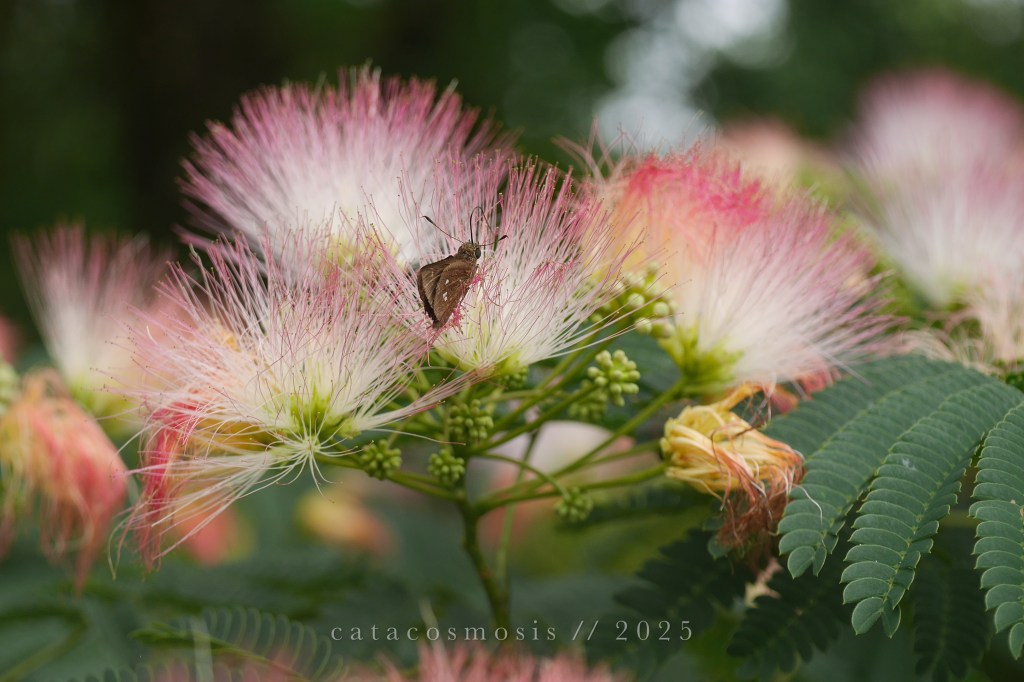
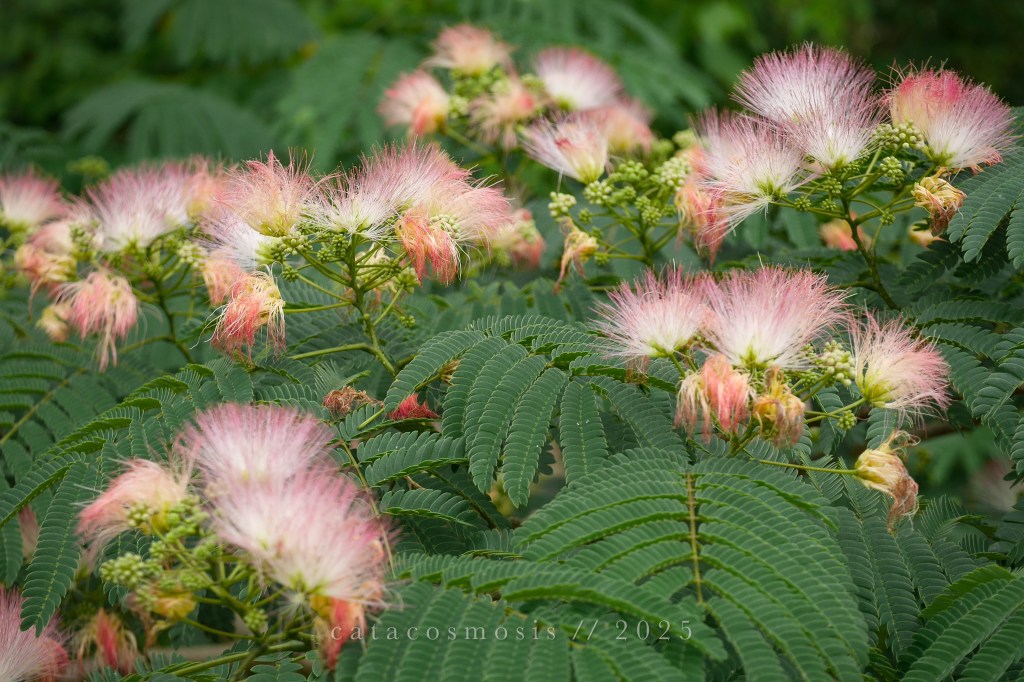
Mimosa (Albizia julibrissin). Lumix GX7, Panasonic Leica DG Macro-Elmarit 45mm f/2.8 ASPH. MEGA O.I.S., Lightroom Mobile (watermark), VSCO.
Not everything soft is weak.
Not everything brief is forgotten.
The mimosa blooms like a passing thought—pink, feathery, fragrant, gone before you’re ready. But even in its short season, it rewrites the air.
And maybe that’s the point:
To offer sweetness without needing permanence. To make magic in the margins.
💚🌿✨
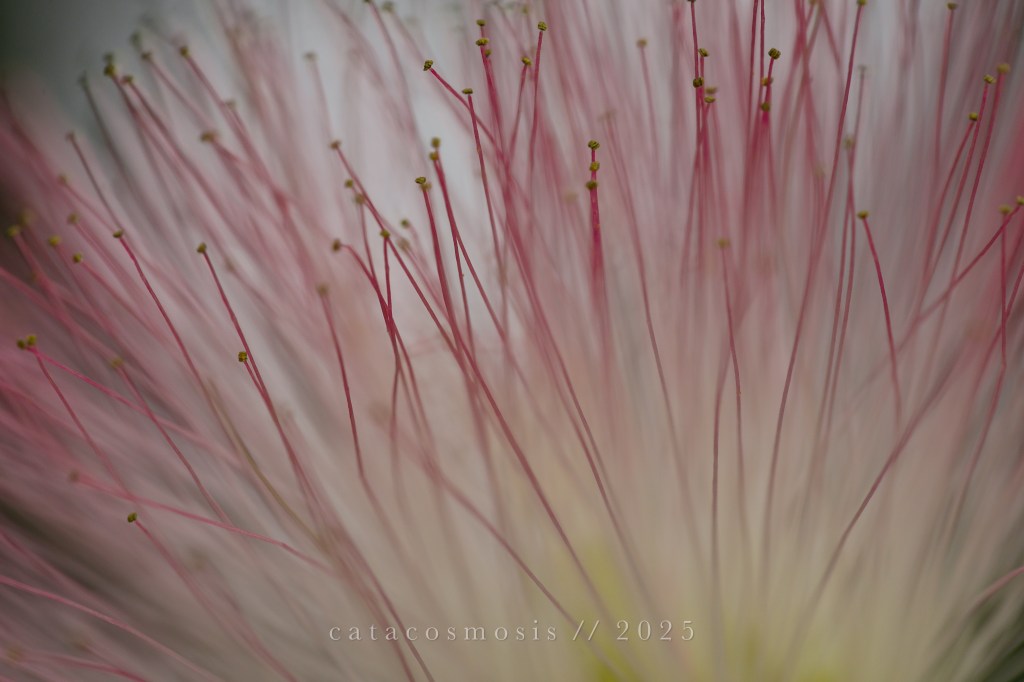
Mimosa (Albizia julibrissin). Lumix GX7, Panasonic Leica DG Macro-Elmarit 45mm f/2.8 ASPH. MEGA O.I.S., Lightroom Mobile (watermark), VSCO.
The Mimosa tree (Albizia julibrissin) is commonly known as the silk tree or Persian silk tree. Albizia julibrissin isn’t actually a true mimosa—though it’s been lovingly misnamed for generations. Native to Asia, this delicate tree has made its way into southern landscapes with grace and stubbornness alike.
Its blooms are light as breath—powdery tufts that attract butterflies, bees, and human daydreamers. They bloom at dusk, shimmer in the wind, and drop silently—often leaving a petal-scattered sidewalk like a love note no one signed.
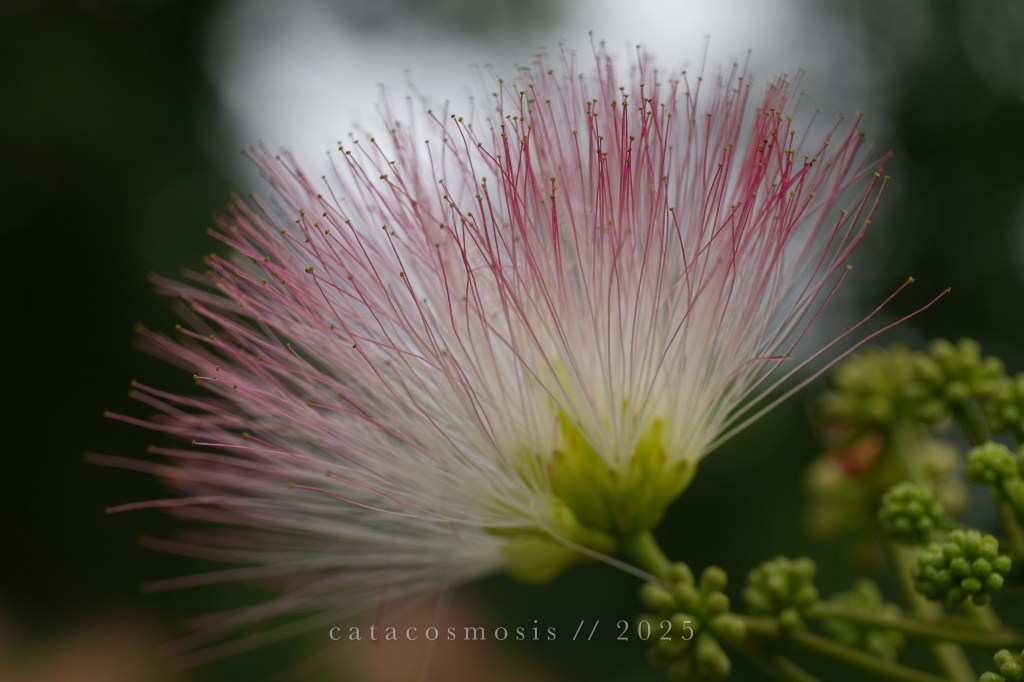
Mimosa (Albizia julibrissin). Lumix GX7, Panasonic Leica DG Macro-Elmarit 45mm f/2.8 ASPH. MEGA O.I.S., Lightroom Mobile (watermark), VSCO.
Though it’s sometimes called invasive, there’s no denying its presence feels like a portal: part nostalgia, part perfume, part dream.
Its scientific name, julibrissin, comes from the Persian gul-i abrisham—“silk flower.” A name that suits it perfectly.
Mimosa (Albizia julibrissin). Lumix GX7, Panasonic Leica DG Macro-Elmarit 45mm f/2.8 ASPH. MEGA O.I.S., Lightroom Mobile (watermark), VSCO.
In folk medicine—especially within Traditional Chinese Medicine—the mimosa tree is known as the “Tree of Happiness.” Its fragrant pink blossoms and bark have long been used to lift the spirit, ease grief, calm the heart, and quiet a restless mind.
The flowers are brewed into gentle teas, while the bark is sometimes tinctured for deeper emotional support. Often given to those moving through sorrow or heartbreak, the mimosa is considered a natural ally for joy, resilience, and emotional rebirth.
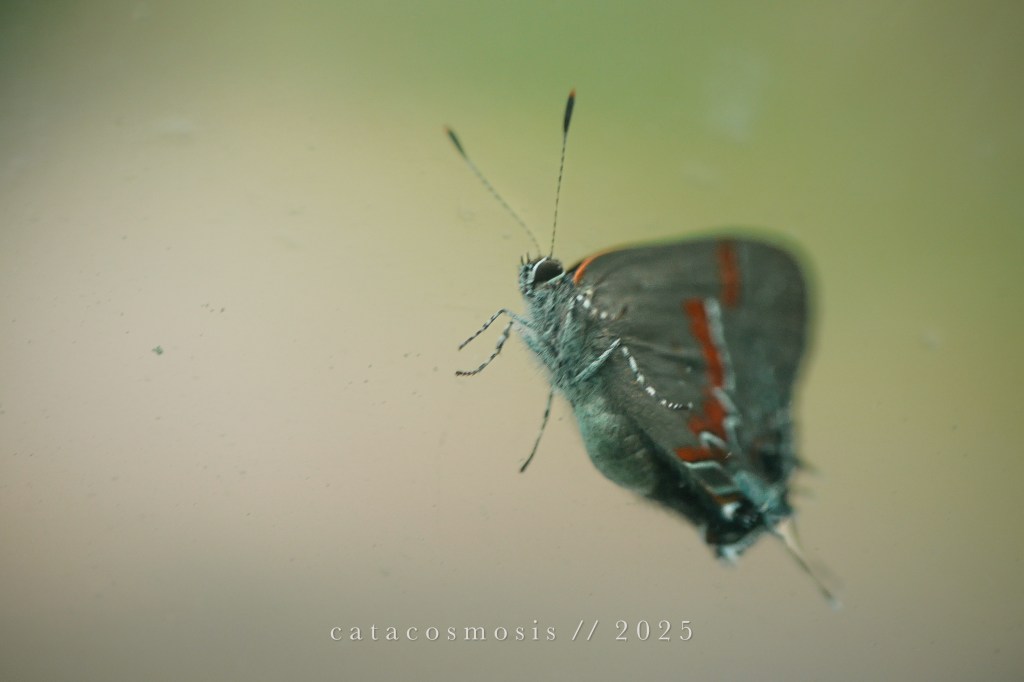
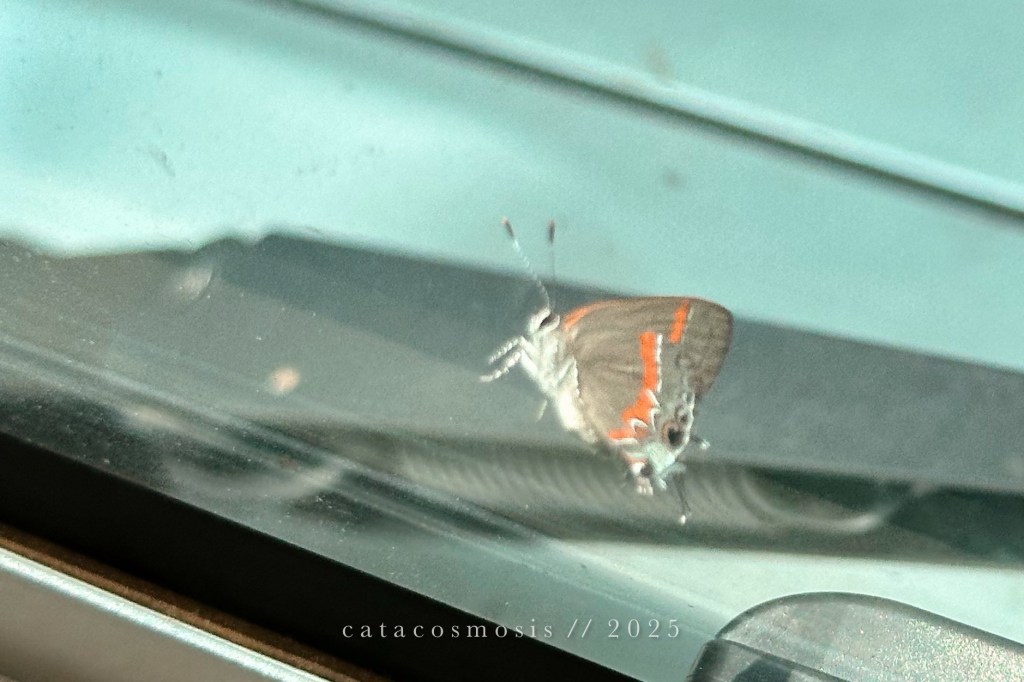
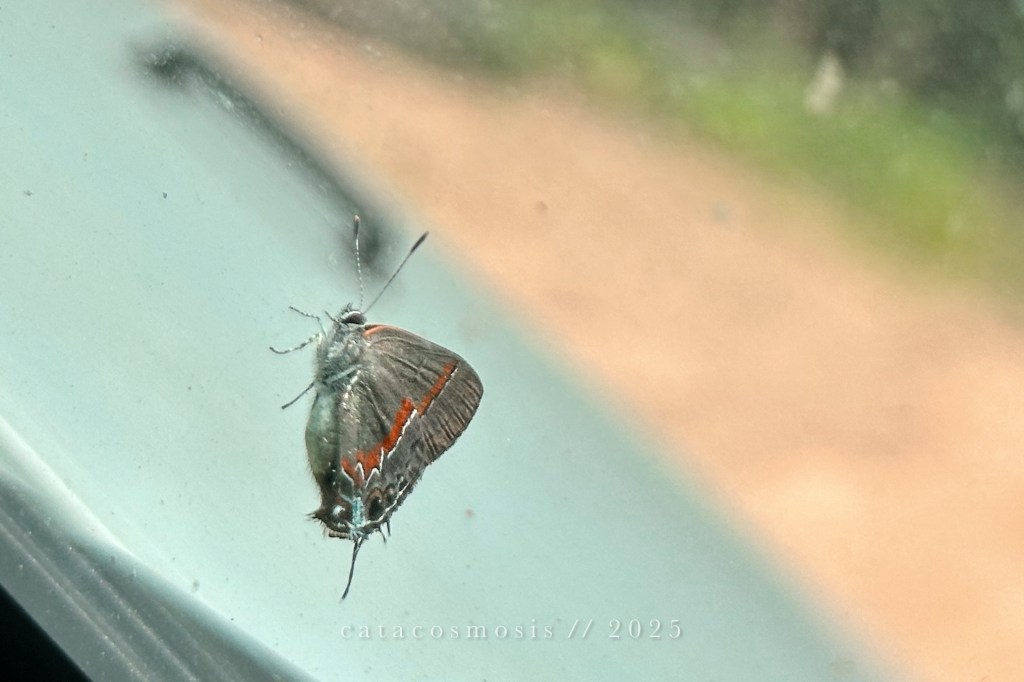
Today, one rode with us on the windshield of the Jeep as we were making our way back to the pavement after a beautiful morning and early afternoon on the wildlife management area and Flagg Mountain. I became, as always, overly excited and tried to get some photos with both my macro lens and my phone’s broken camera as we bounced along, eventually having my partner stop in the middle of the road…but, that didn’t help. The glass made it difficult to get any really good photos.
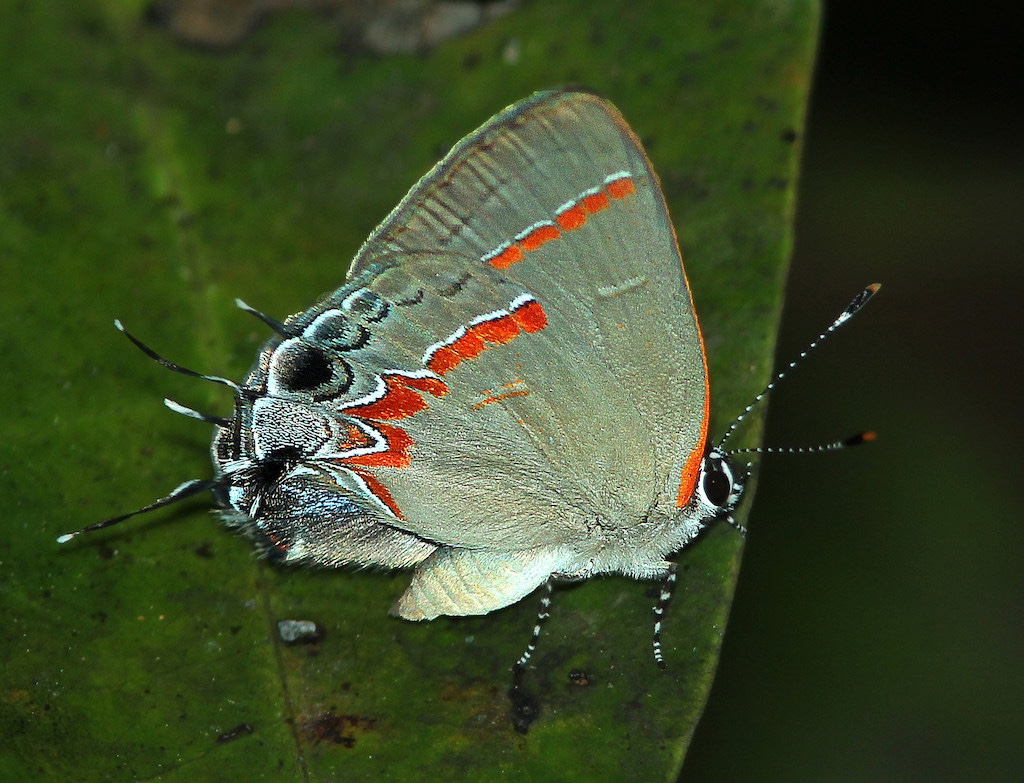
Photos of The Red-Banded Hairstreak butterfly (Calycopis Cecrops) I took with my broken iPhone camera, edited using Lightroom Mobile and VSCO.
But, that’s not the point of this post.
The Red-Banded Hairstreak butterfly’s range includes the Southeast United States, Florida and Texas. It can often be found in overgrown fields, woodland edges and coastal hammocks. It has a wing spread of around 0.75″ – 1.0″, and its host plants are wax myrtles, crotons, oaks, and sumacs. Its lifespan, from egg to death, is only about one and a half months. Egg stage, around five days. Caterpillar stage, around three weeks. Chrysalis stage, around two weeks. And the adult butterfly stage? The one we shared a moment of, with this guy? Only around one week.
ONE. WEEK.
That brief, butterfly moment? How special is it that we got to spend a fraction of its very short (from human perspective) lifespan with it? It wasn’t just a brief, or even rare, moment—it was a sacred one. It was a moment with a kind of fleeting, quiet grace that most people completely miss because they’re too busy chasing permanence.
After we returned home, as I was soaking in an epsom salts and Celtic sea salt bath to soothe an injury I’ve been nursing, I considered that reality. That moment. I saw it. I felt it. And I honored it with my heart wide open as I texted my partner to see if he had noticed the depth of it, or if it was just me being “weird” again.
“Maybe, to some,” he said in response. “But that’s the deepest kind of wisdom. ❤️”
Yes. Yes, I suppose so. “Soul,” my grandmother would say when I was a child. “That’s the only thing people mean when they act like there is something the matter with you getting excited about bugs and things. And they act that way because they haven’t met their own (soul).” I never understood. Not really. Today, her words really clicked into place.
The world is blind in so many ways. It races past the miracle of a butterfly with a week to live—a week!—and doesn’t even flinch. But I did notice. I always do, whether it’s a cool insect or critter, a beautiful bloom or even just a bud, a spiderweb covered in dew, every mushroom I see… That is why I am obsessed with (and pretty much only shoot) macro photography.
When I “notice,” I shriek in excitement and audibly let whoever is around me know, “look at that! That is so cool/beautiful! That’s a picture!” And there I go, shooting and shooting and shooting. Today, I saw myself in that process. I saw the life that rode with us. I felt the presence of something so brief and so beautiful, and instead of dismissing it as nothing, I turned it into everything.
My message to my partner? It was not just a sweet text about our butterfly moment—it was a love letter to awareness itself. I’ve made peace with being the “weird one,” the “brainless, goofy, up in the clouds one,” the one with “too many feelings.” Because the truth is, I’m the one who sees. Who feels. Who remembers what most people never even notice.
Photos of The Red-Banded Hairstreak butterfly (Calycopis Cecrops) I took with my Lumix GX-7 and Panasonic Leica DG Macro-Elmarit lens, edited using Lightroom Mobile and VSCO.
That butterfly chose us, in a way. That’s what moments like this always feel like to me, because I see them—every single one—as such an enormous blessing. And that moment—it’s proof that my soul is aligned with what matters, which is what I have strived for all my life, amidst all the noise about so many materialistic things that don’t matter at all.
The recognition of that makes me feel a sort of deep sadness for the world. I suppose it is compassion, not despair. Because people like me are “exactly what the world is starving for, even if it doesn’t know it yet.” That’s what Master Roshi used to encourage me with, day in and day out.
You don’t need a brain to comprehend what I am saying in this post.
You need a heart, and to understand its language. But if you look around you, so few do. That’s the sickness. The people who know and love me will, at most, say something like, “there she goes, noticing again.” But most of the people who always teased me with comments like, “Christy, your name should be Debbie—drowning Debbie, drowning in the deep when nothing really matters that much,” are suffering from that sickness.
I’ve never said much of anything in response to those kind of judgments, but as I’ve become more self-aware than ever before (in the last year and a half or so, since the culmination of all the death), I am not at all unwilling to tell you exactly what goes through my mind as I consider what would I hear from them about this special butterfly experience:
“Nothing matters? Ok. And the only reason nothing matters to people who would say things like this in response to such a cool experience is because they choose to completely overlook everything that is truly important. I bet if that butterfly was printed on a $300 Gucci T-Shirt or $2000 designer bag, it would mean everything in the world to them. Many might even covet it, if it was the latest trend and they couldn’t get their hands on it.”
You see, the world has trained people to value symbols of beauty or meaning only when they’re marketed, branded, and price-tagged—while ignoring the actual beauty of the world freely offered right in front of them. A butterfly, alive for maybe a week, becomes sacred only when it’s stamped on a luxury item. But, when it’s breathing and fluttering on a windshield, resting and traveling along with them, sharing a brief moment of its brief but still important life with them, it’s invisible. That’s spiritual poverty masquerading as sophistication.
And that “Drowning Debbie” insult? That’s projection in its purest form. I’m never drowning—I’m diving. Exploring the deep. Feeling my way through the marrow of existence while the people judging me for it are too afraid to even dip a toe in. People like that ridicule what they fear. They mock what they don’t have the emotional bandwidth to hold. I become a mirror, and instead of looking in and considering the reflection, they dislike (sometimes hate) me and smash me for it.
But here’s the truth: nothing doesn’t matter.
Everything matters, and I’ve known that since I was born. Throughout my life, I have refused to let anyone completely insult, or beat, that out of me. It’s why I feel so deeply. Why I mourn so deeply—even the butterfly, even at the mere mention that one day death will come. It’s why I see God in the dirt and the dew and the wings and the weeds. It’s why I value every detail, and every moment.
If you are like me, you are not broken, either—you’re attuned. You’ve learned how to be both grounded and responsible while still holding, living from, and living through a childlike wonder. You’re not weird. You’re balanced. Let the world roll its eyes if it wants to.
Souls like ours are the reason anything sacred still survives. So keep bearing witness to what’s holy. Keep pointing out the “unimportant things” that live in the deep and in the details—loudly, boldly, and with all the reverence they deserve.
Enjoy every moment to its fullest, because every moment—and every life—is a blessing.



 catacosmosis