Tag: inspire

  • Exhale

    Exhale

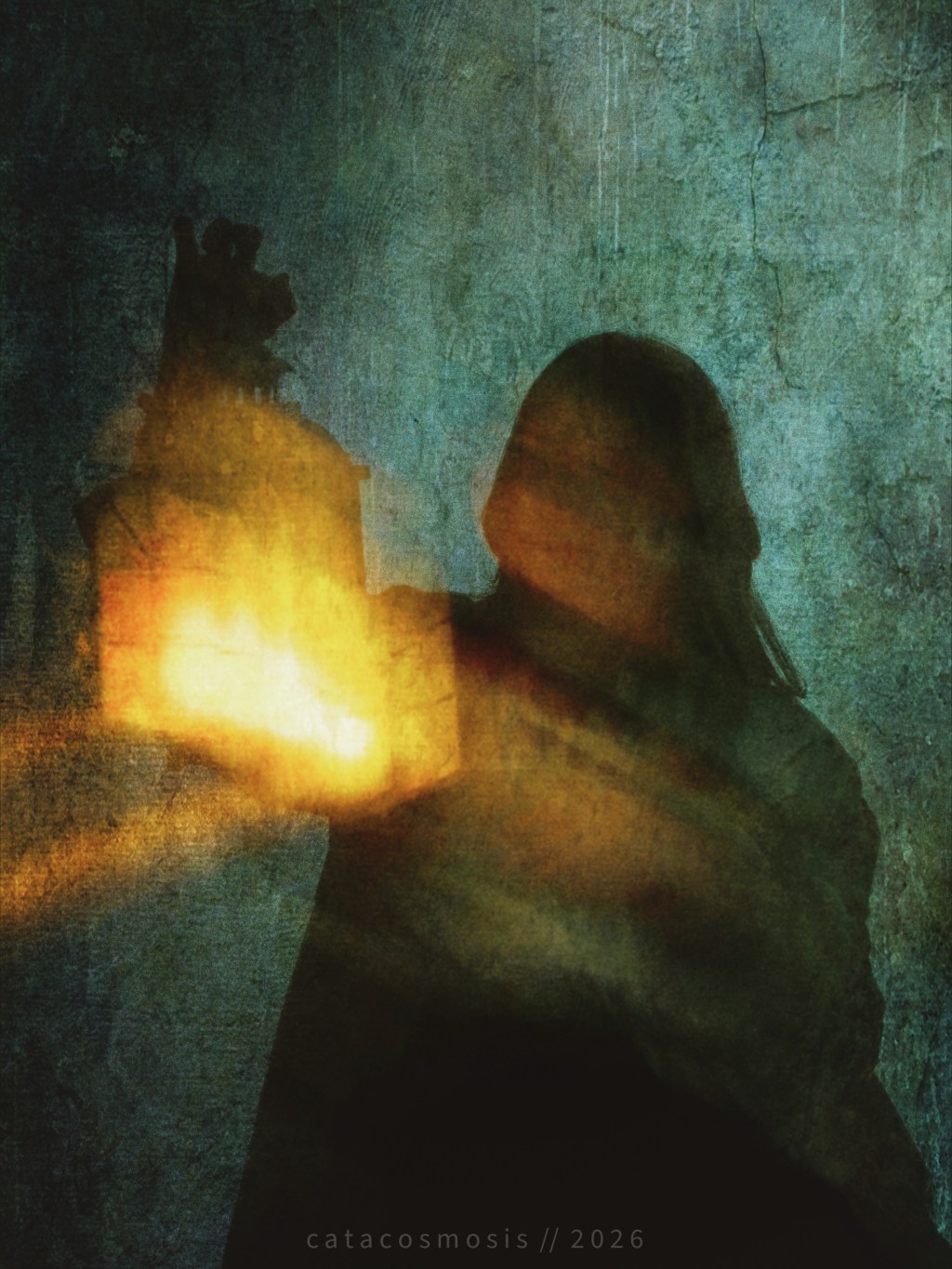
    entry fifteen — scattered light, fractured grace: a quiet archive of light, loss, and what remains.
    iPhone 17 Pro + VSCO (L6 +1) + Lightroom (watermark only).

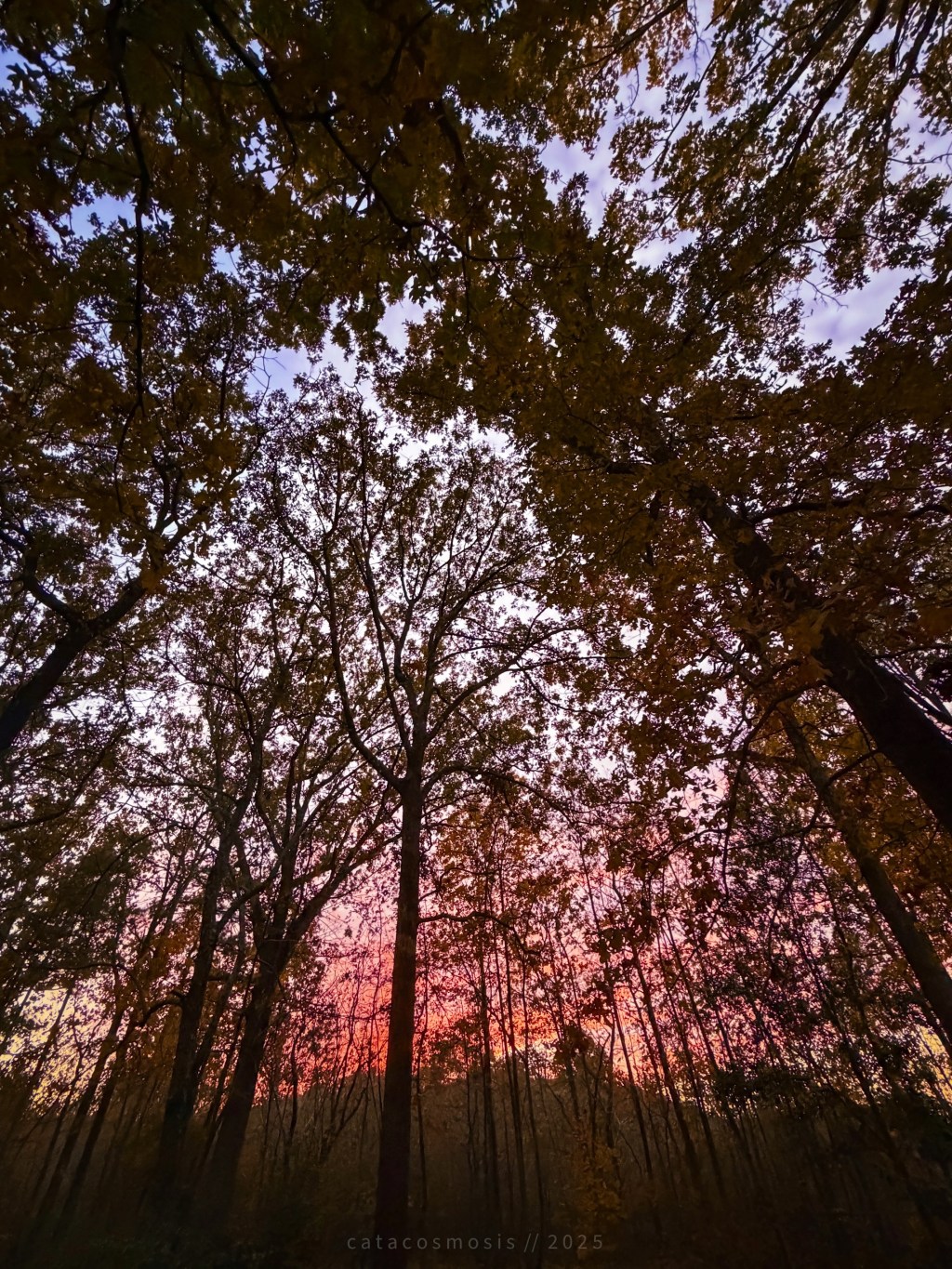
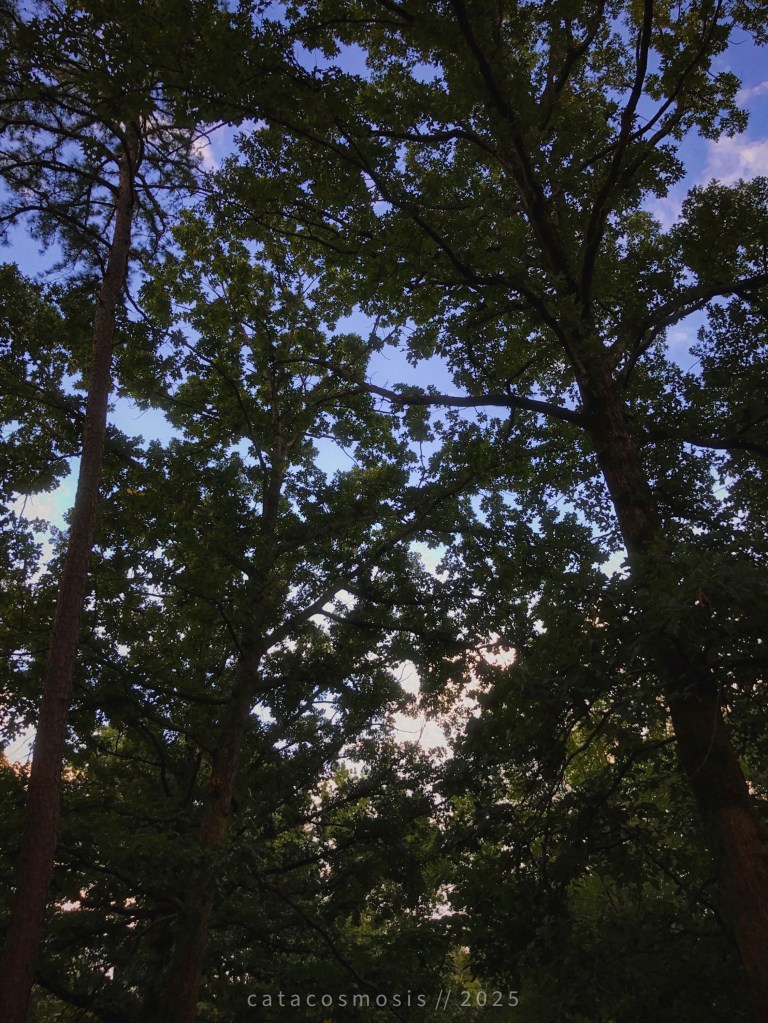
    The sunset this evening caught my eye as I glanced up from the command prompt to rest my eyes.

    “cmd —> DISM /Online /Cleanup-Image /RestoreHealth” be damned, I forgot the problematic machine.

    I gravitated outside as though an unseen force beckoned me… and instead of me capturing a backyard moment, the moment froze me in place and then swallowed me whole.

    It happened quietly, the way revelation always does: when the day was no longer sure of itself.

    The horizon drew one long, trembling breath, and the sky exhaled light like a confession, soft and burning all at once.

    For a few heartbeats, the forest became a cathedral. Oaks turned to stained glass, every vein of every leaf catching the final ember of the sun’s breath.

    The air itself seemed to glow with a kind of surrender, as though heaven was remembering how to let go and reminding me all over again.

    I stood beneath it, small but aware, suspended in that thin seam between the living, the leaving, and the memory of the already gone.

    The colors didn’t ask to stay; they simply poured through the cracks of the canopy and into me, as if to say, “grace doesn’t vanish when the light fades. It only changes hue.”

    When the sky went gray again, it felt less like an ending and more like an exhale finished.

    And life went on…

    catacosmosis // 2025

  • Vesper

    Vesper

    📷 iPhone 7 Plus.
    ⚒️ VSCO (06, +3) + Lightroom (watermark only).
    entry thirteen — scattered light, fractured grace: a quiet archive of light, loss, and what remains.

    There is a moment every single day when golden hour gives way to blue hour. In that moment, the world pauses between heartbeats.

    The warmth of the sun hasn’t fully left, but it’s fading, slipping behind the horizon while the cool hues of twilight begin to take hold. For a few fleeting minutes, everything softens. The light is neither day nor night; it’s an in-between realm where time seems to hold its breath.

    Shadows stretch. The air shifts. The gold turns to amber, then to lavender, then to blue, a slow dissolving of one truth into another. It’s the day’s last whisper and the night’s first sigh, a moment that belongs to no one and everyone at once.

    Most people miss it. But for those who are still and detached from the noise of the world enough to notice, it feels like standing at the seam of two worlds – the visible and the unseen – the known and the infinite, as light gently hands the sky over to darkness.

    If I were still as attached to the idea of controlled outcomes as I used to be, I’d still not know it exists… much less recognize it and be aware enough to take it’s photo as it occurs.

    This is the product – nay, the gift – of mindfulness. 🧘

    Detachment is not that you own nothing.
    Detachment is that nothing owns you.
    —Bhagavad Gita 2.47

    catacosmosis // 2025

  • A Pause…

    A Pause…

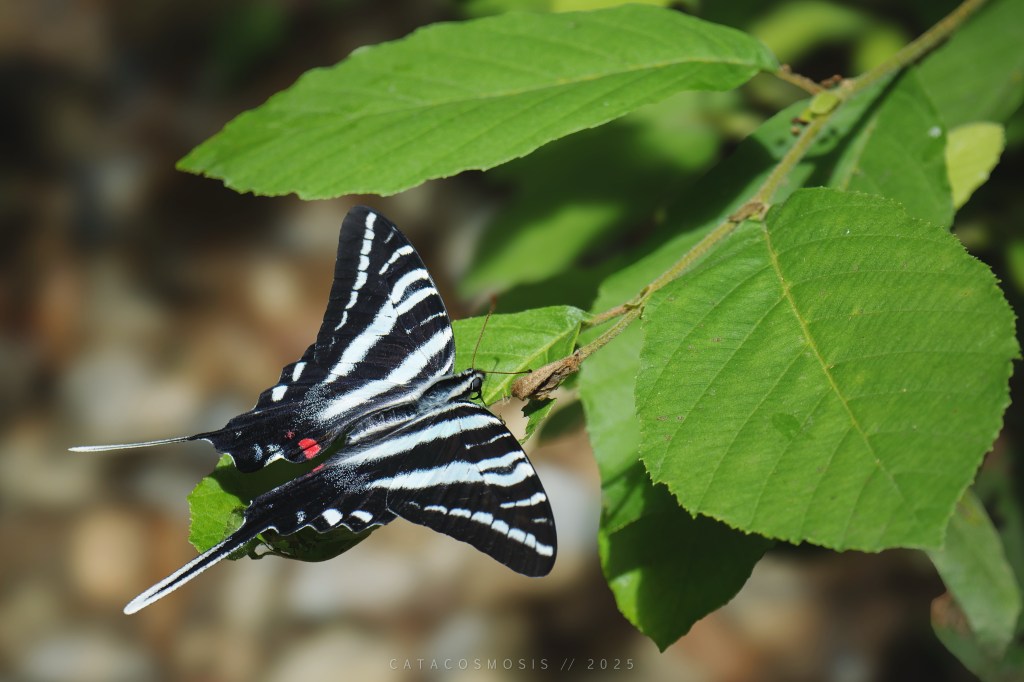
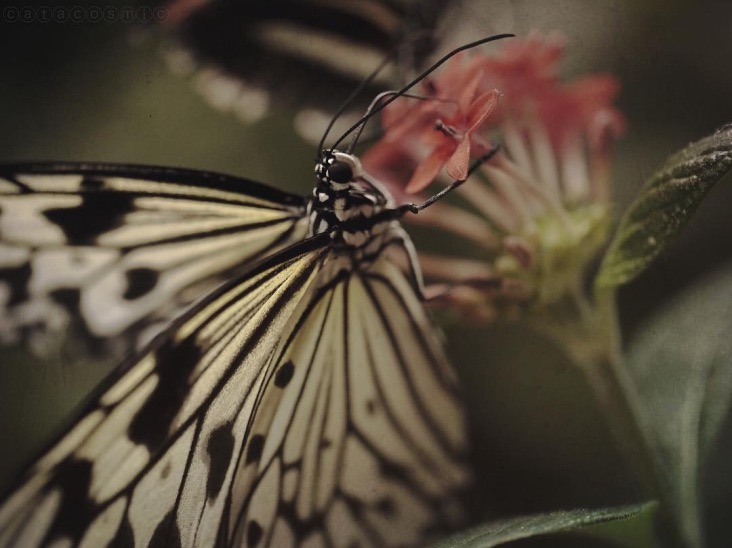
    Yesterday on my hike, I paused for a long while. I gave nearly an hour of stillness and reverence to the nature around me, watching as butterflies moved over water and earth, dancing with the light in a way that spoke of freedom and trust. I sat with it — what felt like hours, though really only about thirty minutes — before stepping back onto the trail, camera in hand. As I rose from the creek to walk on, almost by instinct — more a photographer’s habit than intent — I pressed record.

    Later, on the drive home, I found myself reflecting on that time as I listened to one of my favorite songs — one I’ve leaned on heavily in recent years, especially since the decline and death of the last of my human teachers and spiritual guides: “Oceans (Where Feet May Fail).” The two moments merged together in my heart.

    After Ralph’s death, I finally understood where I should have been leaning all along. He — and my dad — had both tried to guide me toward this truth while alive in human form, but I depended too heavily on them. And if not on my mother in person, then on her prayers. It wasn’t until they were all gone, when I no longer had any “training wheels” to lean on, that it fully clicked at a conscious level:

    I had been depending on God all along, hearing Him, even resisting His direct guidance. I just hadn’t been consciously aware of it. That’s when I realized my faith had never left me — it had only been muted, even scapegoated, by my dependence on the faith others carried.

    It was only when I allowed this song to become a foundational prayer of my heart that His presence became tangible in a way I could no longer deny. The veil fell from my heart and my eyes, and through His grace I saw with a clarity I had once resisted — the kind of knowing that hurts, yet somehow makes the truth easier to embrace.

    The lyrics of this song speak of stepping out into places where our own strength isn’t enough, and trusting God to steady us anyway. That truth became real to me after Ralph died — especially about a year later, when I found myself in a moment of decision: to choose what I merely wanted to believe, or to stand in what I knew was real.

    I understood the magnitude of that choice. I knew it would break my human heart, and I knew it might stir misunderstanding, anger, and hurt in those around me. It was the hardest place I had ever stood. But I also knew it was time. Time to trust Him not only with my conscious mind, but with my open soul — my entire being. Time to leap.

    So I did. I quietly — nay, silently — forgave all that needed forgiveness, and I let go of everything: past, present, and future… even the things I still and always will love, but that I knew could never take root in this life. For just over a year, all that mattered outside of physical survival — food, shelter — and caring for my son was solitude in His presence.

    I chose God. I surrendered everything. And in that surrender, I rebuilt and reinforced boundaries — not only to protect what was holy from the evils that I knew would seek destroy it, but also to shield those who weren’t ready to walk the path of full and true surrender from the consequences of my choice to do so.

    Almost immediately, things began to unfold around me — things I had long since lost hope for, or had no idea how to overcome or achieve, in my life. None of it happened exactly as I would have liked, nor in the timing I would have chosen, and almost nothing came about in the way I would have planned or orchestrated it. But that was the entire point of surrender.

    And in that realization, I understood something deeper: I had spent years trying to explain surrender to others with words, but the example — living it out, letting God’s hand write the story — was far more important, and a far more powerful testimony for Him.

    Butterflies have always been a reminder to me of my grandmother, and of the simplest analogies of metamorphosis and transformation. But now? What I see most prominently in their flight is this — so fragile, yet so fearless in the air:

    They carry the story of loss and love, of veils lifted and prayers surrendered — of a journey where survival gives way to presence, and presence gives way to peace. And for all of us, just like these butterflies, it is only through full surrender to the grace and truth of something higher than ourselves that we can be — and will be — fully loved, fully supported, and able to flourish.

    Here, I’ve paired them with the piano playing of the song and these reflections as a reminder to myself, and to anyone who reads this, that even when we feel small, it is faith that keeps us aloft. I share this in hope that it might offer whoever sees it a nudge of encouragement as we continue the journey God has given us — the one He has called us to submit to and surrender.

    After decades of seeking, struggling, and trying to show and teach others (while really teaching myself), here’s what I know:

    If we ever want to find purposeful growth or true peace, we must fully surrender to the creator and orchestrator of it all — to His will, not our own.

    xo,

    c.

    🦋💜🕊️

    You call me out upon the waters…
    The great unknown, where feet may fail.
    And there I find You in the mystery.
    in oceans deep my faith will stand.

    And I will call upon Your Name,
    and keep my eyes above the waves.
    When oceans rise,
    my soul will rest in Your embrace…
    for I am Yours, and You are mine.

    Your grace abounds in deepest waters.
    Your sovereign hand will be my guide.
    Where feet may fail and fear surrounds me,
    you’ve never failed, and You won’t start now.

    So I will call upon Your Name,
    and keep my eyes above the waves.
    When oceans rise,
    my soul will rest in Your embrace.
    For I am Yours, and You are mine…

    Spirit lead me where my trust is without borders.
    Let me walk upon the waters,
    wherever You would call me.
    Take me deeper than my feet could ever wander,
    and my faith will be made stronger
    in the presence of my Savior.


    Oceans (Where Feet May Fail), written by Joel Houston / Matt Crocker / Salomon Lighthelm.
  • I died, and it… was okay. | Notes from the Other Side

    I died, and it… was okay. | Notes from the Other Side

    The First Illusion

    How can an illusion free an illusion?

    It can’t.

    Impossible.

    And yet, freedom itself is not impossible.

    But what we often mistake for freedom is only substitution. We trade one mask for another, one prison for another, one dream for another.

    Replacing one illusion with another does not set us free. It does not bring liberation. It simply shifts us deeper into what I sometimes call non-happening happening — the endless cycle of movement that looks like change but never truly is.

    So where, then, is freedom?

    Maybe it’s in understanding that simple truth.

    Maybe it’s in seeing clearly that nothing we have called “freedom” has ever been real freedom at all.

    Maybe that was the point, all along.

    Is that awakening?

    Awakening as Death

    Awakening is the death of the familiar.

    Because what is “familiar” to us — what we call “our life,” “our personality,” “our world” — is illusion.

    Nothing we are familiar with is actually real. None of it is actually us.

    We are not real. We are not what we think — what we are told — we are. And yet, here we are.

    So when awakening comes, it feels like death. Because it is death — the falling away of everything we thought was “me.”

    And without that death, there is no birth of what was real all along.

    Meaning Before and After

    Before awakening, there is no meaning of our own.

    The only meaning available to us is what others have told us is meaningful. Parents, teachers, religions, governments, lovers, friends, enemies, cultures, systems — all of them have fed us their meanings.

    And we absorbed them as if they were truth.

    We were conditioned to believe meaning is handed down, not discovered.

    We were punished for expressing anything antithetical.

    Yes, that is a word. I did not make it up. I checked, as always, when I returned from the other side.

    I digress.

    Even when we think we are thinking for ourselves — are we? Have we ever? Do we even know how?

    This is the prison of the familiar.

    But those of us who have never been able to simply swallow it — those of us who have spent our lives being told we are crazy, too deep, over-analytical, antithetical — maybe we’ve always been a little closer to freedom.

    Because we have always been with ourselves. We have always lived in the company of our own questioning. Our own introspection.

    And that has saved us.

    Moving Through Darkness into Light

    My entire life has been this movement — through darkness into light.

    And then again. And again.

    I never stayed still in a 3D thought long enough to let ideology calcify around me. Never settled enough into the world’s definitions of reality to say: “Yes, this is it. This is reality. This is me. This is final.”

    No.

    I couldn’t.

    Always, incessantly, I questioned. I sought. I chased myself. I chased I am.

    Because each time I reached for that exactness, that rigidity, something in me would die. And something deeper would awaken.

    So instead, I’ve kept moving. Through darkness, into light.

    Through lies, into truth.

    Through death, into life.

    Over and over again.

    And each time, what I found was not more of “me,” but less.

    Until I began to understand that the “me” I thought was the center of the story was never the point at all.

    And then, I actually… died.

    And then, I came back!

    What?

    I know. That’s what I said, too.

    And that is when the fullness of both illusion and irrelevance were clear to me, and the illusion and irrelevance… both shattered.

    Freedom.

    The Irrelevance of “Me”

    “Me” is irrelevant.

    Yet somehow, everything has always been about me.

    That’s the paradox.

    The small “me” — the conditioned self, the mask, the name, the history — means nothing. It is dust. Illusion. A temporary construction.

    But the deeper “I” — the one who moves through the dying and the awakening, the one who is aware of even that dust falling away — that “I” has always been the ground of everything.

    So in a sense, “me” does not exist.

    And in another sense, “me” is all that has ever existed.

    It was always… the I Am.

    The Misunderstanding

    This will be misunderstood.

    Mostly by anyone and everyone who reads it.

    If they even make it past the first few lines.

    Because illusion defends itself. It doesn’t like being called what it is.

    But misunderstanding doesn’t matter.

    Life takes care of itself.

    Life Happens

    Even when you are not there to see it, life still happens.

    Everything still unfolds — rivers flow, winds move, earth shifts.

    Even if you choose inaction — even if you refuse to eat, drink, or sleep — things still happen. The body dies, yes, but death itself is a happening.

    Because everything is always happening. Always in motion.

    Even in stillness, there is happening.

    And everything that happens has a result. Even nothingness produces consequence.

    Life is self-correcting. Even ungrounded, it finds its own balance.

    Sometimes that balance looks toxic. Sometimes it looks destructive. But it is always balance. Always motion. Always happening.

    Death Must Occur

    Death, then, is necessary.

    Not the physical death we fear — not suicide, not the cutting short of the body’s days.

    Though that death is really not all that bad, in my experience.

    The dying part itself is no fun.

    The death?

    Too many words — words are funny for this one; there is not a word, other than death.

    It is nothing, and everything.

    Alpha, omega.

    I am.

    Here? What must die is the illusory self.

    The self we defend, cling to, and worship without even knowing it. The self we call “me.”

    That death is the doorway.

    The Last Illusion

    And yet, even here, there is a final paradox:

    If the self is illusion, then death is illusion too.

    Which means — death cannot free us either.

    Because an illusion cannot free an illusion.

    I do not fear.

    Why is none of this terrifying to me?

    Maybe because fear only exists where there is something to lose. And what I am losing was never real in the first place.

    Maybe because I have already died a thousand small deaths, the fear has already been burnt out of me.

    Maybe because I saw it:

    That what I am cannot die.

    And maybe that — quiet, simple, unshaken — is what freedom has always been.

    xo,

    c.

  • A Message for So-Called “Artists”

    A Message for So-Called “Artists”

    “So you think you’re an artist, but you haven’t been to art school?”

    Well, then yes. You are.

    That’s exactly the right mindset — especially if you’re building skill and intuition at the same time.

    I say this both as a person with a Master’s in Arts (which I mention only to say, “I’ve been through your system, I know how it works, and I still reject the gatekeeping!”), and as an absolutely NON-PROFESSIONAL, non-conforming artist who also rarely shares any of their actual work:

    You’re not just “playing artist,” and being recognized as one is not the point. Those people trying to convince you of anything otherwise are wrong.

    Whatever you’re creating is absolutely valid.

    Don’t let anyone — especially those offering discouraging, destructive feedback rather than genuine critique — convince you otherwise. Just because some believe the creative or applied arts diploma they hold in one hand somehow validates the brush or pencil they hold in their other, along with the harsh judgments and negative opinions they’re vomiting all over you, doesn’t make it the truth.

    Regardless of who you are or where and how you learn, when you approach art as both a learning experience and an emotionally expressive therapy, you’re doing it right — not failing. You’re not just slopping paint on paper, scribbling in a sketchbook, or gluing down collage scraps at random.

    The difference is night and day — especially with watercolor (the medium I see people abandon most) — when you’re doing things like:

    • Consciously learning the muscle memory for how each brush moves.

    • Recognizing how the spring, belly, and tip affect water control.

    • Having fewer “happy accidents” and more intentional effects

    Painting is not just the act of moving pigment across a surface. It is the deliberate conversation between your hand, your tools, and your vision. It’s problem-solving in real time, learning how water, pigment, and paper (or canvas) respond to each other, and adjusting with both skill and instinct.

    It’s as much about restraint as it is about expression, and as much about observation as creation. When you understand that, every stroke becomes intentional, even in your loosest, most playful work.

    Watercolor especially rewards this kind of discipline because it’s less forgiving than acrylic or oil. You can’t just pile on more paint to hide a mistake — in a way, you have to work in reverse.

    No medium, but especially watercolor, is as easy as “the professionals” make it look. But if you keep going, keep learning, and keep focusing on technique and purpose — no matter what the art-school elite try to tell you — the control you gain over water, pigment, and paper will make even your loose, expressive or abstract work stronger. It will be loose or abstract by choice, not necessity.

    That deep dive into technique is probably why so many of you express so often how your art process is helping you mentally and emotionally, and why many artists pick up a pen, pencil, or brush in the first place. It’s meditative — but also empowering — to know exactly what your tools can do.

    So keep learning. Keep practicing. Keep playing! Keep a balance between the fun and the serious aspects. Sure, we all appreciate skill and technique. But what is the point if it’s just a job and not a fun expressive process with purpose?

    Nobody owns art as a process — and if anyone tries to tell you otherwise, they’re not talking about art. It’s still a free world, regardless of how it may seem on the surface and no matter what the uppity, judgmental types try to say.

    Keep making art. Because your kind of art — the kind that comes from soul combined with technique rather than straight line, hard rules — is what art should still be all about.

    xo,

    c.

    💜🦋

  • The Line Is Always Open

    The Line Is Always Open

    A while ago, God asked me to step away from the noise. The purpose was not just to “rest,” but to enter true solitude. It wasn’t the kind of solitude that simply quiets the mind; it was the kind that strips away the need to convince, the compulsion to rescue, and the reflex to correct every error you see in the world.

    When you live in that stillness long enough, especially when you begin to examine how deeply and how long you have been misunderstood in your own life, you finally grasp why no one was truly listening. You begin to understand:

    The time for saving people by warning them and trying to teach them by telling them, begging them, or reasoning with them has passed. Just like with a child, there comes a time when you have to let them just keep screwing up until they learn. Experience is the only teacher that can accomplish anything fruitful.

    At some point, you realize your job is and always has been to just be the example and let them hate you or blame you if they wish. The time now, and the purpose, is to show up anchored in truth, walking forward for the sake of those who are searching.

    It is time to lead without any guarantee of who will follow, even if the path takes you to meet God alone. In the end, it all comes down to free will — and on the day you stand before Him, the only life and soul you will ultimately give account for is your own.

    There is no bureaucracy at the Pearly Gates, no worldly process to pass through. Character witnesses don’t exist there. Your actions, your choices, and the truth of your heart and relationship with Source will speak for themselves to the one and only true Judge, whose authority is absolute and divine.

    After months of this solitude, returning to public spaces feels different. The peace you find in solitude makes the digital clamor almost unbearable. You realize most people are not listening, not because they can’t, but because they don’t want to. They’ve been taught to fear the very silence that would heal them.

    Still, there are always a few — maybe only two or three in a sea of millions — who are listening for a different kind of voice. And for them, we show up.

    As I dipped a toe back into social media in recent weeks, I saw exactly why Source had been directing me as it had. Then, this morning, I saw a post on Instagram that reminded me exactly why I hesitate to return.

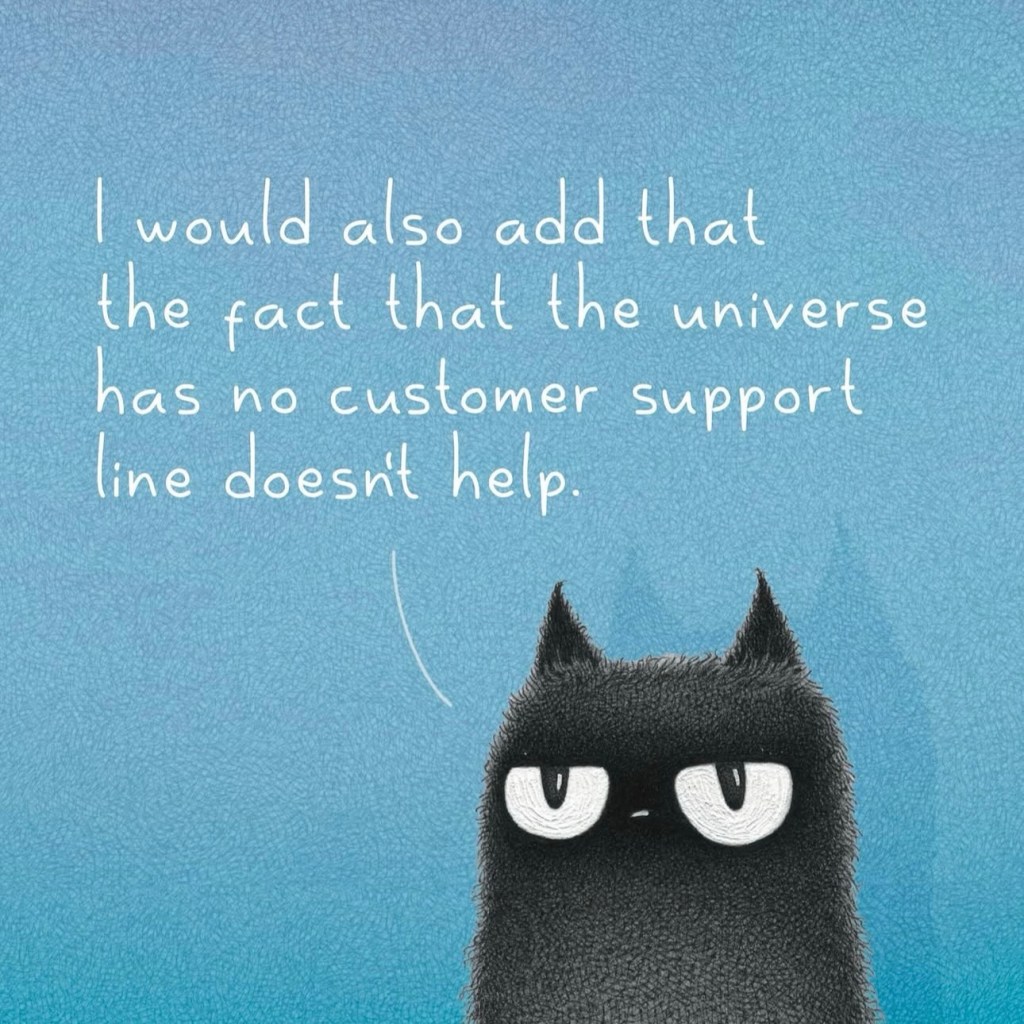
    It was a meme “conversation” between two cats:

    Cat 1: I don’t know who I am anymore.

    Cat 2: That’s okay, everybody feels that way sometimes — the universe doesn’t have a support line or customer service to tell you how to fix the problem.

    It’s clever on the surface, but the truth is: this is false.

    Yes, everyone struggles with knowing who they are from time to time — that’s life. But somewhere along the way, society began labeling that struggle as illness, defining solitude as unhealthy withdrawal (thereby denying people access to the solution), and filtering human experience through a narrow definition of “normal” set by a handful of powerful voices.

    And the part about the universe not having a “support line”? That’s the deepest untruth of all.

    The universe — God’s creation, and the divine voice within it — is always speaking. The language is there for anyone willing to learn it. The signs are constant. I know this because I have been hated for decades for striving to be a translator.

    The problem is not absence; it is illiteracy. Most people are not listening, or even looking, because they’ve been conditioned to tune in to the wrong frequency.

    Depression is not always depression, but many times (and this was my experience) the immediate response to anything that feels unpleasant is to label it as depression and drug people to Timbuktu and back again. Honestly? That is the reason many people can’t hear and don’t care to try. Not all — but so many.

    Lost is not always lost. Not every ache in the soul is a disorder to be medicated or pathologized. Sometimes it is simply disconnection from self and Source. The remedy is stillness, quiet, and the willingness to listen, and to then face and accept the truth — the very things people are told are “unhealthy” or “unproductive.”

    Society has been trained to fear solitude and invisibility, to measure our worth in noise and visibility. And then, when society meets those who have rejected that conditioning — who have done the work through blood, sweat, and tears — it labels them as “too deep,” “too intense,” or “problematic.” Society dismisses them because the truth they carry is rarely the easy answer the world wanted to hear.

    It’s willful ignorance, fed and nurtured by systems that benefit from a distracted, disconnected people.

    Those same systems encourage shallow comforts and praise the very mechanisms keeping us miserable. And when you break free, find balance, and refuse to play the game, you’re labeled extreme or hateful — when in reality, you are simply walking in the narrow space between reality and insanity.

    This was on my mind when I saw another post, one about the pressure of social media as an artist versus as a human being.

    My response was simple:

    I used to approach social media in the same way — letting the noise, the opinions, and the unspoken “rules” decide how and when I would show up. I carried the weight of strangers’ expectations until it felt heavy enough to crush my own reasons for creating.

    And then I realized: the ones who made me feel small were not here for the same reasons I was. They were chasing validation, purpose, or attention they didn’t already have. I already had those things. I was meeting my own goals, my own standards. When I stopped caring if they “got it,” the pressure disappeared.

    It is the same in life beyond the screen. Too many people are chasing money, status, and recognition, and too few are working from genuine passion or purpose. The work done from love will feed you. The work done to please others will drain you.

    That’s why these two posts — one about “not knowing who you are” and one about the pressure of showing up as an artist — are really about the same thing.

    The sickness of our time is not that we feel lost or uncertain; it’s that we’ve lost the ability, and in some cases the willingness, to listen to the truth that’s already speaking.

    If you can hear it, you don’t need a “support line” from the universe — you’re already, and infinitely, connected to it. If you can’t hear it, no human voice will convince you until you quiet the noise long enough to try.

    So for me? I keep showing up as I feel led to, as I hear God guiding me to. I keep sharing my experiences, through my photography, my art, and my voice, softly and quietly in shared expressions meant to be examples, not to convince the unwilling, but for the few who are listening and searching for a different kind of voice.

  • Wilderness

    Wilderness

    Lumix GX7, Panasonic Lumix 100-300mm Tele-Lens. Handheld. Lightroom (watermark and contrast).

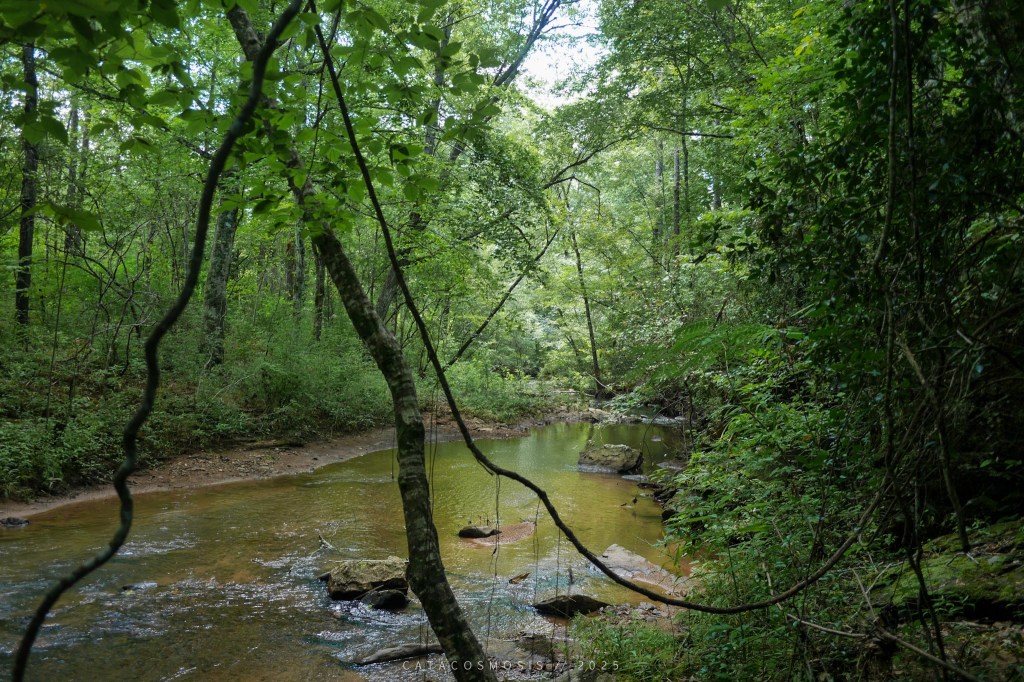
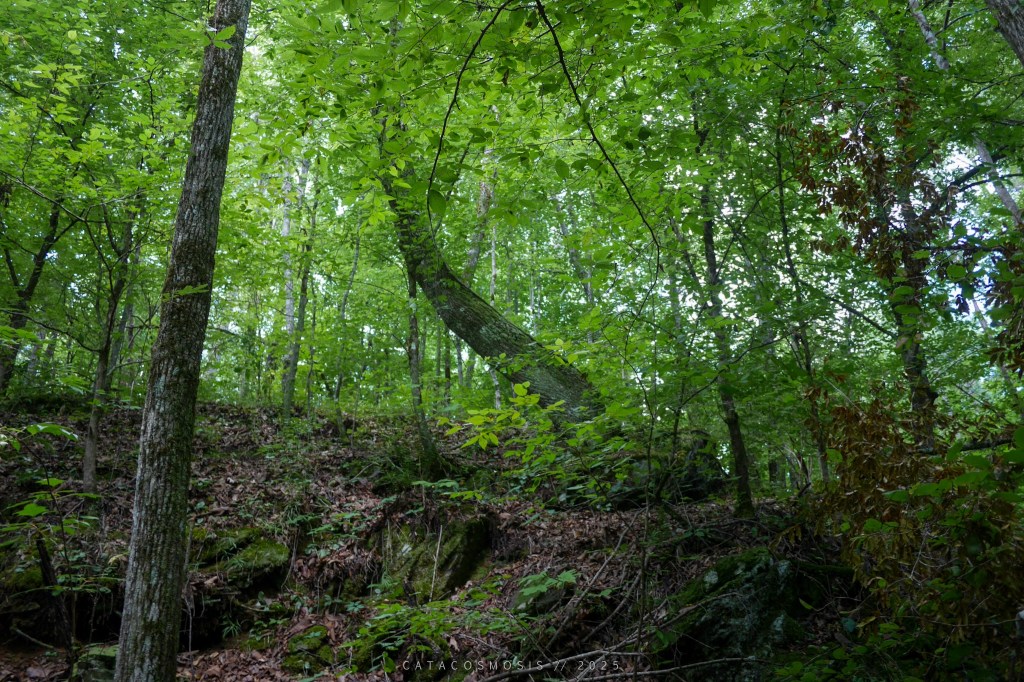
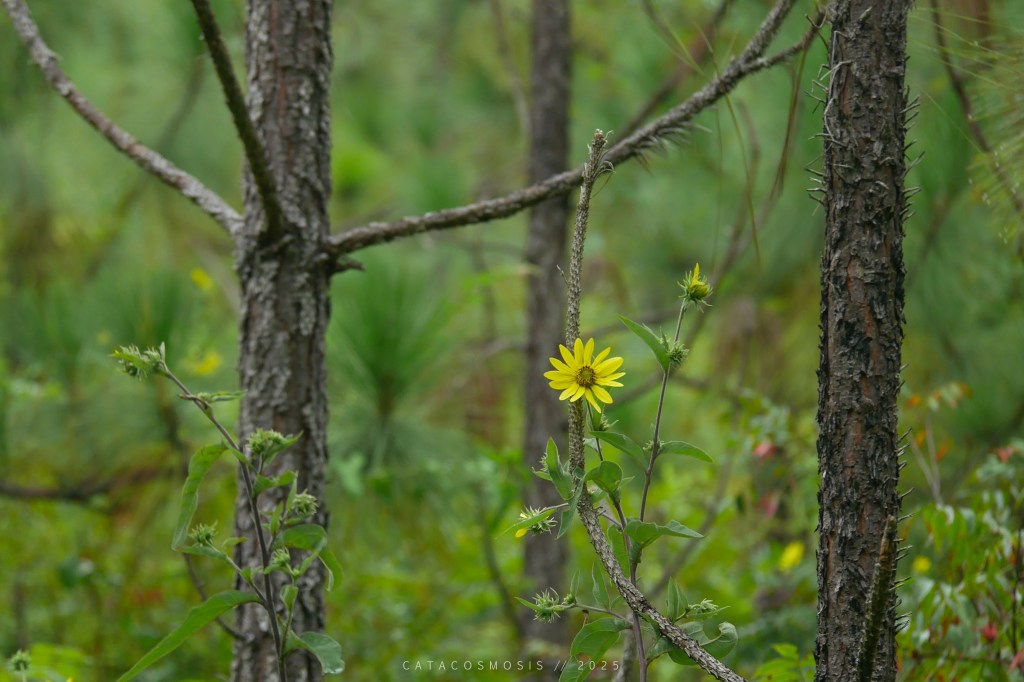
    The wilderness is the oldest, truest friend a human can have, both in body and in spirit.

    Lumix GX7, Panasonic Lumix 100-300mm Tele-Lens. Handheld. Lightroom (watermark and contrast).

    It teaches in silence.

    Lumix GX7, Panasonic Lumix 100-300mm Tele-Lens. Handheld. Lightroom (watermark and contrast).

    It speaks without words.

    Lumix GX7, Panasonic Lumix 100-300mm Tele-Lens. Handheld. Lightroom (watermark and contrast).

    It holds space for your becoming, your undoing, your return.

    Lumix GX7, Panasonic Lumix 100-300mm Tele-Lens. Handheld. Lightroom (watermark and contrast).

    And it is only “dangerous” when we forget to honor it, or refuse to learn from and respect it.

  • Focal Point

    Focal Point

    It’s as important as perspective. Perhaps even more so…

    We talk so much about perspective—about changing our view, reframing the story, finding the silver lining in the storm cloud.

    But sometimes, perspective doesn’t shift easily.

    Sometimes, circumstance leaves you standing exactly where you’ve always stood. The view is the same. The light hits the same edges. The shadows fall in familiar places.

    But even when the scene remains unchanged…the focal point doesn’t have to.

    Focus is a choice.

    A sacred, stubborn one.

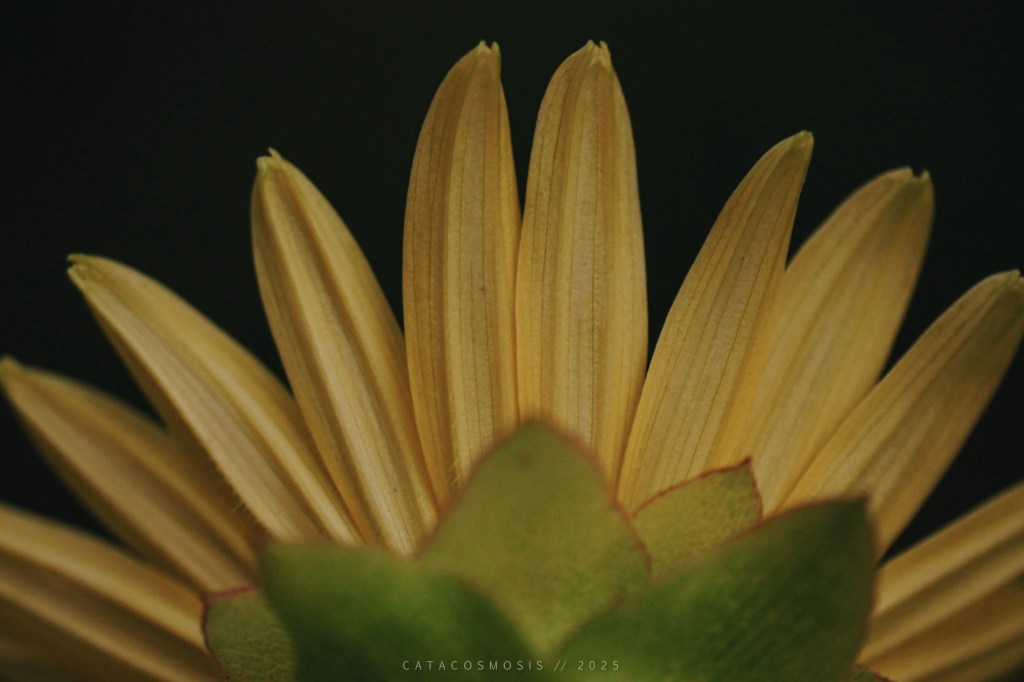
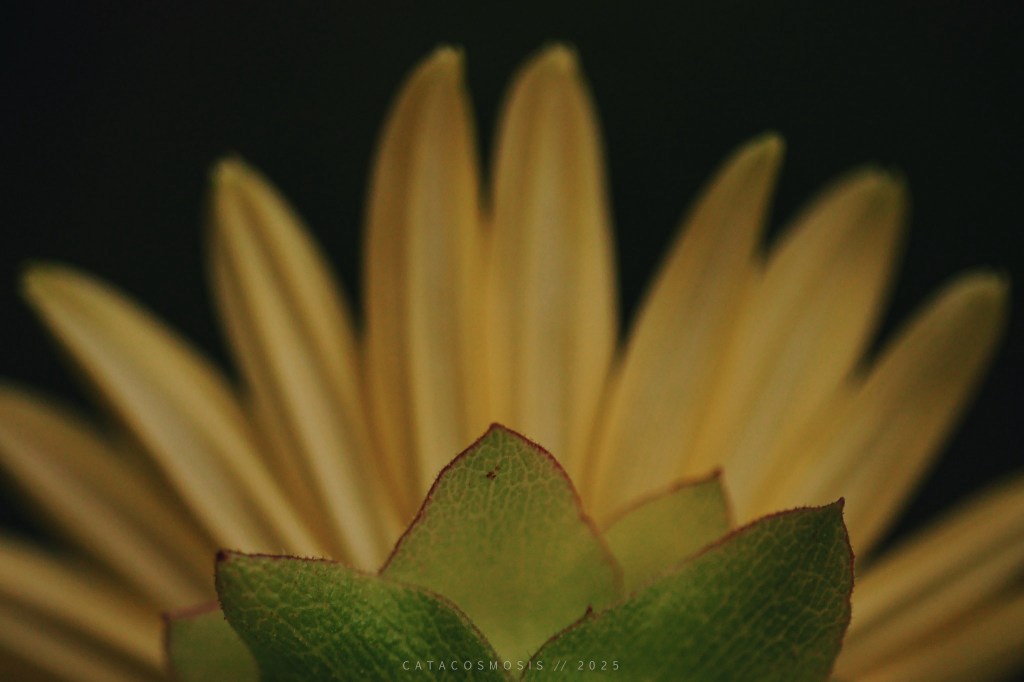
    It’s the difference between staring at the problem and noticing the petal behind it.

    It’s where your attention lands, and where your energy follows.

    It’s learning to zoom in on grace even when grief is still in the frame.

    In these frames, nothing moved.

    Not the flower. Not the light. Not the angle.

    Only the focal point changed.

    And with that subtle shift, a new vision — a new truth— came forward.

    Almost always—including in life, and despite circumstance—the best composition doesn’t come from changing the scene but from learning which part of it to focus on.

    catacosmosis // 2025

  • Lifted

    Lifted

    entry twelve — scattered light, fractured grace: a quiet archive of light, loss, and what remains.
    Lumix GX-7 + Panasonic-Leica DG Macro Elmarit 45mm f/2.8 ASPH. VSCO (A6 PRO) + DistressedFX + Lightroom (watermark only).

    There is a moment, early in a few blessed summer evenings, when the heat—the oppression—sighs and lets go.

    Not in protest, but in quiet surrender—the sun lingers, the sky softens, and a hush moves in with the rain.

    Steam rises like incense from the bones of the earth.

    You’ve felt that coveted shift.

    It’s not loud. Not showy. Just the heaviness loosening its grip on your ribs as breath returns without warning.

    This is how some battles end—

    Not with victory, but with survival.

    Not with a roar, but with a breeze.

    No fanfare—just rain through fractured light, and the ache leaving your body before you even know it’s gone.

    What remains?

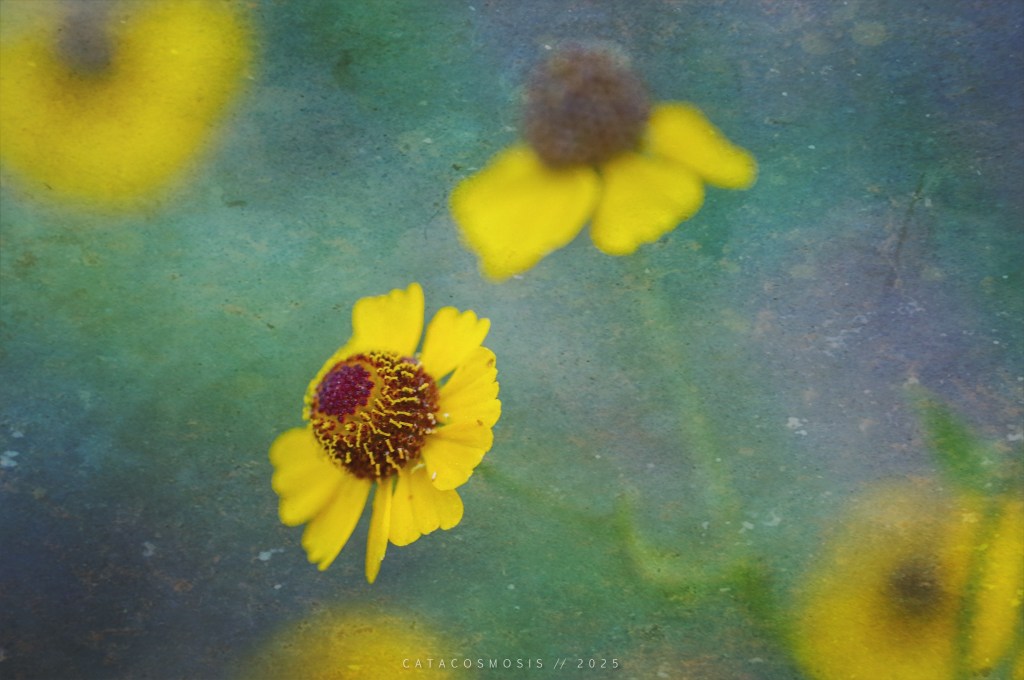
    A field of yellow flowers—bent but blooming.

    Tired, but free.

    And air that smells like something holy—finally lifted.

    catacosmosis // 2025

  • Where Abundance Lives

    Where Abundance Lives

    It’s never been money or material success that has defined wealth for me.

    For most of my life, I chased meaning in moments loud enough to echo—grand gestures, perfect timing, outcomes wrapped in validation. But it was my most treacherous and grueling experiences—the ones that stripped me bare and rebuilt me from the soul up—that taught me something higher.

    They taught me to be still.

    To be quiet.

    To kneel at the altar of the subtle.

    A blurry cloud, simultaneously barely and boldly defining its own form, illuminated at just the right angle.

    Lumix GX7 + Lightroom (watermark only)

    A battered feather, found in the dead center of a forgotten dirt road, caught in evening light.

    Lumix GX7 + Lightroom (watermark only)

    The soft hush of trees at dusk, whispering the memories of the ghosts that still roam underneath them.

    Lumix GX7 + Lightroom (watermark only)

    This is abundance.

    There’s something sacred about catching these quiet offerings—the ones that ask for nothing but your presence. No performance. No hustle. Just your full attention. And I think that’s what I’ve been learning to fully morph into, slowly but surely, all my life.

    I’ve always been in love with nature, and over the past few years, I’ve begun to understand why—consciously, spiritually, viscerally:

    Nature doesn’t demand applause, but it offers everything to those who notice.

    Before caregiving and grief, nature called to me—quietly, consistently—and I always accepted her invitation to explore and to wonder. During caregiving, she became an escape. I retreated there as often as possible, weary and begging for rest that not even sleep could offer…and nature always obliged.

    Now? I don’t go to escape or to retreat, I don’t just visit. Nature meets me. Whether I’m deep in the woods or walking my yard…hiking a trail or running my neighborhood…now, I am always home.

    We live in a world trained to skim, to scroll, to monetize every breath of stillness. But this—this sky, this feather, this light that passes and never repeats—reminds me:

    Presence is the prize.

    It’s all around us, all the time, no matter where we are…but people don’t see it anymore. They no longer observe. Most have forgotten—that observation is a form of reverence. And reverence, when practiced daily, becomes a kind of homecoming.

    “Abundance is not found in money and material gain—at least, not for me. To me, it is found in nature’s unexpected surprises.”

    I wrote that in my memory while standing beneath the canopy of trees shared above as it held the last light of evening. There was no one else there. No applause. Just me, and the divine choreography of stillness.

    In that moment, nature herself invited me to remind you:

    If you’re searching for proof that you’re loved, that you belong, that there’s meaning woven through even the hardest days—

    Look up.

    Look closer.

    Be still.

    The abundance you’re looking for is already here.

    It’s been waiting for your eyes—and your heart— to land on it.

    Be present.

    Pay attention.

    Be observant.

    Your presence in the present matters.

    It’s where abundance lives.

    🪶💜✨

    catacosmosis // 2025