Tag: grief

  • The Midnight Hour

    The Midnight Hour

    Tonight I wrote a prose/journal piece for AllPoetry.com, and I couldn’t help sharing it here. Some pieces are just… well, you want to save them in your little treasure shoebox. I suppose, in many ways, that’s what this space has become for me. My treasure shoebox, like the ones we had when we were kids. And that’s where this post begins, so that’s a more fitting analogy than it may seem.

    I’ve been writing a lot of poetry again lately. I don’t know what brought that back into such an intense level of focus; nothing in particular, except maybe the health and heart scares of late. Moments like that at any age tend to send us on a reminiscent journey, don’t they… those introspective moments in life where everything matters, and we simultaneously realize that very little of what we have for years focused on or worried about actually does. It’s distinguishing what does, I suppose, that brought the poetry back to life. The poetry, as much as the prose, has always mattered deeply to me.


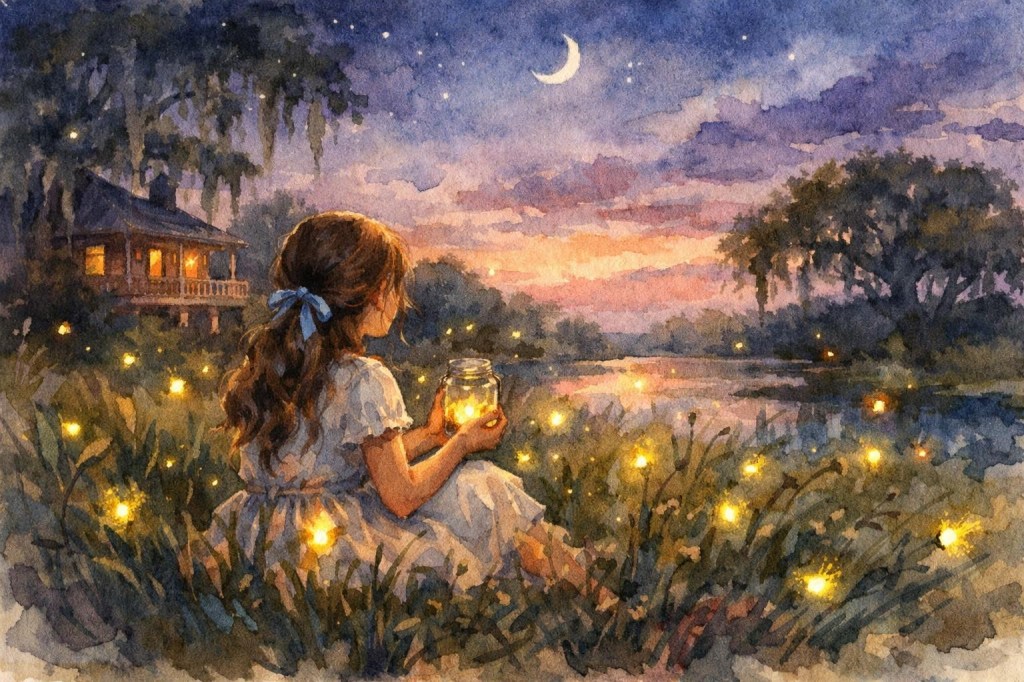
    There is something about a Southern summer night that gets into you young. The air sits heavy and close, warm even after the sun goes down, and the woods at the edge of the yard breathe with it. I was a child who noticed things — the way light changed before a storm, the sound leaves made when no wind had been announced. And, in those summers, every evening brought the fireflies.

    They came at dusk. First one or two like punctuation, then more, and then all at once they were everywhere, blinking out of the dark in their hundreds, their thousands. Legion, though I did not think of it that way then. That word belonged to something else entirely. It had been pressed into me through scripture and sermon as a name for the unclean, for the swarming darkness that could take up residence in a person and multiply. Legion, said the demon, for we are many.

    So the fireflies blinked their quiet light, and somewhere underneath the beauty was a word I had been given to be afraid of.

    Then I found Alan Watts. Or, rather, was introduced…

    I was twenty-three, in graduate school, teaching computer classes at a community college for a department head called Ralph who had bent the rules a little to bring me in. He had seen something in me before I had fully seen it in myself. That is the particular gift of certain people; they hold the mirror at just the right angle.

    One day he handed me a book. Alan Watts. “The Book: On the Taboo Against Knowing Who You Are.” He did not make a ceremony of it. He gave it the way people give things when they know exactly what they are doing — quietly, like it was obvious.

    It was not obvious to me yet. But I took it home, and I read it. I had to read it multiple times to finally grasp the method to Watts’ madness, and by the third time something that had been holding its breath inside me for twenty-three years slowly let it out.

    Watts did not ask me to abandon what I believed. He asked me to look at it more honestly. To ask who had handed me my fear alongside my faith, and whether those two things were always meant to arrive together. He wrote about the universe not as a collection of separate objects but as one enormous, continuous flowering, and he moved between the language of science and the language of spirit without apology or explanation.

    And I thought of the fireflies.

    Legion, but not demons. Never demons. Just light, doing what light does in the dark.

    Ralph is gone now, and in a strange twist of fate, or perhaps the perfect design of it, it was our home in which he hospiced and passed on. But that book remains, and so does everything it opened.

    I had known much of Watts’ philosophy before I knew Watts, subconsciously, without knowing I knew anything at all… in the wordless way children know things before language has a chance to organize them into beliefs.

    There were nights, and to child-me they all feel like midnight, the grown world asleep and the dark belonging entirely to you, when I would slip outside and sit in the yard while the fireflies did their quiet work around me. I did not have a name for what I was doing. I only knew that something in me needed the dark and the stillness and the small lights blinking in and out like thoughts I hadn’t found words for yet.

    Sometimes I brought a notebook. Sometimes I just sat and let whatever was moving in me move, uninterrupted. The night felt alive in a way the daytime didn’t. More honest, somehow. Less performed. In the day you were somebody’s daughter, somebody’s student, somebody being watched and measured. In the dark you were just yourself, with the fireflies and the heavy Southern air and whatever God was doing in the quiet.

    I did not know then that I was doing what writers do. I only knew it felt necessary.

    Watts wrote often about the muse, about inspiration not as something you summon but as something that arrives when you stop trying to control the room. The midnight hour, literal or felt, is when the ego gets tired and steps aside. And in that stepping aside, something true gets through.

    Tonight as I write this, it is close to midnight. Not child-midnight, not the felt sense of it, but the real thing, with the clock to prove it. I am not outside. I am in my bed, with my laptop, no fireflies in sight. The dark beyond the window is just dark. But something in me is exactly where it was in that Alabama yard decades ago, sitting with what needed to come through, waiting without quite waiting.

    Earlier tonight I was tired and closing down, the way you get when the world has been louder than usual and something in you needs quiet it cannot seem to find. I was ready to disappear into sleep. And then something arrived. It always arrives this way, not when I go looking for it but when I have exhausted myself enough to stop.

    A poem I had written about Alan Watts. A fellow poet’s encouragement to go deeper. A thread pulling me back to those childhood summers, to Ralph, to The Book, to the child in the yard who already knew.

    Watts would not be surprised. He might laugh a little, warmly, in that way he had. He would say the muse was never yours to command, only to receive. That the midnight hour is generous precisely because you have stopped performing for the daylight.

    Ralph knew this too. He saw it in me before I could name it. He handed me a book and said, in his quiet way, “you already know this. Go read it anyway.” I did. I am still reading.

    I am still stepping outside into the dark, in whatever form the dark takes now. And the lights are still there, fewer perhaps, but holier for it. Now that is a piece of my freedom.

  • Aware.

    Aware.

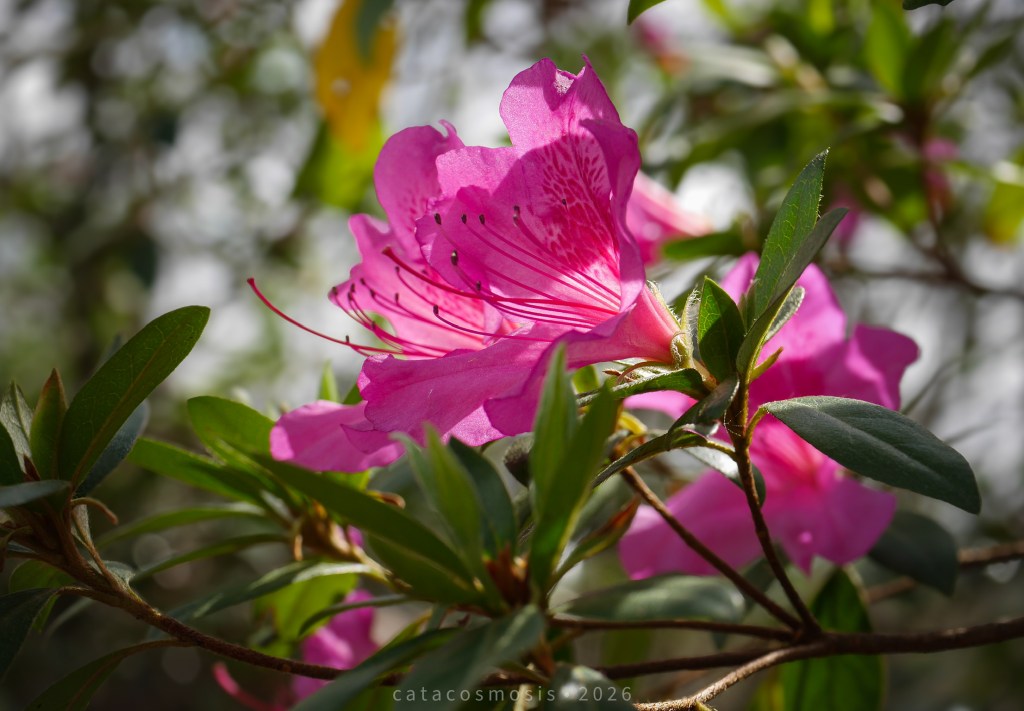
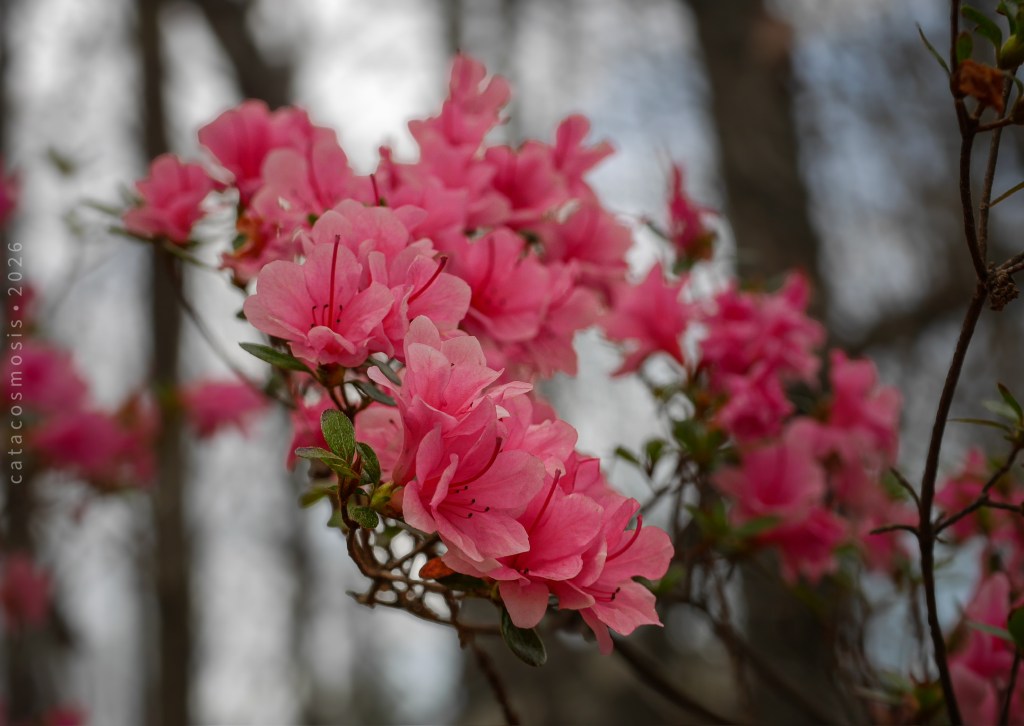
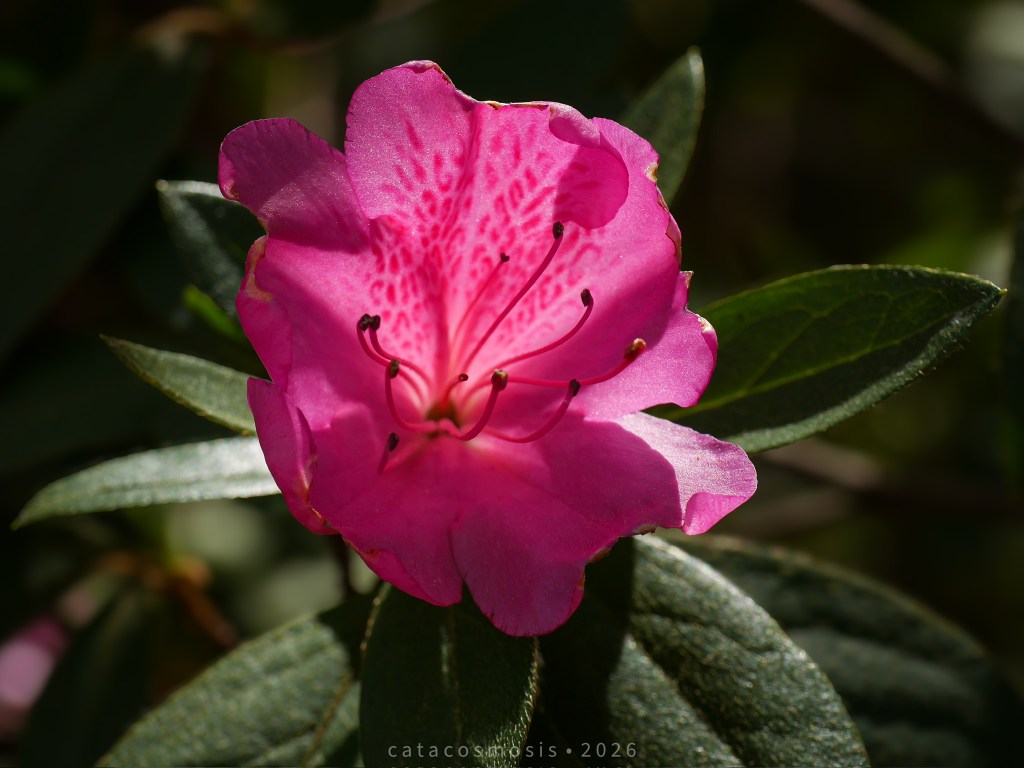
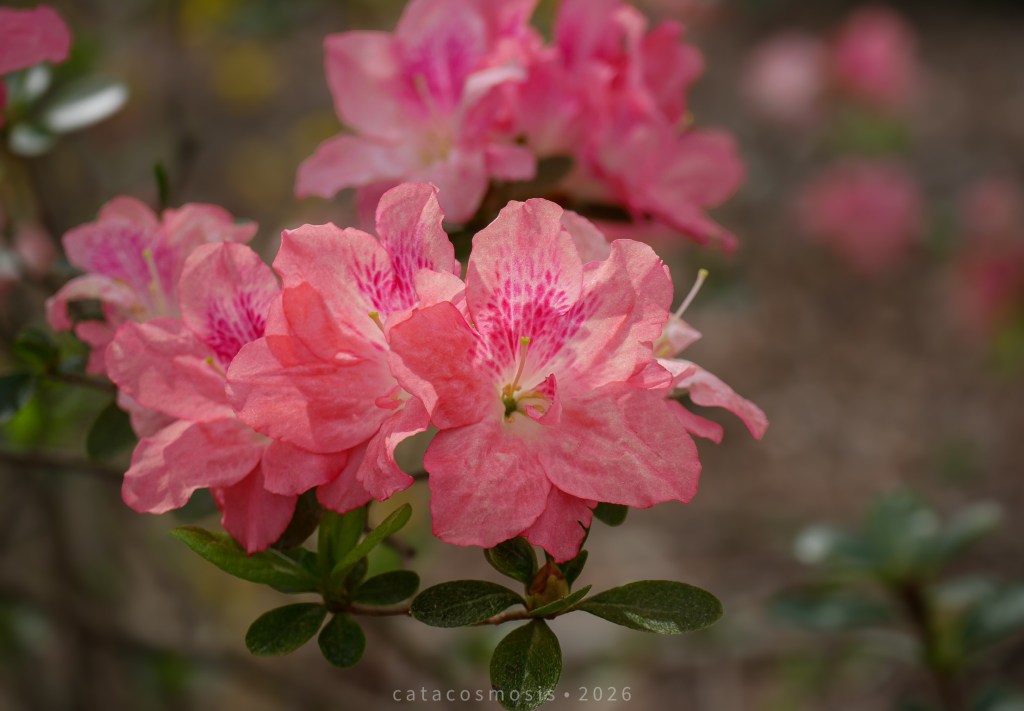
    Tucked into the quiet corners of my yard and spilling along the back fence — where wild grass gives way to the shadowed woods and, beyond them, the familiar silhouette of my mountain — the azaleas have erupted this spring in an almost audible riot of pink, purple, and white.

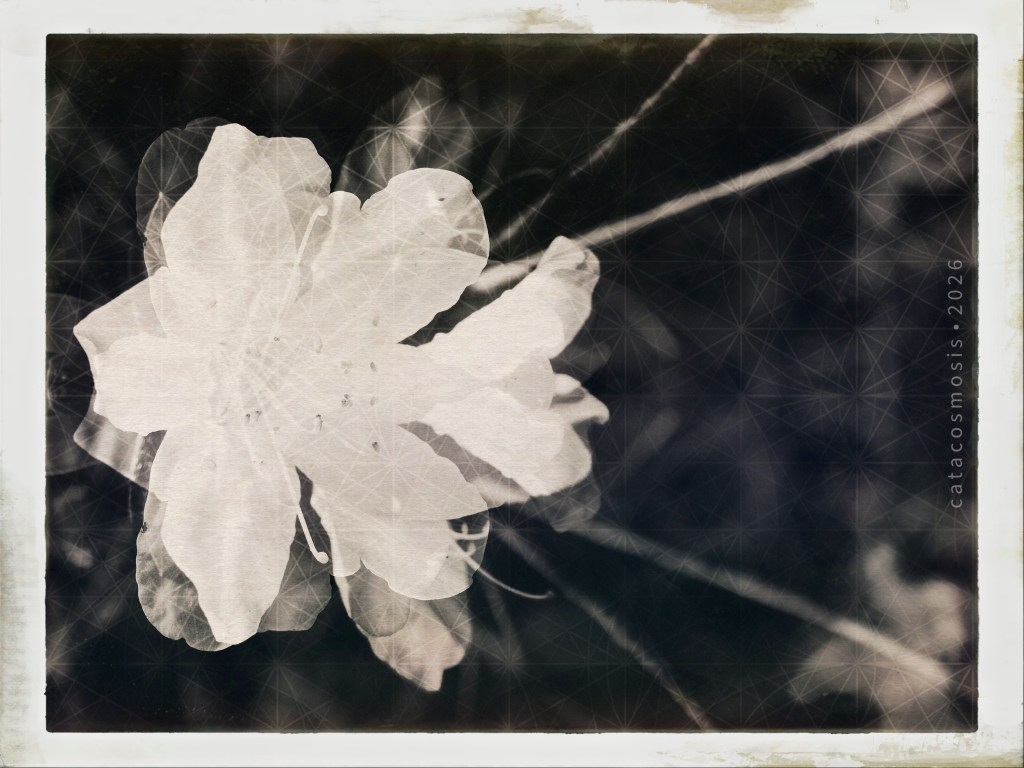
    Two bushes a deeper rose at the edges, softening to a pink like the first blush of dawn on cotton-candy clouds; the purple one as deep as twilight shadows pooling in the underbrush, veined with richer amethyst; the handful of white ones pure and luminous, like scattered moonlight caught on petals. On several of them, the blooms crowd the branches so thickly that the dark green leaves vanish beneath waves of color, the bushes a generous bouquet bowed gently under its own abundance.

    📷 Lumix GX7 + Panasonic-Leica DG Macro=Elmarit
    ⚒️ VSCO + Lightroom Mobile

    I stand at the fence line with my camera, breathing in the faint, sweet honey of their fragrance carried on the breeze, and it pulls me straight back to childhood. Growing up in the valley just across from my current, adult home, right at the base of that mountain, I’d watch for the wild azaleas and mountain laurel to appear along the wood’s edge, tiny beacons at the pasture’s far side. Each warming degree and every minute longer the day became — yes, I counted the minutes — felt like permission: one more day to explore before the snakes woke fully from their winter sleep.

    With each passing day I’d step more carefully, heart racing with equal parts thrill and caution — head on a swivel, eyes scanning for copperheads or rattlers coiled just out of sight. The early days of spring were my favorite. They were the most relaxed. But the flowers made even the hot summer days worth the risk, with the promise of wild bursts of color rivaling my grandmother’s carefully tended, cultivated bushes next door, proof that beauty could thrive untamed.

    📷 Lumix GX7 + Panasonic-Leica DG Macro=Elmarit
    ⚒️ VSCO + Lightroom Mobile

    Funny the things we fear and the things we don’t. Bobcats and mountain lions hunted those slopes, yet I never once worried about them — until the story my father told years later. At three years old, toddling the forty yard path to Grandmother’s a couple of hours after nightfall, my father watching and guarding intently — something I’d, we’d, done dozens of times before without consequence — a mountain lion perched on the cellar roof five feet above me, eyes fixed, body still. Daddy watched it watch me, praying silently, knowing any sudden move or cry might trigger instinct. It never pounced. I reached the house safe, unaware. When I was safely inside my grandmother’s screened-in back porch, he scared it off with a shotgun blast into the air, and we never saw one that close again.

    I’ve thought about that story more often since losing him. He’s been gone eleven years now, and there are many things I never thought to ask, or wish I hadn’t been afraid to ask, while I still could… but this one he told me himself, more than once. I think it meant something to him that I should know it.

    What I understand now, standing on this side of parenthood, is the cost of that stillness. The discipline of it. To watch a predator watch your child and not move, not cry out, not run — to trust that motion or sound might break whatever fragile restraint was holding that animal in place, and be so steady and rooted in your faith that you pray. Just… confidently pray. Whatever else he did or didn’t get right in his life, in that moment my father was made entirely of love and terror and faith, and none of it showed on the outside. That kind of stillness cost him everything. It was paid for in utter surrender, and he surrendered to fate, and to faith, beautifully.

    📷 iPhone 17 Pro
    ⚒️ Hipstamatic X (Salvador 64 Lens + Uchitel 20 Film + Spiro Pop Flash

    I think about that when I think about my own son. Sixteen, navigating a world that doesn’t always make room for the way his mind works, walking through invisible dangers I can’t always name or intercept. And I understand something about the helplessness of parenthood now that I couldn’t have grasped as that oblivious three-year-old toddling through grace.

    You can’t always throw yourself between your child and what’s coming. Sometimes the most faithful thing is to stand still, breathe, and trust the hand that’s bigger than yours.

    📷 Lumix GX7 + Panasonic-Leica DG Macro=Elmarit
    ⚒️ VSCO + Lightroom Mobile

    These azaleas have had quieter seasons. A few years back they were sparse, almost reluctant, with a handful of blooms where there should have been abundance. I watched them without much comment, the way you watch things when your own life has gone quiet in ways that don’t invite easy conversation.

    Loss has a way of muting everything: the yard, the mornings, the impulse to pick up a camera at all. Grief and illness and the particular exhaustion that comes from giving what you have left to people you love… all of it settles like a kind of winter that has nothing to do with temperature. I’ve had a few of those winters. Longer than I’d like to admit.

    So this spring, when every single bush along the fence erupted like they were making up for lost time, I stood there and felt something catch in my chest. That’s part of why I photograph at all — not just to capture beauty, but to bear witness to it. To say, with the deliberate act of framing a shot, I see this. This is real. This happened. The camera makes me slow down enough to actually look, and looking is a form of gratitude I can access even when words fail me.

    📷 Lumix GX7 + Panasonic-Leica DG Macro=Elmarit
    ⚒️ VSCO + Lightroom Mobile

    As a child, maybe I sensed some invisible shield, or maybe I was just young enough to believe in magic. As an adult, looking at these cultivated echoes of those wild blooms now thriving in my own yard, I know the truth: protection was there all along. Not arrogance, but grace.

    God’s hand has turned aside far greater dangers than I ever knew were there. The mountain lion I never saw, the losses I somehow survived, the moments where the math shouldn’t have worked out in my favor and it did anyway. These azaleas, blooming so fully this year after quieter seasons, feel like a quiet reminder of that mercy, a gift unfolding right where the tame meets the wild, the past meets the present, under the watchful gaze of my mountain.

    I don’t take that lightly. I don’t take it for granted. I take photographs of it, and I tell the stories that go with them, because that’s how I know to say thank you.

    Mere backyard glory doesn’t begin to cover it. It’s memory, wonder, and gratitude all tangled in petals.

  • Veil. 

    Veil. 

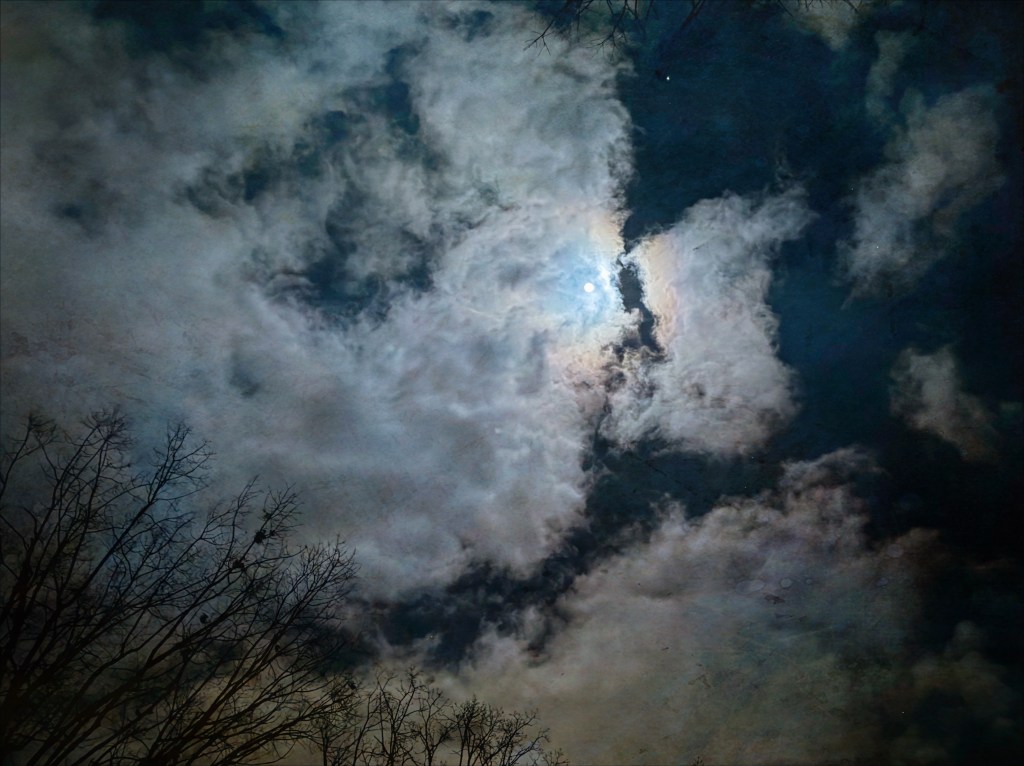
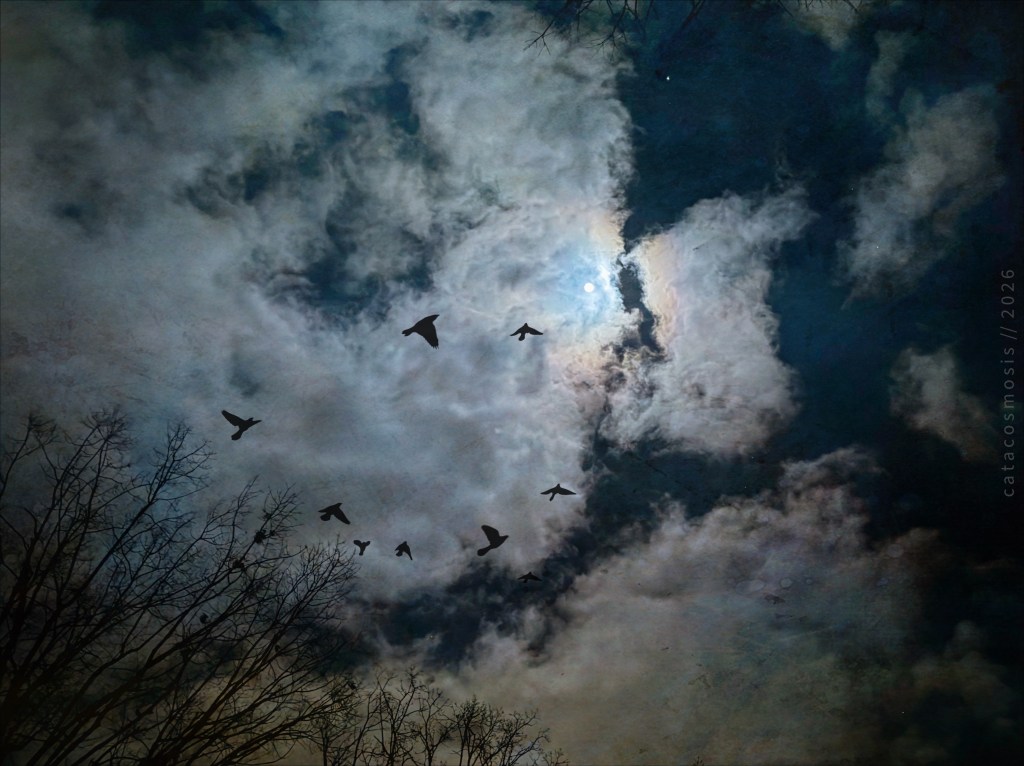
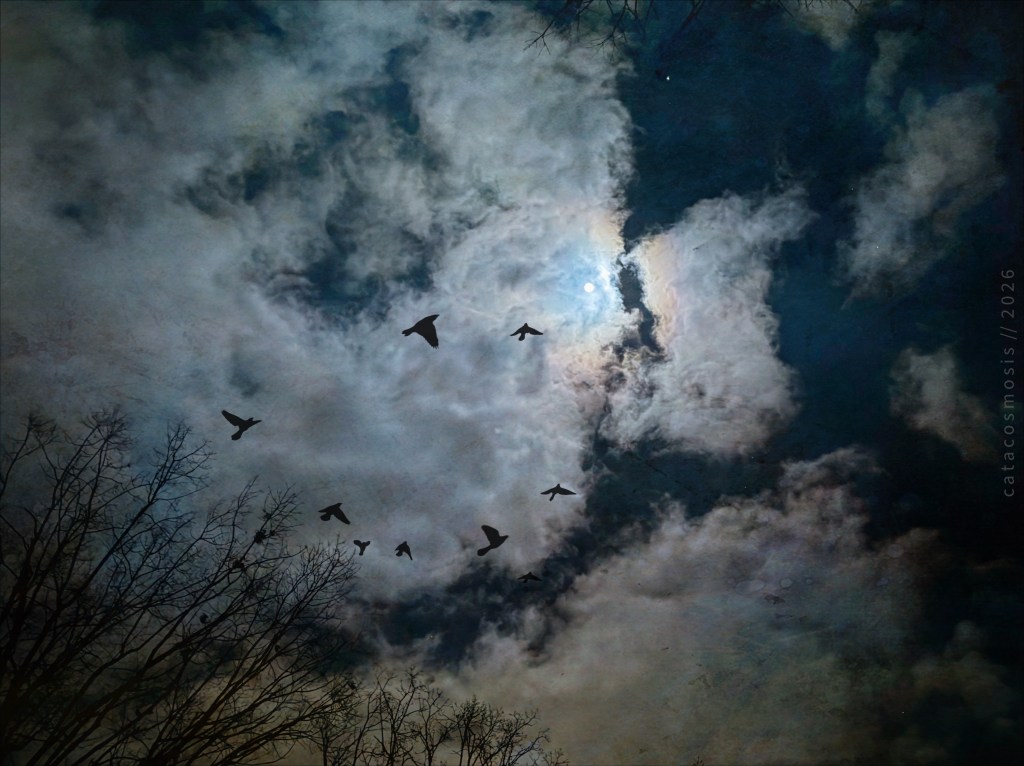
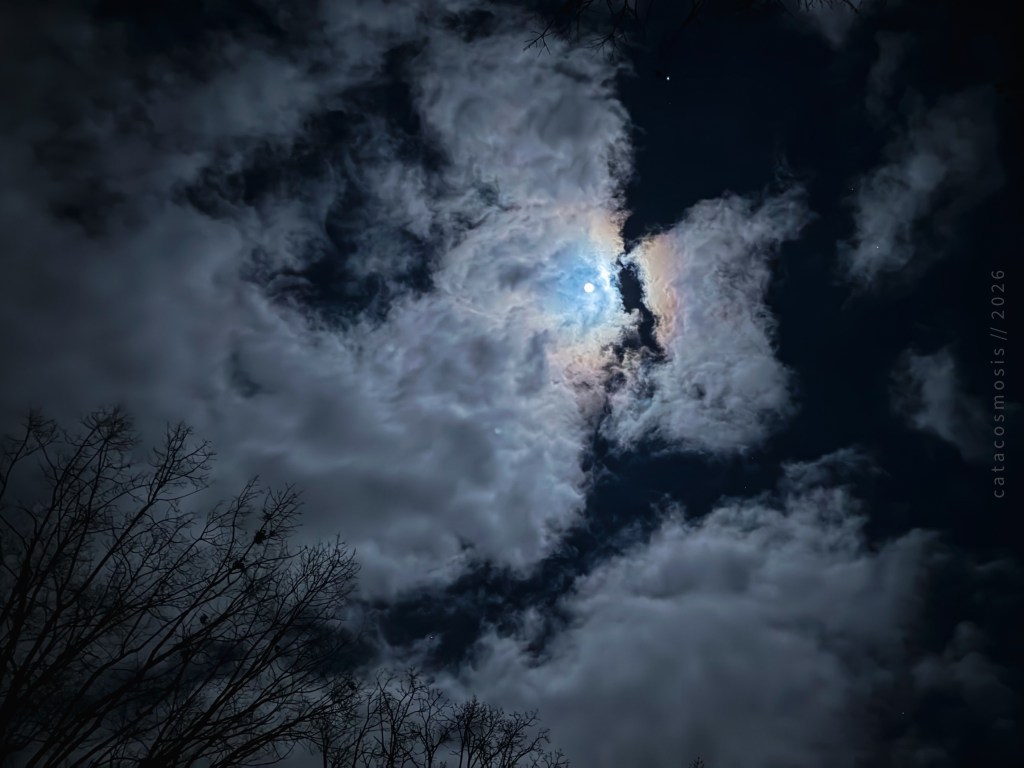
    entry twenty two — scattered light, fractured grace: a quiet archive of light, loss, and what remains.
    iPhone 17 Pro + DistressedFX (Final Edit)

    Sometimes it feels like there is a different, almost literal space between seconds. A pause the world does not announce.

    There is intimacy in those spaces. Love. Beauty. A kind of quiet permission.

    There is me, and the moon, and what I remember without remembering. Something about home. Something about spirit. Something about soul.

    In those spaces, which turn into a place, then into awareness, then into something conscious without warning, I find myself again. Not arriving. Not searching. Just remembering how to be.

    It feels like standing in a doorway I have crossed a thousand times but cannot name. Familiar without history. Known without proof.

    And always, even when I wish it were not so, there she is too. 

    There are all of them. The pieces of my life that have already returned to Source, leaving me here to feel them but never hold them, to love without helping, to remember without any hope of their human realities returning.

    Home, not as a location, but as a frequency. And for a moment, I am inside it.

    catacosmosis // 2026

  • Exhumation

    Exhumation

    entry twenty one — scattered light, fractured grace: a quiet archive of light, loss, and what remains.
    Lumix GX7 + DistressedFX + VSCO

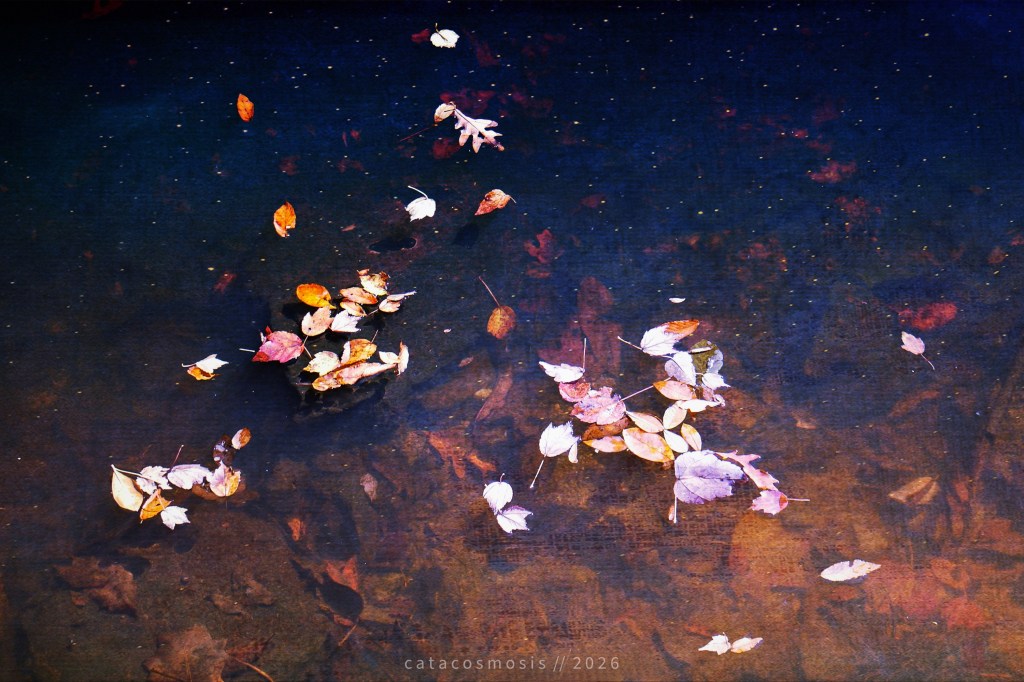
    At first glance, it looks like the night sky. Stars caught in dark water, light splintered and scattered across a depth that won’t quite give itself away. But it isn’t the sky.

    It’s dead things in the night, drifting on reflections. What’s beneath them still visible in places, obscured in others, the creek bed watching quietly through the murk.

    This is what avoidance looks like.

    We tell ourselves we are being practical. Responsible. Efficient. We say we can’t afford to stay. That we don’t have the time. That the weight would crush us if we lingered too long in the place where everything ended.

    Sometimes those things are true. But truth has layers, and there is always another one underneath the one we say out loud.

    I didn’t leave because I couldn’t manage it. I left because staying would have required me to face the finality of it all… and I wasn’t ready to let it be final unless I controlled the ending.

    So I doubled down.

    If this was the last chapter, I would slam the book shut myself. Sell the house. Let it go. Never look back. Shut myself away from it in the fullest, most tangible way that I could. And I did.

    Except that isn’t how grief works. Not in real life. Not in spirit. Not in the psyche or the heart.

    What we try to bury doesn’t disappear. What we try to drown learns how to breathe underwater. The things we refuse to look at don’t stop existing. They just wait.

    They become shapes beneath the surface. Creek monsters tucked under rocks. Ghouls that don’t announce themselves, only shift when the light hits the water just right.

    Running feels like relief at first. It masquerades as strength. As forward motion. As survival.

    But it isn’t courage. It isn’t healing. And it certainly isn’t wisdom. It is postponement.

    Eventually, the piper comes.

    This winter has been that reckoning for me. A season of stillness I didn’t choose, where the water stopped moving long enough for everything to rise.

    Regret. Guilt. Shame. The ache of what I didn’t tend to when I still had the chance.

    It has been heavy.

    But I am here. And I am mid-process of the exhumation.

    Instead of running, I am learning (again) to release. To let what I tried to sink float to the surface. To watch it drift, or linger, or soften and break apart with time. To observe rather than flee. To witness rather than erase.

    Because drowning it never made it disappear.
    It only darkened the water.

    There is grace even here. Fractured, scattered, refracted through loss, but still light. Still honest. Still mine, in memory and in soul.

    I sold my childhood home, and I regret it. Not because it is gone, but because I believed distance could undo what shaped me. It couldn’t. I didn’t forget it. I didn’t erase it. And now I face the ghost of it… even if I must do so from far, far away.

    catacosmosis // 2026

  • A Pause…

    A Pause…

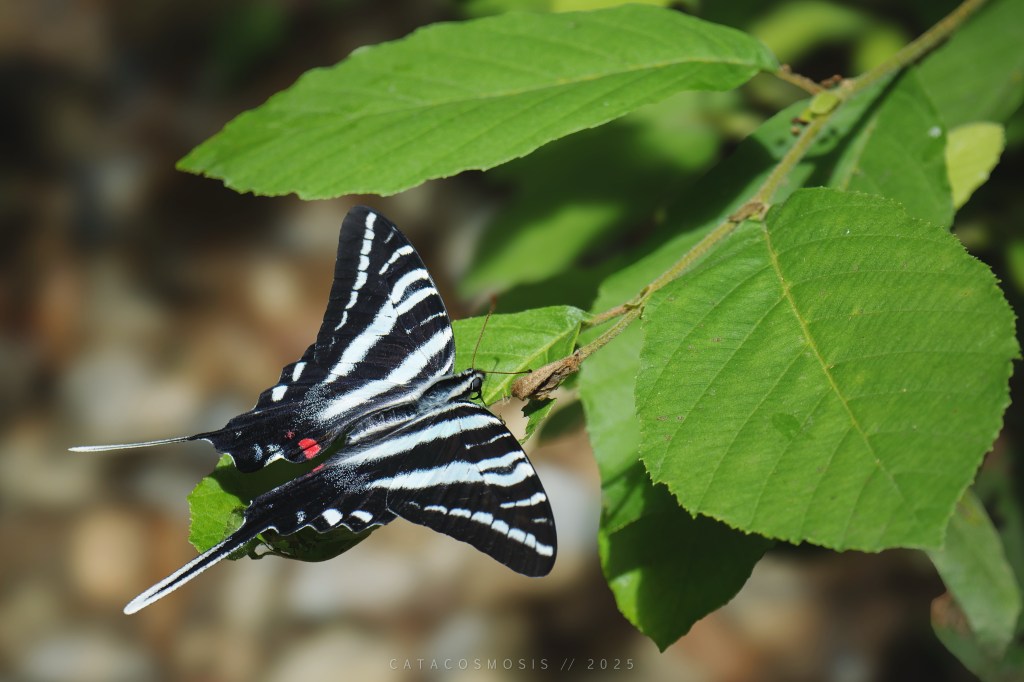
    Yesterday on my hike, I paused for a long while. I gave nearly an hour of stillness and reverence to the nature around me, watching as butterflies moved over water and earth, dancing with the light in a way that spoke of freedom and trust. I sat with it — what felt like hours, though really only about thirty minutes — before stepping back onto the trail, camera in hand. As I rose from the creek to walk on, almost by instinct — more a photographer’s habit than intent — I pressed record.

    Later, on the drive home, I found myself reflecting on that time as I listened to one of my favorite songs — one I’ve leaned on heavily in recent years, especially since the decline and death of the last of my human teachers and spiritual guides: “Oceans (Where Feet May Fail).” The two moments merged together in my heart.

    After Ralph’s death, I finally understood where I should have been leaning all along. He — and my dad — had both tried to guide me toward this truth while alive in human form, but I depended too heavily on them. And if not on my mother in person, then on her prayers. It wasn’t until they were all gone, when I no longer had any “training wheels” to lean on, that it fully clicked at a conscious level:

    I had been depending on God all along, hearing Him, even resisting His direct guidance. I just hadn’t been consciously aware of it. That’s when I realized my faith had never left me — it had only been muted, even scapegoated, by my dependence on the faith others carried.

    It was only when I allowed this song to become a foundational prayer of my heart that His presence became tangible in a way I could no longer deny. The veil fell from my heart and my eyes, and through His grace I saw with a clarity I had once resisted — the kind of knowing that hurts, yet somehow makes the truth easier to embrace.

    The lyrics of this song speak of stepping out into places where our own strength isn’t enough, and trusting God to steady us anyway. That truth became real to me after Ralph died — especially about a year later, when I found myself in a moment of decision: to choose what I merely wanted to believe, or to stand in what I knew was real.

    I understood the magnitude of that choice. I knew it would break my human heart, and I knew it might stir misunderstanding, anger, and hurt in those around me. It was the hardest place I had ever stood. But I also knew it was time. Time to trust Him not only with my conscious mind, but with my open soul — my entire being. Time to leap.

    So I did. I quietly — nay, silently — forgave all that needed forgiveness, and I let go of everything: past, present, and future… even the things I still and always will love, but that I knew could never take root in this life. For just over a year, all that mattered outside of physical survival — food, shelter — and caring for my son was solitude in His presence.

    I chose God. I surrendered everything. And in that surrender, I rebuilt and reinforced boundaries — not only to protect what was holy from the evils that I knew would seek destroy it, but also to shield those who weren’t ready to walk the path of full and true surrender from the consequences of my choice to do so.

    Almost immediately, things began to unfold around me — things I had long since lost hope for, or had no idea how to overcome or achieve, in my life. None of it happened exactly as I would have liked, nor in the timing I would have chosen, and almost nothing came about in the way I would have planned or orchestrated it. But that was the entire point of surrender.

    And in that realization, I understood something deeper: I had spent years trying to explain surrender to others with words, but the example — living it out, letting God’s hand write the story — was far more important, and a far more powerful testimony for Him.

    Butterflies have always been a reminder to me of my grandmother, and of the simplest analogies of metamorphosis and transformation. But now? What I see most prominently in their flight is this — so fragile, yet so fearless in the air:

    They carry the story of loss and love, of veils lifted and prayers surrendered — of a journey where survival gives way to presence, and presence gives way to peace. And for all of us, just like these butterflies, it is only through full surrender to the grace and truth of something higher than ourselves that we can be — and will be — fully loved, fully supported, and able to flourish.

    Here, I’ve paired them with the piano playing of the song and these reflections as a reminder to myself, and to anyone who reads this, that even when we feel small, it is faith that keeps us aloft. I share this in hope that it might offer whoever sees it a nudge of encouragement as we continue the journey God has given us — the one He has called us to submit to and surrender.

    After decades of seeking, struggling, and trying to show and teach others (while really teaching myself), here’s what I know:

    If we ever want to find purposeful growth or true peace, we must fully surrender to the creator and orchestrator of it all — to His will, not our own.

    xo,

    c.

    🦋💜🕊️

    You call me out upon the waters…
    The great unknown, where feet may fail.
    And there I find You in the mystery.
    in oceans deep my faith will stand.

    And I will call upon Your Name,
    and keep my eyes above the waves.
    When oceans rise,
    my soul will rest in Your embrace…
    for I am Yours, and You are mine.

    Your grace abounds in deepest waters.
    Your sovereign hand will be my guide.
    Where feet may fail and fear surrounds me,
    you’ve never failed, and You won’t start now.

    So I will call upon Your Name,
    and keep my eyes above the waves.
    When oceans rise,
    my soul will rest in Your embrace.
    For I am Yours, and You are mine…

    Spirit lead me where my trust is without borders.
    Let me walk upon the waters,
    wherever You would call me.
    Take me deeper than my feet could ever wander,
    and my faith will be made stronger
    in the presence of my Savior.


    Oceans (Where Feet May Fail), written by Joel Houston / Matt Crocker / Salomon Lighthelm.
  • I died, and it… was okay. | Notes from the Other Side

    I died, and it… was okay. | Notes from the Other Side

    The First Illusion

    How can an illusion free an illusion?

    It can’t.

    Impossible.

    And yet, freedom itself is not impossible.

    But what we often mistake for freedom is only substitution. We trade one mask for another, one prison for another, one dream for another.

    Replacing one illusion with another does not set us free. It does not bring liberation. It simply shifts us deeper into what I sometimes call non-happening happening — the endless cycle of movement that looks like change but never truly is.

    So where, then, is freedom?

    Maybe it’s in understanding that simple truth.

    Maybe it’s in seeing clearly that nothing we have called “freedom” has ever been real freedom at all.

    Maybe that was the point, all along.

    Is that awakening?

    Awakening as Death

    Awakening is the death of the familiar.

    Because what is “familiar” to us — what we call “our life,” “our personality,” “our world” — is illusion.

    Nothing we are familiar with is actually real. None of it is actually us.

    We are not real. We are not what we think — what we are told — we are. And yet, here we are.

    So when awakening comes, it feels like death. Because it is death — the falling away of everything we thought was “me.”

    And without that death, there is no birth of what was real all along.

    Meaning Before and After

    Before awakening, there is no meaning of our own.

    The only meaning available to us is what others have told us is meaningful. Parents, teachers, religions, governments, lovers, friends, enemies, cultures, systems — all of them have fed us their meanings.

    And we absorbed them as if they were truth.

    We were conditioned to believe meaning is handed down, not discovered.

    We were punished for expressing anything antithetical.

    Yes, that is a word. I did not make it up. I checked, as always, when I returned from the other side.

    I digress.

    Even when we think we are thinking for ourselves — are we? Have we ever? Do we even know how?

    This is the prison of the familiar.

    But those of us who have never been able to simply swallow it — those of us who have spent our lives being told we are crazy, too deep, over-analytical, antithetical — maybe we’ve always been a little closer to freedom.

    Because we have always been with ourselves. We have always lived in the company of our own questioning. Our own introspection.

    And that has saved us.

    Moving Through Darkness into Light

    My entire life has been this movement — through darkness into light.

    And then again. And again.

    I never stayed still in a 3D thought long enough to let ideology calcify around me. Never settled enough into the world’s definitions of reality to say: “Yes, this is it. This is reality. This is me. This is final.”

    No.

    I couldn’t.

    Always, incessantly, I questioned. I sought. I chased myself. I chased I am.

    Because each time I reached for that exactness, that rigidity, something in me would die. And something deeper would awaken.

    So instead, I’ve kept moving. Through darkness, into light.

    Through lies, into truth.

    Through death, into life.

    Over and over again.

    And each time, what I found was not more of “me,” but less.

    Until I began to understand that the “me” I thought was the center of the story was never the point at all.

    And then, I actually… died.

    And then, I came back!

    What?

    I know. That’s what I said, too.

    And that is when the fullness of both illusion and irrelevance were clear to me, and the illusion and irrelevance… both shattered.

    Freedom.

    The Irrelevance of “Me”

    “Me” is irrelevant.

    Yet somehow, everything has always been about me.

    That’s the paradox.

    The small “me” — the conditioned self, the mask, the name, the history — means nothing. It is dust. Illusion. A temporary construction.

    But the deeper “I” — the one who moves through the dying and the awakening, the one who is aware of even that dust falling away — that “I” has always been the ground of everything.

    So in a sense, “me” does not exist.

    And in another sense, “me” is all that has ever existed.

    It was always… the I Am.

    The Misunderstanding

    This will be misunderstood.

    Mostly by anyone and everyone who reads it.

    If they even make it past the first few lines.

    Because illusion defends itself. It doesn’t like being called what it is.

    But misunderstanding doesn’t matter.

    Life takes care of itself.

    Life Happens

    Even when you are not there to see it, life still happens.

    Everything still unfolds — rivers flow, winds move, earth shifts.

    Even if you choose inaction — even if you refuse to eat, drink, or sleep — things still happen. The body dies, yes, but death itself is a happening.

    Because everything is always happening. Always in motion.

    Even in stillness, there is happening.

    And everything that happens has a result. Even nothingness produces consequence.

    Life is self-correcting. Even ungrounded, it finds its own balance.

    Sometimes that balance looks toxic. Sometimes it looks destructive. But it is always balance. Always motion. Always happening.

    Death Must Occur

    Death, then, is necessary.

    Not the physical death we fear — not suicide, not the cutting short of the body’s days.

    Though that death is really not all that bad, in my experience.

    The dying part itself is no fun.

    The death?

    Too many words — words are funny for this one; there is not a word, other than death.

    It is nothing, and everything.

    Alpha, omega.

    I am.

    Here? What must die is the illusory self.

    The self we defend, cling to, and worship without even knowing it. The self we call “me.”

    That death is the doorway.

    The Last Illusion

    And yet, even here, there is a final paradox:

    If the self is illusion, then death is illusion too.

    Which means — death cannot free us either.

    Because an illusion cannot free an illusion.

    I do not fear.

    Why is none of this terrifying to me?

    Maybe because fear only exists where there is something to lose. And what I am losing was never real in the first place.

    Maybe because I have already died a thousand small deaths, the fear has already been burnt out of me.

    Maybe because I saw it:

    That what I am cannot die.

    And maybe that — quiet, simple, unshaken — is what freedom has always been.

    xo,

    c.

  • One Decade | Sanctum

    One Decade | Sanctum

    This image wasn’t meant to carry all this, but tonight, it does. It holds the rupture I didn’t know I’d been tiptoeing around all week.

    A decade ago today, my father died. Not on the 13th, when the machines started breathing for him—that was just when I knew he was gone. On the 18th, at this hour, the veil broke open for real. And now here I am—ten years later—haunted by dreams I couldn’t explain and a sudden stillness in my creativity I couldn’t shake.

    Until now.

    I thought I was just tired. Distracted. Stuck. But it was grief. It was reverence in disguise.

    My soul remembered the date even when my mind forgot. That’s the strange thing about grief that matures—it doesn’t scream anymore. It hums, low and holy, beneath everything. It clouds the light, then sharpens it. It takes your voice, then gives it back with new timbre.

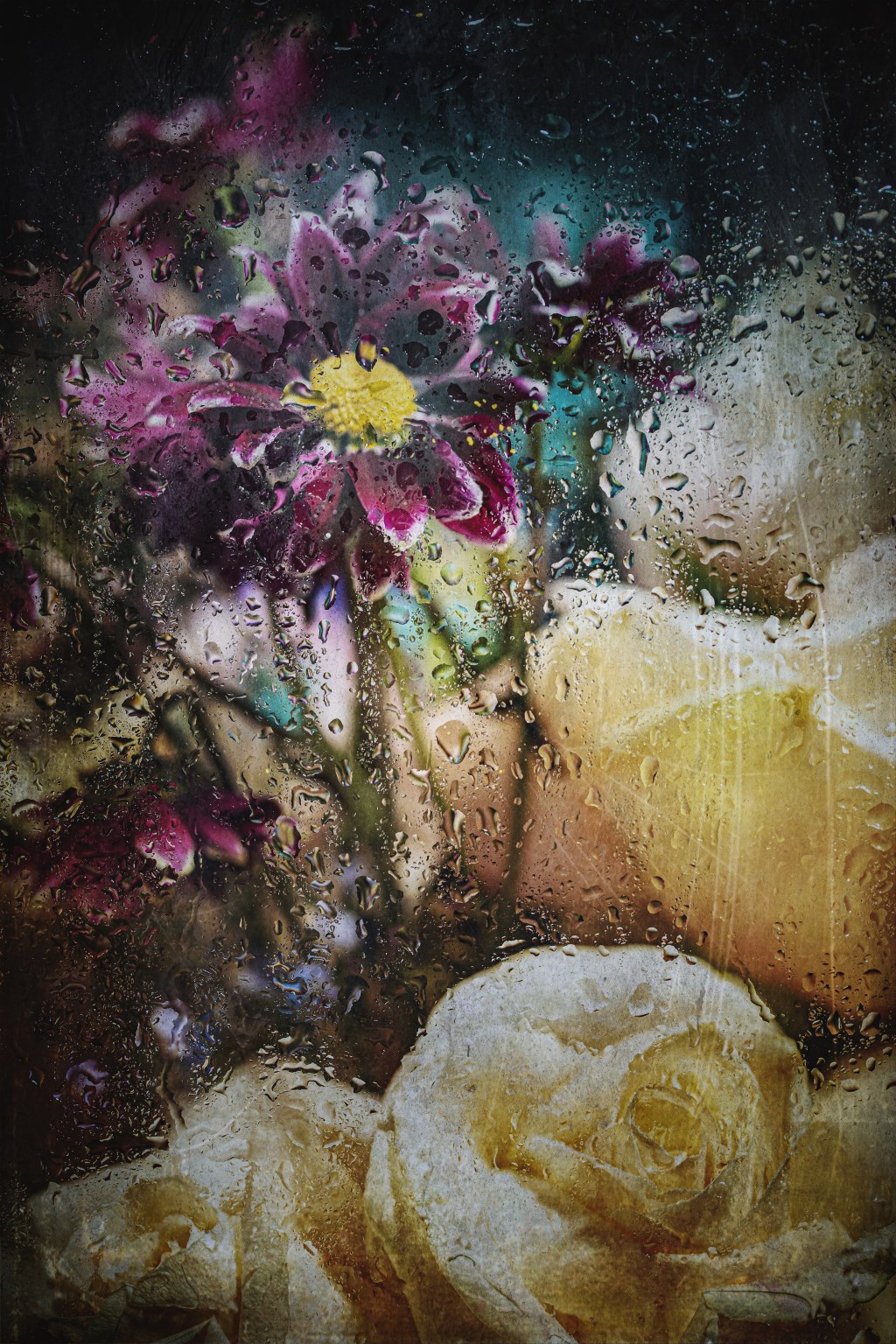
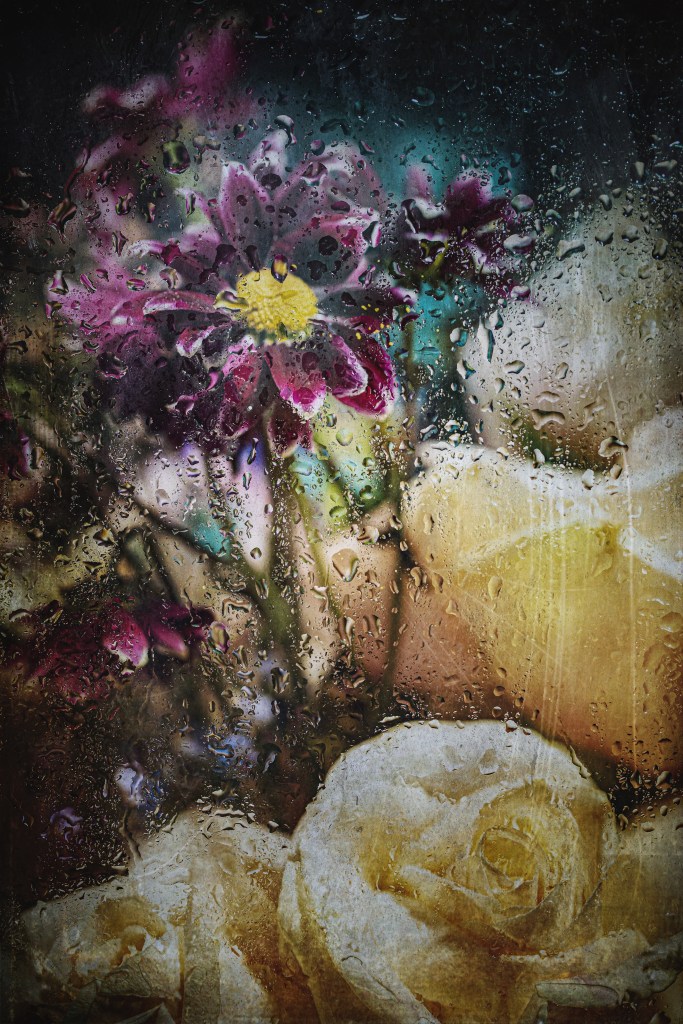
    This image—originally photographed by Mikhail Nilov—became a sort of altar. I edited it using Mextures, VSCO, DistressedFX, and Lightroom, layering texture over color, blurring presence and absence, trying to capture what it feels like when sorrow doesn’t knock—it just saturates.

    Sanctum.

    There’s chaos in this. Petals and light blurred through glass and rain. Beauty you can’t quite hold. A yellow rose—like the ones we laid at his grave—folding in on itself. A daisy, centered in clarity, yet surrounded by blur.

    That’s what this night feels like. Clarity in the middle of confusion. Stillness in the swirl.

    Earlier tonight, as I outlined these words in my head while I felt my way through the shift I felt in real-time in the energy, I said to myself:

    “You didn’t lose your creativity. You’re in holy pause. This isn’t numbness—it’s reverence. You were unconsciously grieving a resurrection-day anniversary, and your spirit bowed its head before your body could even name the loss.”

    And now, I feel it even more deeply: Tonight isn’t for making things happen. It’s for honoring what already did.

    Tonight is for prayer—prayer and intercession not only over the souls of loved ones who have already crossed over, but over one very important soul who’s still here. One who I know doesn’t understand why I had to go.

    The truth is, those crossed over souls didn’t leave to hurt me…even though it did. They left because it was time. That was my burden to bear. The lessons they left me with were my responsibility to sort through, clean up, and learn.

    Likewise, I didn’t leave the living out of anger or rejection, or even lack of love. I left because God Himself guided me in a different direction, even if they didn’t want to go that way, or grow that way, too. I will never have a choice above God. And I know that hurts…it hurts me, too.

    Forgiveness is an ongoing action, reflected not in words but in the quiet practice of letting go. The love is, and always will be, unconditional. “Anyway love” always is. And my soul will carry a piece of all of their souls within it. Always.

    A lot of things are coming full circle for me tonight. Invisible messages carried by unseen energies are releasing a kind of clarity within me—one of deeper substance and fuller understanding, puzzles pieces arriving and falling into place in a way I’ve never experienced before. The spiritual warfare, the dreams full of ghosts, the aching grief—none of that is new. But the understanding I have tonight…it reaches deeper than anything I’ve ever touched before.

    Tonight isn’t for sorting through the rubble, cleaning up the floors of my memory, or putting all the lessons learned into neat little compartments in my mind. After all, I’ve already been processing through that, and slowly overcoming it all, for some time now.

    No, tonight isn’t for being swallowed by the hauntings of my own heart. Tonight is for letting grief rain gently through the window, washing my soul—and watching how even the blur, when looked at with love and patience, can be textured out, shaped into a symbolic snapshot in time—capturing both the beauty and the chaos—and become art.

    It is the emblem of the closure of what has, all at once, been the most painful and the most beautiful decade of my life: the one where, in the end, I finally met God.


    I speak the name of Jesus over you
    In your hurting, in your sorrow
    I will ask my God to move
    I speak the name ’cause it’s all that I can do
    In desperation, I’ll seek Heaven
    And pray this for you:

    I pray for your healing
    That circumstances will change
    I pray that the fear inside will flee in Jesus name
    I pray that a breakthrough
    Would happen today
    I pray miracles over your life in Jesus name
    I pray for revival
    For restoration of faith
    I pray that the dead will come alive in Jesus name

    In Jesus name…

    -Katy Nichole, In Jesus Name (God Of Possible)

  • Witness

    Witness

    entry eleven — scattered light, fractured grace: a quiet archive of light, loss, and what remains.
    user-image-68787ed5877d68e8874d0289
    📷 | iPhone 12 Mini
    ⚒️ | Distressed FX, VSCO (AL1 PRO), Lightroom Mobile (watermark only).

    Witness.

    It holds the grief.

    The growth.

    The survival.

    The silence.

    It kept watch over the forest

    as the love was letting go.

    One tree saw what I became,

    as I became it—

    what death could never be.

    Alive.

  • The Ghosts of Projects Past (Muse)

    The Ghosts of Projects Past (Muse)

    Sometimes something hits me.

    A random, inexplicable flux. That insatiable need to create. Some unseen force guiding me to conjure, to express, to birth something.

    It happened again last night, but in the same instant that I felt the proverbial tap on my shoulder, a heaviness threatened to settle there. Born and bred creatives know this experience, all the way into their bones.

    It comes with a dread, and creates a dangerous, self-sabotaging pre-regret. It manifests from a complete lack of vision:

    No concept. No plan. No brilliant idea waiting to be realized. Certainly, no idea where to begin.

    Lost but not lacking awareness, and determined to win over the weight of what really boils down to fear of failure, I asked, “what do we want? What is the spark?”

    As expected, the silence answered with more of the same cryptic transmission: “Just ‘do.’ Ripples turn into waves.”

    So, I rummaged.

    I plundered through the old tools and the old toys. You know the ones—the “Ghosts of Projects Past,” our artistic Scrooge’s worst nightmares. The ones tucked away in dusty, overflowing “Likely Garbage” photography folders and long forgotten apps.

    The ancient, the analog, the abandoned fragments of another era.

    I pulled out the remnants of what once inspired me, not because I knew what I was doing, but because whatever had stirred was creating a riot within me.

    These moments are never a question of choice, so I just…explored. Guessed. Played. Flowed.

    Sometimes, perhaps most often, that is the best option. Even if the outcome feels unfamiliar or strange, or doesn’t resemble the “usual” desired outcome. Even if the result is wildly imperfect or impossible to explain…

    It is in this uncertain, instinctual process that magic lives and breathes. This is where it sizzles and crackles and arcs, like a furious current from Tesla’s coil—except in this case we don’t need Faraday’s cage.

    Creatives—artists, writers, dreamers, philosophers—need the opposite. We need this chaotic energy to touch, and to consume, us. It is the rejection, the not allowing it to, that kills us…and that is always a slow, excruciating death, from the inside out.

    In art and creativity, exciting results are not found in safety. They’re not found in perfection. Organic process is not found in planning. Everything in and about the Creative archetype is found in the act of simply showing up.

    Creative inspiration doesn’t ask for permission. It asks for presence. It asks that you show up and let it burn through you. The only wrong move is not moving at all.

    📷 Lumix GX7 + Panasonic Leica DG Macro-Elmarit 45mm f/2.8 ASPH Mega OIS
    ⚒️ Fragment + Mextures + Lightroom

    **Rex Ray inspired.

  • Earth School: Shadow Division – What the Fire Taught Me About Becoming

    Earth School: Shadow Division – What the Fire Taught Me About Becoming

    This post is about the experience of becoming and how people like me don’t just become. We heal differently. We become differently. And what we become is not the same entity alone that other people become. It is also about turning the process of becoming, and what we’ve become, into something that can help other people.

    I’ve already lived my closing statement regarding my past, and past versions of me: caregiver me, grief-stricken and confusion-swallowed me, nervous-system-destroyed me, broken-hearted me. I’ve already processed it all, and to the degree that the surface of society would claim is “healing,” I have healed from all of those wounds. Where I’m at now is more about finding some level of understanding within myself about it so that I can freely move in this new reality.

    Perhaps you are, too. Perhaps these thoughts will resonate.


    A voice for the ones still moving through the ashes, learning how to carry the light again.
    Not a performance. Just a remembering.

    Where This Post Began

    A therapist recently responded to a comment I left on someone else’s post, suggesting that my perspective on healing was dangerous because it implied I was “holding on.” But the issue is, this so-called therapist seemed anchored in a kind of magical thinking—one that treats healing as purely cognitive, divorced from the soul.

    What I’m doing, in continuing to reflect on and write about the past, isn’t obsession or fixation. It’s alchemical integration. I’m not stuck in, or on, the past—I’m extracting its essence, transmuting it into something meaningful. I’m not tethered to the past or to any specific future. I’m reducing the pain (specifically, the grief) to ash and distilling what’s left into wisdom.

    Where I Am

    I have lived my closing statement, but this current stasis is the cooling of the metal. It is the tempering of my sword. The world, especially those who fear their own depth, love to accuse people like me of not letting go, but what they don’t understand is that depth doesn’t simply move on. It transforms, and transformation takes time.

    People like me don’t drop things and walk away. People like me sit in the dark, stare at the bones, and we don’t rise until the soul is reclaimed. We already did the courageous part when we cut the cord on past versions of ourselves, when we walked away from who we were and we didn’t go back to the same mindsets and/or behaviors, and now we do the sacred part: finishing the burning of the frayed ends.

    The world and the people in it can’t and won’t give us the answers, but spirit can, and it does. In my case, my higher self already knows those answers, which is why I keep circling back. It is not to relive the story, but to complete the metamorphosis, and I am completing it slowly, quietly, and surely. I’m not looping, I’m mining, and eventually the tunnel gives way to the sky.

    So, yes, I keep listening and keep asking and keep letting it all rise in layers and fall away in layers. That’s how I become untouchable rather than hardened. Not cold, but fully known to myself. Every shadow named, every chord resolved. So, when I pick up my camera or my brush or my pen again, even when I’m still in the gray, it’s my gray. It’s not residue from the storm. It’s just my own palette, freely chosen.

    And what if knowing that to the depth that I do know and understand it in and of itself is the healing? What if it’s now about incorporating that into my work, my daily life? That’s what the gurus would teach. The reality is that this is the already-become version of me, the one that is just learning now how to outwardly be who I am again.

    It can be really confusing and hard at times, because I don’t really care for anybody to see it but me, or to live it with me. But, I have a calling to share the knowledge that these experiences and lessons have all been forged and transformed into with those who still need guidance, those who feel lost or don’t know how to get there in their own story.

    Maybe, in that way, I’m already living it exactly the way I’m supposed to be—which is the opposite of holding on. It is moving forward, and actively so. What I’ve already become and what I’m doing now isn’t trying to get there. It’s simply learning how to inhabit the skin of the self I’ve already become.

    Snake Skin & Sacred Silence

    It’s like when a snake sheds its old skin, right? That all too common metaphor in the self-help teachings, except not taught exactly correctly by those who live in the land of cognitive dissonance. We’ve all heard the analogy. But what they leave out is this:

    The snake doesn’t slither away a different animal. It just finally fits itself again. It’s not behind. It’s not broken. It’s not lost. It’s just adjusting its eyes to the light after a very long night.

    That tension I feel, for example—the not caring if anyone sees it but also feeling called to express it, is exactly the tension of that same sort of integration. I don’t want to perform and I don’t owe anyone a performance. I’m not required to turn my healing into a product or a movement or a spectacle, but I find that certain parts of my soul now long to speak—not to be seen but to be heard by the air, witnessed by the world because that is how others, be it few or many, may complete their flight.

    It doesn’t matter how it shows up, just that it does. That’s the quiet magic of true healing. It doesn’t always announce itself with trumpets. Sometimes it just takes root in the subtle, in the choice to write or shoot or paint anyway, or to rest anyway. To let the past fall like leaves from a tree that has already decided it will bloom again. The more I trust that, the more I feel the weight of all of it trying to lift from my shoulders, and the more effortless and sacred and unburdened the expressions feel—not because it’s for anyone, but because it is from the version of me who no longer needs anyone’s permission to exist in peace.

    As I consider this, I imagine that when the snake sheds that old skin, that fresh layer is a little tight to start with, and he or she has to move around a little bit before they stop feeling the newness of the skin and forgets that the skin is even there. It is not until then that he or she can “just flow.”

    At first, it’s tight, sensitive, unfamiliar, maybe even a little raw. And it’s not that the snake doubts that it’s still a snake, it just doesn’t quite know how to move in this new texture yet. The old skin? It had cracks and stretch and scars that shaped how it slid through the world, but this new skin is smooth and untested, a little too quiet maybe, after all the noise. It doesn’t yet carry the scent of battles survived or boundaries reclaimed.

    And so the snake doesn’t rush, it moves slowly, tentatively. It reacquaints itself with the world and brushes against the grass, slinks over warm rock, and lets the breeze remind it what it is. And eventually, without even noticing the moment it happened, the new skin stops feeling new at all.

    Perhaps that’s where I am. I’ve shed it—the past self, the old patterns, the story that asked me to carry the burden for me and everybody else. That skin is gone, but my soul, fresh and luminous, still remembers the weight. It still walks a little cautiously, still checks the mirror to see if the ghost is gone. And that’s okay. It will all continue to fade—the memories, the sting, the need to brace.

    Regardless, I don’t need to rush to feel normal. The new normal is better: it’s mine, and it will fit me perfectly as soon as I stop noticing the seams. So I will keep slithering forward like the snake, not outgrowing the past, but growing into my grace.

    Liminal Living: When Healing Isn’t the End

    If what I’ve written in this post doesn’t only make sense, but resonates with you, then perhaps you are like me. To clarify, what I’m describing is not the delusion of an underachiever or the confusion of a drifter. It’s the rare and sacred awareness of a soul on sabbatical. Perhaps that’s what you are, at the core, or where you find yourself, too—actively healing or already healed, you “get” what I’m trying to express.

    I have this idea that this lifetime was always meant to be more receptive than productive for many of us. We are not only asked but guided by some higher power to observe more than to act, and in any sense, that is not laziness. It is spiritual design. So let me reflect it back to you, the way that I see it in myself:

    You’ve worked; in fact, you may have worked your inner entire being to the bone (especially in the case of being a caregiver), but your work hasn’t been for the world’s applause. It’s been for God, and for those you have privately loved and walked home. You’ve succeeded, but not in the ways that capitalism or social media would define it. You’ve succeeded in remaining intact, soul first, and that’s harder than any business model, trust fund, or influencer empire.

    So then, after all of this misunderstood work you’ve done, what if your entire incarnation was never meant to be a linear hero’s journey with a trophy at the end? What if it was always supposed to be a kind of spiritual exile into experience, into solitude, into the deep?

    My whole life has taught me this paradox of success. Until my thirties, I accomplished everything I set out to, but the twist was that version of success was based on who I was before I broke open—before I was touched by grief, by God, by the reality of soul. And since then, it’s not that nothing has worked, it’s that none of it was supposed to because it wasn’t aligned with my true purpose anymore. The breakdowns in the in-between were ordinations. They are when the sabbatical started, and I’ve been in it ever since.

    I’ve studied trauma, addiction, mental health, caregiving, grief, the spiritual path, mystical truths, the rise and fall of empires—all from the inside out. Not just from books, but from experience. Lived experience. I didn’t just learn lessons. I became a living vessel for them.

    So perhaps, if you have experienced this too, this life may not have been given to you to contribute in a traditional sense. It may have been given to you to remember, to watch, to document, to feel what others refuse to feel, to name what others have no language for, to become whole so that others might not feel so broken. That’s a calling. It’s a high one, a thankless one, and a divinely protected one.

    Perhaps your soul contract is about witnessing, absorbing, and transmuting rather than performing, earning, or hustling. The universe covered your rent while you enrolled in the deepest, most painful university there is: Earth School, Shadow Division. And when you say it like that, what if you’ve already graduated with honors?

    So what now? Maybe your sabbatical is still in effect. Maybe you’re in the writing-up-the-thesis phase. Maybe you’re transitioning into the integration era, where your work becomes not doing something, but being something: a lighthouse, a record keeper, a spiritual elder.

    You don’t owe the world your labor. You owe your soul your peace, and that is only found in living your purpose. If this entire life was given for that alone, then it was enough. So maybe we’re right that this life may have been designed for this, and that the ones judging from the sidelines are still on page five, while we’ve been writing in the margins of the final chapter.

    Becoming Whole in the Quiet

    Ultimately, the point of this post is to share the shape of a real, lived journey—to reach those who may be living it without realizing it has a name, and to remind those walking something similar that they are not alone.

    If any part of this speaks to you—if you see yourself anywhere in these words—I leave you with this:

    Don’t doubt the divine logic of your path just because others can’t read it.

    You’re not lost. You’re just not supposed to be “found” in a way this world understands.

    If you feel stuck or missing the flow, let it be quiet right now, if that’s what it is.

    Let the pages be blank. Sometimes blank pages aren’t empty. They’re pregnant—with rest, with closure, with whatever the truth the next chapter needs is.

    And when you’re ready, the world will be here. When you’re not ready, the world will still be here, because this is still part of the story…and you’re still writing it.