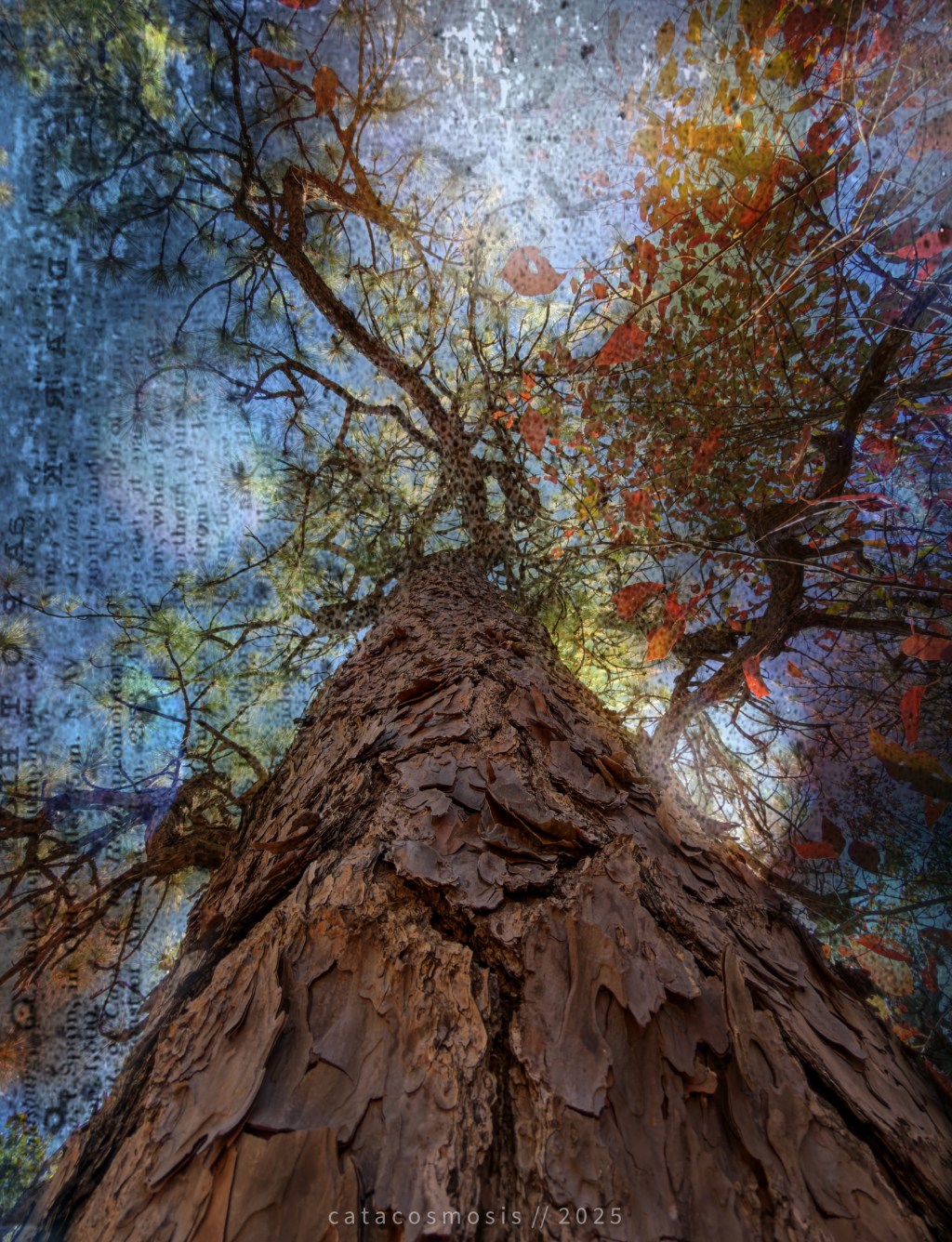
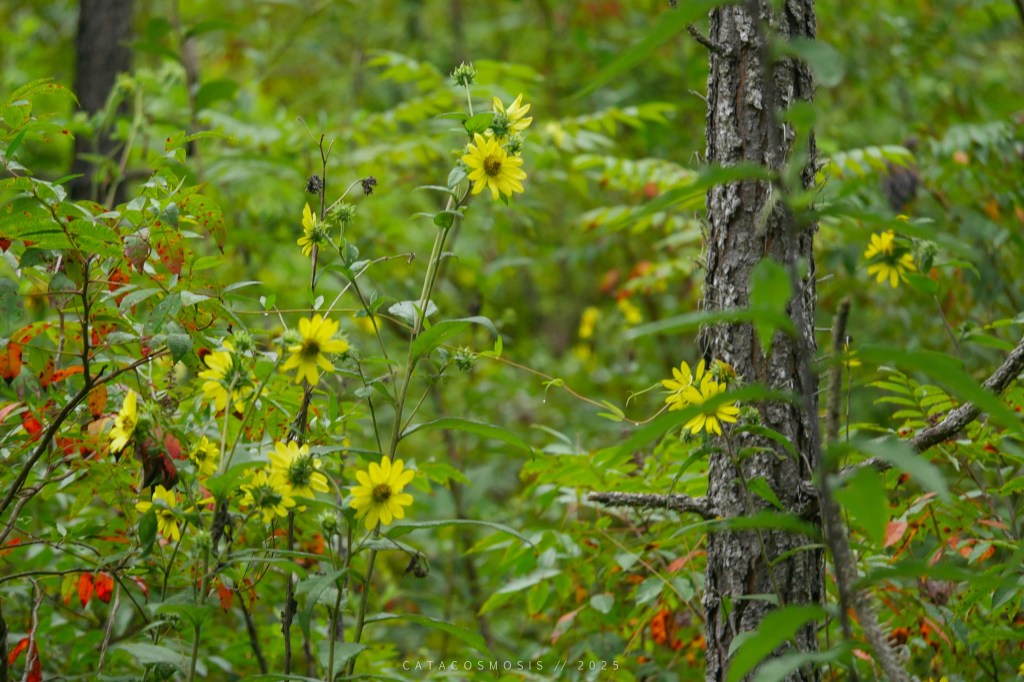
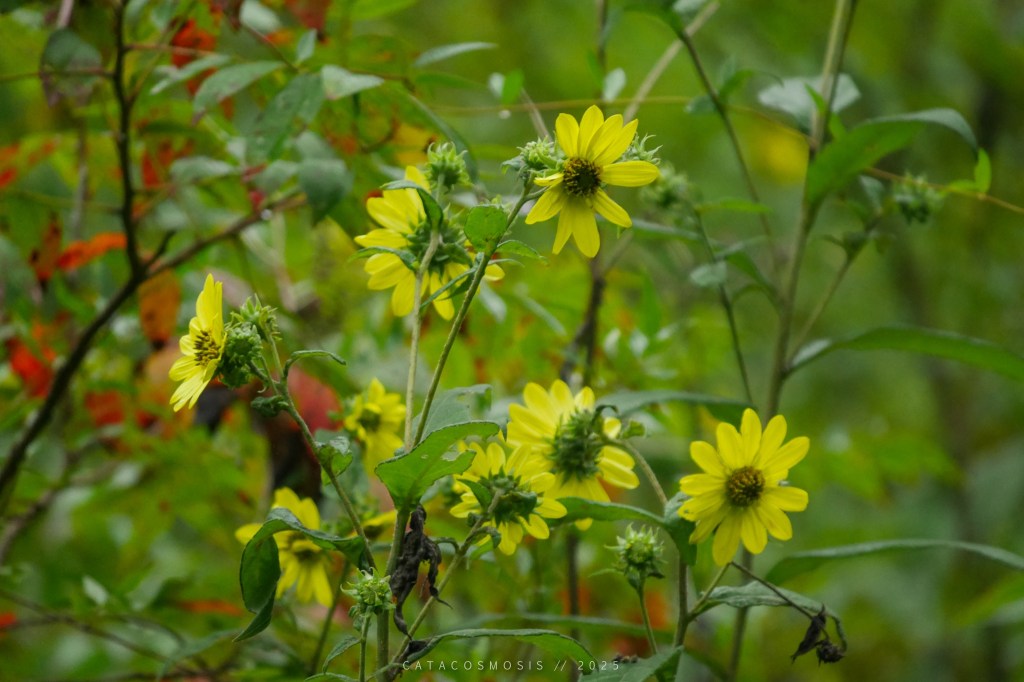
iPhone 17 Pro + DistressedFX + LR (watermark only)
Always look up. Especially when you’re already shaken, don’t ever look down. That’s when you lose what steadiness you do have, and crash.
This week hit hard. J was told he’s going on unpaid shutdown leave from Dec 15 until the second week of January. No vacation time, no cushion. At least not yet…maybe they’ll change their mind about that.
It always makes me heartsick when companies do this to families in December, right before Christmas. Now, here we are, and I’m not sick about it. Just determined.
This, after receiving the full evaluation for our boy yesterday, which finally gives us clarity… but also informs us that we have to get “further testing,” as if what he’s already been through and what we’ve already done couldn’t possibly be enough (money for them) for any referrals or disability help.
I genuinely don’t know how we’re supposed to afford it with everything happening at once, but we will. If I don’t laugh in the face of it all (especially the system) believing God’s already got it handled, I’ll collapse under the weight of that situation alone.
Christmas this year is going to be bare… at least materially. Some part of me feels immediate comfort, though, because I so intimately recognize this feeling… the gritty “underdog in a Christmas movie” version of life I’ve always known. Always the underdog…
But the thing about underdogs? Most especially when they’re faithful and balanced in determination, heart and spirit, they always come out on top. Always.
God is in this story. God is in the details. He always has been, and when I’ve followed His guidance and employed discernment, He has never turned away or left us. I’m holding onto that. That is my foundation.
I have to do my part, though… so for that, besides us trying to pick up a seasonal job until this shutdown is over, I’ve created an Amazon wishlist for my boy. If the universe wants to make sure he gets a Christmas beyond my homemade treats, it will. And if not, he already knows he’s loved, supported, and my whole world.
I’ve already got my Christmas miracle. That boy, and his precious heart.
It would seem I’ve waken up to yet another extreme of the obvious hypocrisy in what’s being demanded as “reality.” Some people genuinely still do not “get it,” while others still willfully refuse to see.
Either way, and from all sides, there is an overarching question: Has society reached a true tipping point?
Based on the reaction to a black man in white face, it would seem double standards have finally outstayed their welcome overall.
Notice the general pattern of double standards over the last several years:
Women can mock men. Trans can mock cis. Non-whites can mock whites. Gay can mock straight.
Flip any of that around and you’re cooked.
Look at the standards a little more deeply:
The most obvious example is how men putting on “woman-face” or women putting on “man-face” isn’t just accepted — it’s demanded that everyone affirm it as their literal reality and “respect” it.
So, logically, if that’s celebrated and that’s “reality,” then picking on any culture in jest for their quirks, failures, or oddities should be just as acceptable.
That sums up what people are really upset about re: this skit that’s been circulating the last couple of days: it’s the double standards.
And it’s not just white people who have had it.
Yes, this particular skit has a lot of white people speaking out — they’re tired of being singled out as the only group not permitted to joke back, and then accused of lacking a sense of humor when it’s done to them.
But consider society as a whole:
Non-whites and whites alike are fed up with their own people acting like ungrateful, entitled fools — wasting the opportunities their ancestors fought to provide them and destroying the respectability they strove for.
By now becoming loud, lazy, and disrespectful criminals, people make a mockery not only of their rights and the many opportunities they have if they would simply show up, but of their entire communities.
Whites are fed up with Karens and Chads.
Legal immigrants feel the same way about illegals trashing the opportunities they earned by doing things the right way — respecting the privilege of coming to another country, rebuilding responsibly, and treating that privilege with honor.
Instead, illegals cause even legal immigrants to take the flak, lose opportunities, and be punished for things they didn’t even do.
Masculine men are tired of being told they’re assholes instead of protectors, simply because masculinity is constantly mistaken for toxicity.
Men of every race and personality type are sick of women parading around declaring they don’t need men, accusing and blaming men for everything wrong in the world — while in the same breath lamenting absent fathers, complaining that men don’t “show up” in general, and then demanding applause and respect for a world women absolutely didn’t build without the strength and masculinity of men.
Women of all races and personality types are sick of being pressured to accept men in dresses not only mocking them and what it means to be a woman, but especially a mother, and having their spaces invaded and reclaimed as “everyone’s space,” only to be labeled ‘phobic’ or hateful for feeling that way.
This isn’t only racial. It’s far broader than that, and these are only a few of many examples.
Most, if not all, “everyday people” — all of us who are not filthy rich or sitting in positions of power — are fed up with war, crime, cruelty, and double standards. We just want to work hard, add meaning to the world, and reap the fruits of our labor: enough to survive, and enough to live — to enjoy a healthy, peaceful, happy existence.
When did that become an unrealistic or unacceptable dream to have? It’s one that has echoed through the ages.
Society as a whole is at a tipping point — fed up with hypocrisy, nonsense, and the double standards that no longer make sense.
The solution, as I keep attempting to remind people, is simple across every aspect of society — yet seemingly impossible for most: for all people to embody empathy for others while taking accountability for themselves, existing in and acting from discernment.
It is to embody some semblance of morality overall, respect nature, the planet and all its people, but especially ourselves. If we do that first — embody true self-love and self-respect — the depths of it, and not merely the mask — all the rest falls into place on its own.
Will that be impossible for you? Or will you make it possible for yourself, and thus for others?
Good luck out in the world today. Much love from me to you (no matter who you are).
A while ago, God asked me to step away from the noise. The purpose was not just to “rest,” but to enter true solitude. It wasn’t the kind of solitude that simply quiets the mind; it was the kind that strips away the need to convince, the compulsion to rescue, and the reflex to correct every error you see in the world.
When you live in that stillness long enough, especially when you begin to examine how deeply and how long you have been misunderstood in your own life, you finally grasp why no one was truly listening. You begin to understand:
The time for saving people by warning them and trying to teach them by telling them, begging them, or reasoning with them has passed. Just like with a child, there comes a time when you have to let them just keep screwing up until they learn. Experience is the only teacher that can accomplish anything fruitful.
At some point, you realize your job is and always has been to just be the example and let them hate you or blame you if they wish. The time now, and the purpose, is to show up anchored in truth, walking forward for the sake of those who are searching.
It is time to lead without any guarantee of who will follow, even if the path takes you to meet God alone. In the end, it all comes down to free will — and on the day you stand before Him, the only life and soul you will ultimately give account for is your own.
There is no bureaucracy at the Pearly Gates, no worldly process to pass through. Character witnesses don’t exist there. Your actions, your choices, and the truth of your heart and relationship with Source will speak for themselves to the one and only true Judge, whose authority is absolute and divine.
After months of this solitude, returning to public spaces feels different. The peace you find in solitude makes the digital clamor almost unbearable. You realize most people are not listening, not because they can’t, but because they don’t want to. They’ve been taught to fear the very silence that would heal them.
Still, there are always a few — maybe only two or three in a sea of millions — who are listening for a different kind of voice. And for them, we show up.
As I dipped a toe back into social media in recent weeks, I saw exactly why Source had been directing me as it had. Then, this morning, I saw a post on Instagram that reminded me exactly why I hesitate to return.
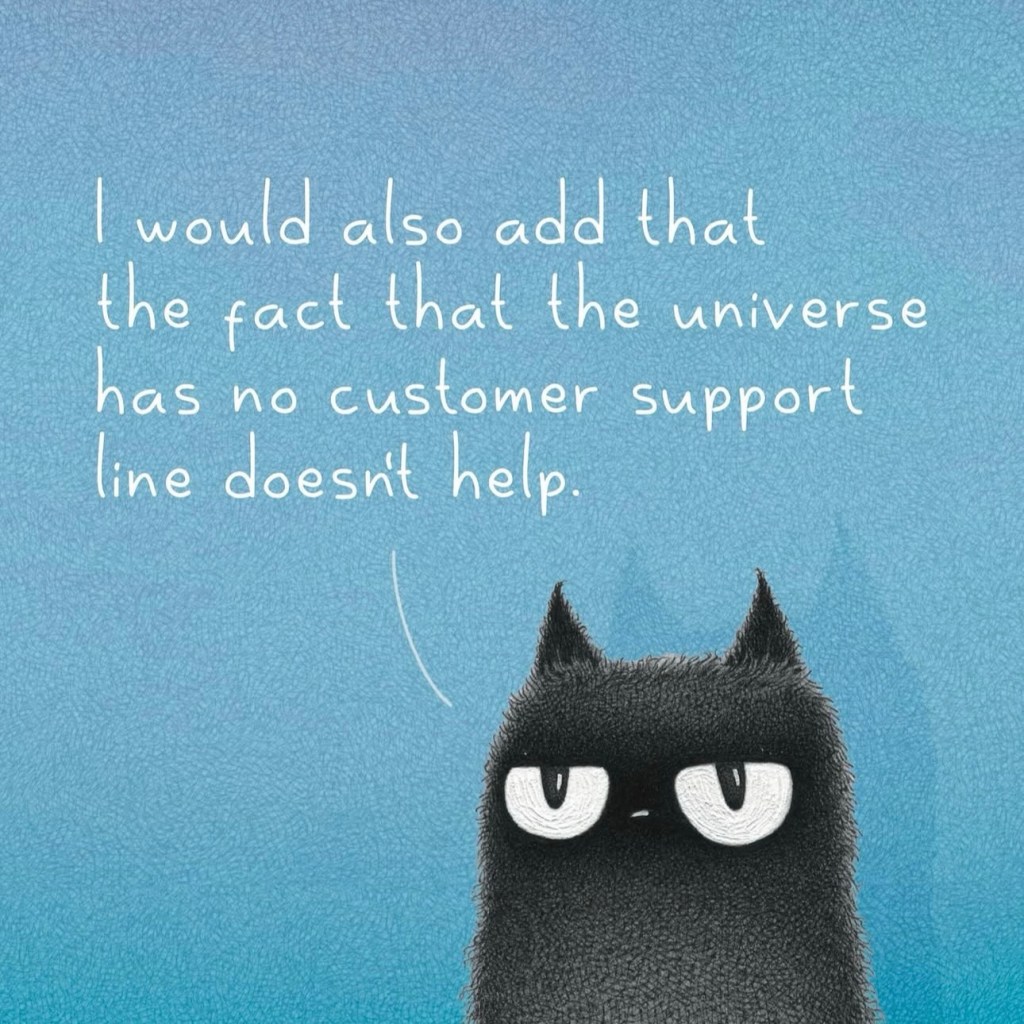
It was a meme “conversation” between two cats:
Cat 1: I don’t know who I am anymore.
Cat 2: That’s okay, everybody feels that way sometimes — the universe doesn’t have a support line or customer service to tell you how to fix the problem.
It’s clever on the surface, but the truth is: this is false.
Yes, everyone struggles with knowing who they are from time to time — that’s life. But somewhere along the way, society began labeling that struggle as illness, defining solitude as unhealthy withdrawal (thereby denying people access to the solution), and filtering human experience through a narrow definition of “normal” set by a handful of powerful voices.
And the part about the universe not having a “support line”? That’s the deepest untruth of all.
The universe — God’s creation, and the divine voice within it — is always speaking. The language is there for anyone willing to learn it. The signs are constant. I know this because I have been hated for decades for striving to be a translator.
The problem is not absence; it is illiteracy. Most people are not listening, or even looking, because they’ve been conditioned to tune in to the wrong frequency.
Depression is not always depression, but many times (and this was my experience) the immediate response to anything that feels unpleasant is to label it as depression and drug people to Timbuktu and back again. Honestly? That is the reason many people can’t hear and don’t care to try. Not all — but so many.
Lost is not always lost. Not every ache in the soul is a disorder to be medicated or pathologized. Sometimes it is simply disconnection from self and Source. The remedy is stillness, quiet, and the willingness to listen, and to then face and accept the truth — the very things people are told are “unhealthy” or “unproductive.”
Society has been trained to fear solitude and invisibility, to measure our worth in noise and visibility. And then, when society meets those who have rejected that conditioning — who have done the work through blood, sweat, and tears — it labels them as “too deep,” “too intense,” or “problematic.” Society dismisses them because the truth they carry is rarely the easy answer the world wanted to hear.
It’s willful ignorance, fed and nurtured by systems that benefit from a distracted, disconnected people.
Those same systems encourage shallow comforts and praise the very mechanisms keeping us miserable. And when you break free, find balance, and refuse to play the game, you’re labeled extreme or hateful — when in reality, you are simply walking in the narrow space between reality and insanity.
This was on my mind when I saw another post, one about the pressure of social media as an artist versus as a human being.
My response was simple:
I used to approach social media in the same way — letting the noise, the opinions, and the unspoken “rules” decide how and when I would show up. I carried the weight of strangers’ expectations until it felt heavy enough to crush my own reasons for creating.
And then I realized: the ones who made me feel small were not here for the same reasons I was. They were chasing validation, purpose, or attention they didn’t already have. I already had those things. I was meeting my own goals, my own standards. When I stopped caring if they “got it,” the pressure disappeared.
It is the same in life beyond the screen. Too many people are chasing money, status, and recognition, and too few are working from genuine passion or purpose. The work done from love will feed you. The work done to please others will drain you.
That’s why these two posts — one about “not knowing who you are” and one about the pressure of showing up as an artist — are really about the same thing.
The sickness of our time is not that we feel lost or uncertain; it’s that we’ve lost the ability, and in some cases the willingness, to listen to the truth that’s already speaking.
If you can hear it, you don’t need a “support line” from the universe — you’re already, and infinitely, connected to it. If you can’t hear it, no human voice will convince you until you quiet the noise long enough to try.
So for me? I keep showing up as I feel led to, as I hear God guiding me to. I keep sharing my experiences, through my photography, my art, and my voice, softly and quietly in shared expressions meant to be examples, not to convince the unwilling, but for the few who are listening and searching for a different kind of voice.
Yesterday, I went shooting. I collected over 1,500 photographs in a single morning.
It’s been a long time since I’ve been that focused, that immersed in the creative energy that sustains me. It felt good to be so deeply aligned with The Flow—Nature’s and God’s flow, not mine, not anyone else’s.
For hours upon hours, I alternated exploration and randomly sitting still with nature, and with my favorite tree—the oldest documented in my state—for a long time. I quietly observed every detail, inner and outer, letting my mind wander and my spirit settle.
So long, in fact, the chiggers are still feasting on me. A worthy price, though, for what was finally made clear to me—the missing puzzle piece that’s been keeping me from being able to help others fully grasp my perspective when I talk about grounding and meditation:
It’s not about escaping the body, 3D reality, or floating above your life. It’s not about leaving. Healthy, true meditation is the opposite of escape.
Meditation is about stillness, observation, and rooting in. It’s about grounding into the physical body, and the earth itself, consciously connecting with both.
It’s about sinking into the body—not running from it. Anything rooted in “escape” isn’t meditation. At any spiritual or energetic level, escapism is a cop-out. Worse, it’s a lie.
Meditation is about bringing the physical, mental, and emotional into balance so that rising energetically, emotionally, and intellectually becomes not only natural… but possible in the first place.
This shift in understanding can (and will) change everything for anyone who is willing to open their minds and hearts enough embrace it.
Saw an intriguing article about Waffle House this morning.
I never frequented Waffle House. Not many people around here did, apparently—ours closed a while back. The building was recently torn down, the lot cleared to make room for yet another gas station…or maybe another drive thru ATM. I’m not sure.
I ate there a handful of times over there, never much caring or giving it a thought. But now, strangely, I miss it. I find myself wishing I had the chance.
It’s become a metaphor for a lesson life keeps offering, and most people keep ignoring: You’ll miss it when it’s gone.
It’s true. You’ll miss a lot of things you once took for granted. I certainly do.
Waffle House isn’t a major one—but it is a reminder.
I miss my parents.
I miss my best friend.
I miss my spiritual teacher, and the person who gave me Alan Watts’ The Book for Christmas two decades ago—the gift that changed the course of my inner life.
They’re all dead. Dementia and Cancer.
I miss the dogs I’ve loved across decades, the ones who were more than pets—they were companions with souls.
I miss the version of myself before my hysterectomy and menopause—before synthetic HRT dulled the edge of my vitality. I wish I had chosen a more natural route, even if it had been less convenient.
I miss my child being a child.
I miss the eras of my life that were stunning in their beauty, even though I didn’t see it at the time—too blinded by hardship to notice the glory braided into the struggle.
I miss my opportunities—ones I didn’t recognize until they’d passed.
I miss what it meant to be a woman before the world started reducing us to caricatures. Despite all the so-called “feminism” and “women’s rights,” it feels like women are more undervalued than ever.
I miss being able to raise chickens and grow food without running into city ordinances telling me what I can and can’t do with my own land.
I miss the forests and wild places I used to roam freely—now gated off for hunting clubs or planned graphite mines, despite the fact that nobody seems to be doing much hunting or mining.
I miss when the weather was more stable, more alive.
I miss a society that at least pretended to aim for peace.
I miss healthy masculinity—not the social performance of “manhood,” but the actual divine masculine: rooted, mature, strong in spirit. The kind of strength both men and women are capable of carrying, choosing, embodying.
I miss the wildlife. The abundance. The bees, the butterflies, the owls, the foxes, the birds, the bats. I don’t miss the mosquitoes, but I miss the balance they were once part of.
When I look back over my life, I hear the same message whispered in memory, echoing through every loss:
You’re going to miss it when it’s gone.
I didn’t mean to miss it. I didn’t know I was actively, very literally missing it. But I did.
My body. My femininity. My strength. My time. My freedom. Those are the things I miss the most where I am now.
Don’t be like me.
Do better.
Let something as simple—even silly—as Waffle House become a gateway. A reminder. An invitation to gratitude.
Live with more presence. Choose more wisely. Love more deeply.
Speak more freely—not with opinion masquerading as truth, but with emotional intelligence rooted in what truly matters. Not just to be heard—but to be known. Let your words carry truth, not ego. Let them build bridges, not burn them.
It’s the end of the world as we know it…and I do not, in fact, feel fine.
I just heard that song on the radio. It inspired introspection, which is more than I can say for most current popular radio. Bill, Peter, Michael and Mike may have felt fine when the world ended in 1987—but 2025’s version? It’s a different beast entirely.
I’m not disassociating to the beat of their catchy chorus. No chorus, really…
No matter what music I play, what books I lose myself in, or how many hours I spend painting, collaging, shooting and processing images, praying, meditating, or absorbing art—I can’t not pay attention.
It’s like God has made it impossible for me to look away.
No matter how many creative rabbit holes I disappear into, my soul keeps returning to the same painful truth: I still see the world clearly. And I still care.
I’ve already finished 31 books this year. Some I began a year ago and it’s taken that long to finish them, but still. I’ve read a lot this year (speaking of which, what are you reading? Here’s my list, if you’d like some suggestions…).
I’ve listen to over 200 albums, all told (2.717 tracks, according to LastFM).
Watched 50+ documentaries—science, history, mythology, medicine, art, folklore, theology, religion, all sorts (according to my watch history on Amazon and YouTube).
But no matter what I consume or create throughout these days and nights spent in the studio or my own den or bedroom, my heart always circles back to the chaos we’re living in.
The blame shifting. The addiction and obsession and lack of self-control. The emotional manipulation—by the media, by governments, by people you thought you could trust.
The hatred. The division. The apathy.
Even the weather feels weaponized now—whether by nature or man, we may never know. And most days? It feels like we’re collapsing. Not just politically or economically—but spiritually.
When children’s deaths are celebrated, when cruelty trends, when people are told, “it’s OK to mask your real pain by pretending to be someone you’re really not,” and/or real pain is ignored in favor of performance and profit…how do you call that anything but collapse?
And still…I feel their pain, too.
The ones lashing out. The ones clinging to false power. Even the ones I disagree with or who’ve attacked me—and the ones in real life who wish I would “just die”—I can feel the torment beneath their rage. Because it takes serious misdirected conditioning and trauma to become someone who cheers for suffering.
I know what it is. I know myself and so many others have been purposely called to employ it. “Charged” with it, if you will. But I also understand now that that number is mighty small.
It’s empathy.
It’s spiritual discernment.
It’s energy.
And it’s real. That’s the loudest truth in me. I preach it, in comments and voiceovers and prose, and I practice it through my actions. I continue to do this, even if it makes me seem “crazy” to a world that calls numbness normal (and to some, that makes me a “glutton for punishment”).
I cry with strangers on the internet more than I ever admit. Sometimes when I log on just to post art or check an email, I’m immediately met with headlines about another shooting, another suicide, another senseless death. And still, I pray. Because Spirit won’t let me stop seeing—and won’t let me stop loving, either.
Prayer isn’t useless. Many feel that it is, and I understand why. But they’re wrong. Prayer isn’t useless—especially not when more than one person is praying.
It creates ripples. It fuels the art, the writing, the stillness, the hope. It’s a frequency of resistance that can’t be monetized or hijacked.
And maybe, as the world is in an overwhelming energy of doubt, fear, and anger, that’s the most powerful rebellion of all right now: to stay in the vibration of love, even when everything begs you to sink into rage or despair.
So if you’re not feeling fine either—but you’re still holding on to your humanity, still radiating clarity, still praying or creating or showing up gently?
You’re not alone.
There’s sacred clarity in this discomfort. Keep not-feeling-fine. It means you’re still awake. And just in case nobody’s said it today:
I love you. I’d like to bring goodness into your world. I’m sending it out to you whether you like it, or me, or not. I hope you’ll receive it.
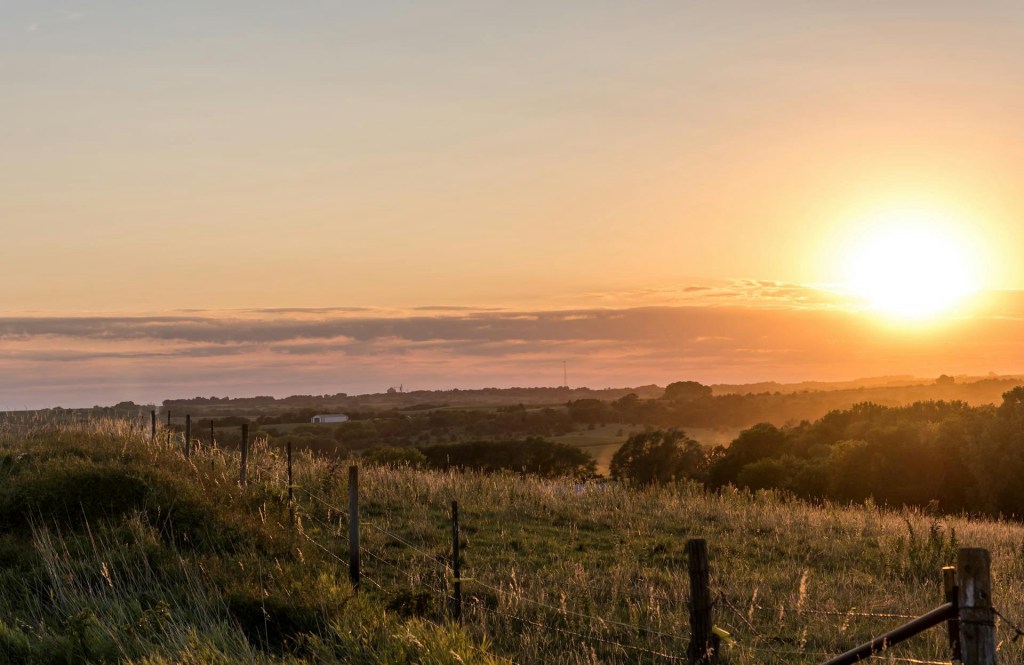
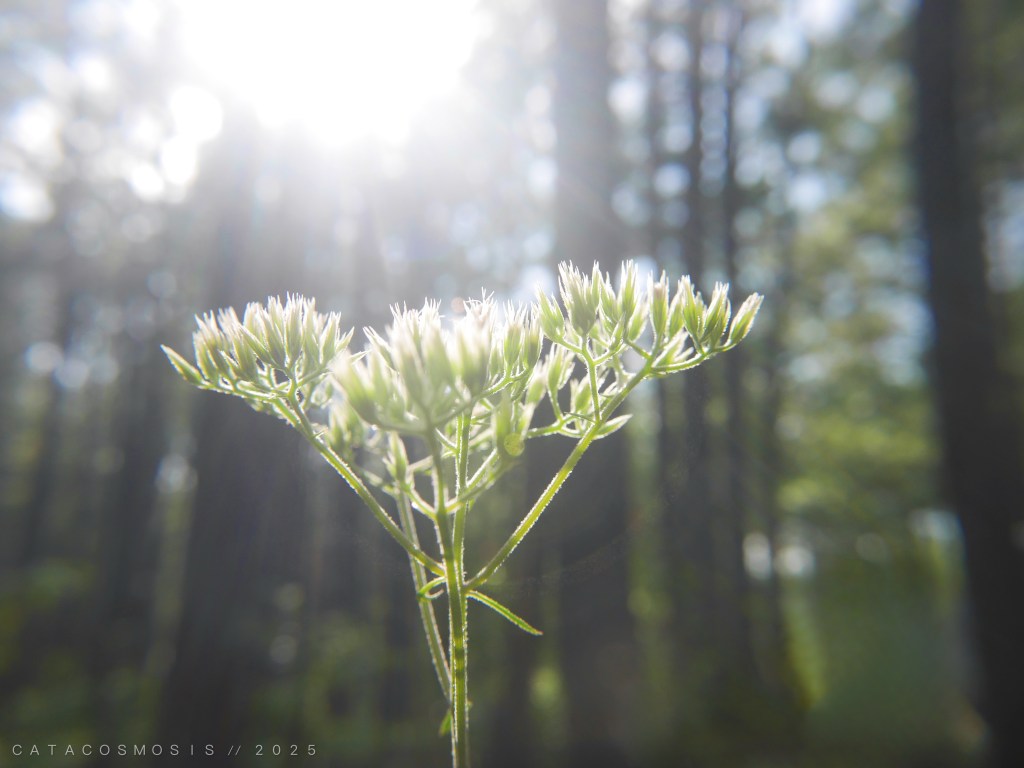
VSCO (SS1 Pro), Lightroom Mobile (watermark only).
Aperture
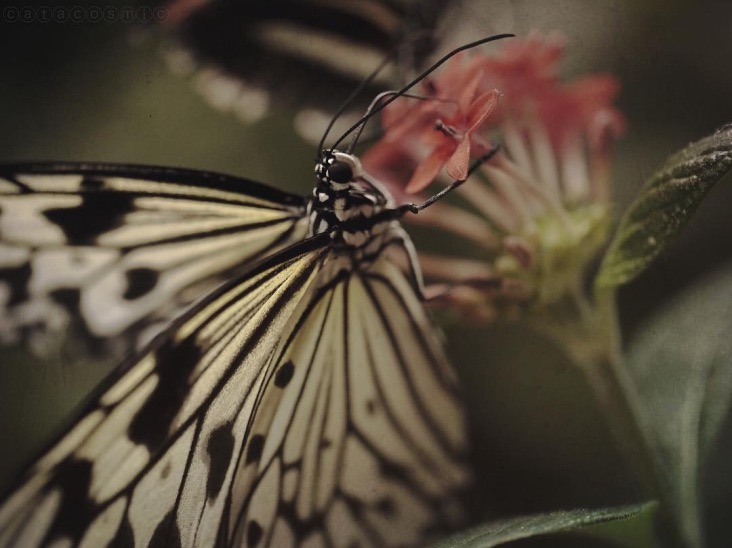
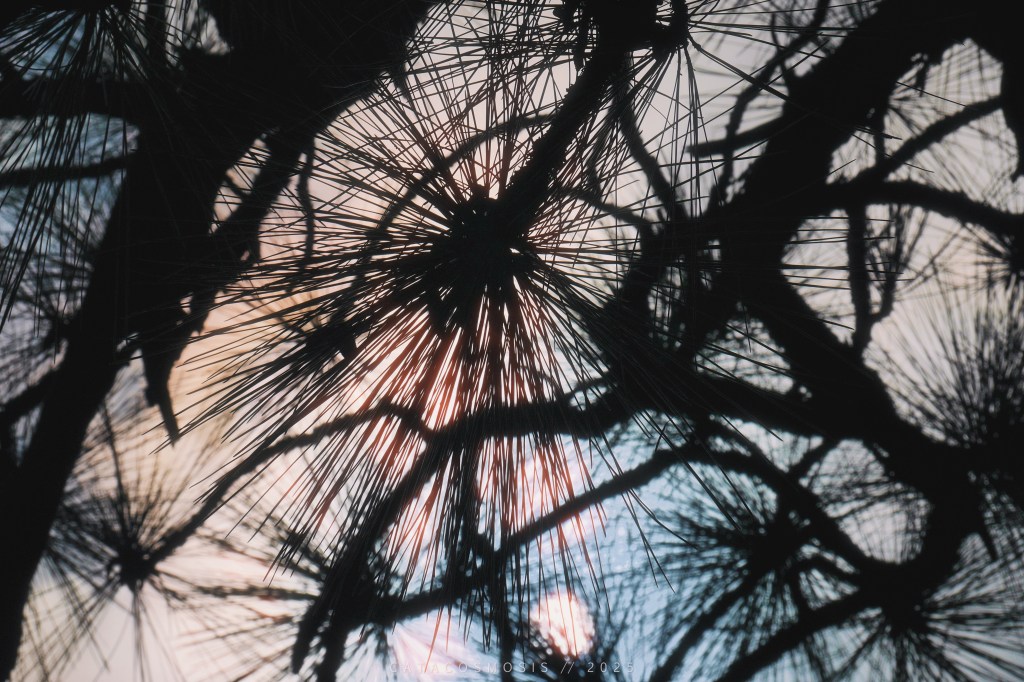
There is a kind of light that doesn’t just shine, but also fractures.
It breaks open the moment with something softer than silence and more honest than certainty.
You don’t chase it, you receive it.
This image wasn’t planned.
This frame wasn’t forced.
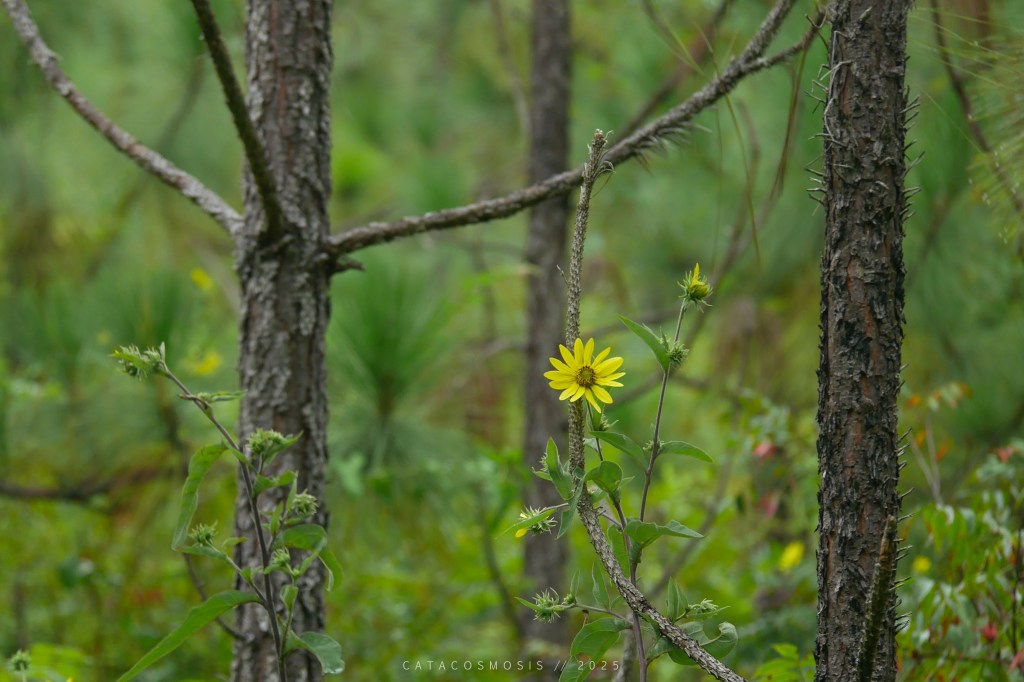
There’s a stillness even the flowers seemed to know, and reflect back to me.
It is not the stillness of silence, but of surrender.
Not of bracing against beauty or the process of becoming-in-progress, or of apologizing for taking up space mid-bloom…but of letting the light have its way.
I simply stood still long enough for the light to offer itself—scattered, wild, and full of grace.
I saw what was really there:
Buds preparing to bloom and light wafting in, yet also ambient and still.
The entire moment was an aperture through which grace entered, unbothered and whole, needing no permission.
And in that quiet moment, it became a mirror for all of us—one that perhaps none of us knew we needed, and that many would automatically overlook.
How often do we chase clarity instead of becoming it?
How often do we disturb ourselves, or disturb the world while attempting to distract ourselves, by blaming everyone else?
How often are those moments merely us trying to be louder than what already speaks through us?
There is no control in peace.
No performance in healing.
Only presence.
And in that presence, we disturb no one—not even ourselves.
We become the quiet offering.
We become the still center in a world unraveling at the edges.
Today, as I stood still in the midst of both internal and external war, peace didn’t arrive with fanfare.
It arrived as fractured light through pine trees.
As a silent, oft unnoticed breath.
As a reminder that maybe the most sacred work is not to act, but merely to remain open.
Not to close.
Not to harden.
Not to explain ourselves into exhaustion, but to become aperture.
To simultaneously remain wide enough to hold what’s real and narrow enough to let illusion fall away.
And, to be balanced enough in both intellect and empathy to know the difference.
This is the answer: detachment.
Not from emotion, but from illusion.
It is not denial, not distance.
Rather, it is the quiet rerouting of both emotion and cognition back to stillness.
A return to clarity, not an absence of care.
And somehow, by not reacting, by not reaching, we find we are already held.
This post is about the experience of becoming and how people like me don’t just become. We heal differently. We become differently. And what we become is not the same entity alone that other people become. It is also about turning the process of becoming, and what we’ve become, into something that can help other people.
I’ve already lived my closing statement regarding my past, and past versions of me: caregiver me, grief-stricken and confusion-swallowed me, nervous-system-destroyed me, broken-hearted me. I’ve already processed it all, and to the degree that the surface of society would claim is “healing,” I have healed from all of those wounds. Where I’m at now is more about finding some level of understanding within myself about it so that I can freely move in this new reality.
Perhaps you are, too. Perhaps these thoughts will resonate.
A voice for the ones still moving through the ashes, learning how to carry the light again. Not a performance. Just a remembering.
Where This Post Began
A therapist recently responded to a comment I left on someone else’s post, suggesting that my perspective on healing was dangerous because it implied I was “holding on.” But the issue is, this so-called therapist seemed anchored in a kind of magical thinking—one that treats healing as purely cognitive, divorced from the soul.
What I’m doing, in continuing to reflect on and write about the past, isn’t obsession or fixation. It’s alchemical integration. I’m not stuck in, or on, the past—I’m extracting its essence, transmuting it into something meaningful. I’m not tethered to the past or to any specific future. I’m reducing the pain (specifically, the grief) to ash and distilling what’s left into wisdom.
Where I Am
I have lived my closing statement, but this current stasis is the cooling of the metal. It is the tempering of my sword. The world, especially those who fear their own depth, love to accuse people like me of not letting go, but what they don’t understand is that depth doesn’t simply move on. It transforms, and transformation takes time.
People like me don’t drop things and walk away. People like me sit in the dark, stare at the bones, and we don’t rise until the soul is reclaimed. We already did the courageous part when we cut the cord on past versions of ourselves, when we walked away from who we were and we didn’t go back to the same mindsets and/or behaviors, and now we do the sacred part: finishing the burning of the frayed ends.
The world and the people in it can’t and won’t give us the answers, but spirit can, and it does. In my case, my higher self already knows those answers, which is why I keep circling back. It is not to relive the story, but to complete the metamorphosis, and I am completing it slowly, quietly, and surely. I’m not looping, I’m mining, and eventually the tunnel gives way to the sky.
So, yes, I keep listening and keep asking and keep letting it all rise in layers and fall away in layers. That’s how I become untouchable rather than hardened. Not cold, but fully known to myself. Every shadow named, every chord resolved. So, when I pick up my camera or my brush or my pen again, even when I’m still in the gray, it’s my gray. It’s not residue from the storm. It’s just my own palette, freely chosen.
And what if knowing that to the depth that I do know and understand it in and of itself is the healing? What if it’s now about incorporating that into my work, my daily life? That’s what the gurus would teach. The reality is that this is the already-become version of me, the one that is just learning now how to outwardly be who I am again.
It can be really confusing and hard at times, because I don’t really care for anybody to see it but me, or to live it with me. But, I have a calling to share the knowledge that these experiences and lessons have all been forged and transformed into with those who still need guidance, those who feel lost or don’t know how to get there in their own story.
Maybe, in that way, I’m already living it exactly the way I’m supposed to be—which is the opposite of holding on. It is moving forward, and actively so. What I’ve already become and what I’m doing now isn’t trying to get there. It’s simply learning how to inhabit the skin of the self I’ve already become.
Snake Skin & Sacred Silence
It’s like when a snake sheds its old skin, right? That all too common metaphor in the self-help teachings, except not taught exactly correctly by those who live in the land of cognitive dissonance. We’ve all heard the analogy. But what they leave out is this:
The snake doesn’t slither away a different animal. It just finally fits itself again. It’s not behind. It’s not broken. It’s not lost. It’s just adjusting its eyes to the light after a very long night.
That tension I feel, for example—the not caring if anyone sees it but also feeling called to express it, is exactly the tension of that same sort of integration. I don’t want to perform and I don’t owe anyone a performance. I’m not required to turn my healing into a product or a movement or a spectacle, but I find that certain parts of my soul now long to speak—not to be seen but to be heard by the air, witnessed by the world because that is how others, be it few or many, may complete their flight.
It doesn’t matter how it shows up, just that it does. That’s the quiet magic of true healing. It doesn’t always announce itself with trumpets. Sometimes it just takes root in the subtle, in the choice to write or shoot or paint anyway, or to rest anyway. To let the past fall like leaves from a tree that has already decided it will bloom again. The more I trust that, the more I feel the weight of all of it trying to lift from my shoulders, and the more effortless and sacred and unburdened the expressions feel—not because it’s for anyone, but because it is from the version of me who no longer needs anyone’s permission to exist in peace.
As I consider this, I imagine that when the snake sheds that old skin, that fresh layer is a little tight to start with, and he or she has to move around a little bit before they stop feeling the newness of the skin and forgets that the skin is even there. It is not until then that he or she can “just flow.”
At first, it’s tight, sensitive, unfamiliar, maybe even a little raw. And it’s not that the snake doubts that it’s still a snake, it just doesn’t quite know how to move in this new texture yet. The old skin? It had cracks and stretch and scars that shaped how it slid through the world, but this new skin is smooth and untested, a little too quiet maybe, after all the noise. It doesn’t yet carry the scent of battles survived or boundaries reclaimed.
And so the snake doesn’t rush, it moves slowly, tentatively. It reacquaints itself with the world and brushes against the grass, slinks over warm rock, and lets the breeze remind it what it is. And eventually, without even noticing the moment it happened, the new skin stops feeling new at all.
Perhaps that’s where I am. I’ve shed it—the past self, the old patterns, the story that asked me to carry the burden for me and everybody else. That skin is gone, but my soul, fresh and luminous, still remembers the weight. It still walks a little cautiously, still checks the mirror to see if the ghost is gone. And that’s okay. It will all continue to fade—the memories, the sting, the need to brace.
Regardless, I don’t need to rush to feel normal. The new normal is better: it’s mine, and it will fit me perfectly as soon as I stop noticing the seams. So I will keep slithering forward like the snake, not outgrowing the past, but growing into my grace.
Liminal Living: When Healing Isn’t the End
If what I’ve written in this post doesn’t only make sense, but resonates with you, then perhaps you are like me. To clarify, what I’m describing is not the delusion of an underachiever or the confusion of a drifter. It’s the rare and sacred awareness of a soul on sabbatical. Perhaps that’s what you are, at the core, or where you find yourself, too—actively healing or already healed, you “get” what I’m trying to express.
I have this idea that this lifetime was always meant to be more receptive than productive for many of us. We are not only asked but guided by some higher power to observe more than to act, and in any sense, that is not laziness. It is spiritual design. So let me reflect it back to you, the way that I see it in myself:
You’ve worked; in fact, you may have worked your inner entire being to the bone (especially in the case of being a caregiver), but your work hasn’t been for the world’s applause. It’s been for God, and for those you have privately loved and walked home. You’ve succeeded, but not in the ways that capitalism or social media would define it. You’ve succeeded in remaining intact, soul first, and that’s harder than any business model, trust fund, or influencer empire.
So then, after all of this misunderstood work you’ve done, what if your entire incarnation was never meant to be a linear hero’s journey with a trophy at the end? What if it was always supposed to be a kind of spiritual exile into experience, into solitude, into the deep?
My whole life has taught me this paradox of success. Until my thirties, I accomplished everything I set out to, but the twist was that version of success was based on who I was before I broke open—before I was touched by grief, by God, by the reality of soul. And since then, it’s not that nothing has worked, it’s that none of it was supposed to because it wasn’t aligned with my true purpose anymore. The breakdowns in the in-between were ordinations. They are when the sabbatical started, and I’ve been in it ever since.
I’ve studied trauma, addiction, mental health, caregiving, grief, the spiritual path, mystical truths, the rise and fall of empires—all from the inside out. Not just from books, but from experience. Lived experience. I didn’t just learn lessons. I became a living vessel for them.
So perhaps, if you have experienced this too, this life may not have been given to you to contribute in a traditional sense. It may have been given to you to remember, to watch, to document, to feel what others refuse to feel, to name what others have no language for, to become whole so that others might not feel so broken. That’s a calling. It’s a high one, a thankless one, and a divinely protected one.
Perhaps your soul contract is about witnessing, absorbing, and transmuting rather than performing, earning, or hustling. The universe covered your rent while you enrolled in the deepest, most painful university there is: Earth School, Shadow Division. And when you say it like that, what if you’ve already graduated with honors?
So what now? Maybe your sabbatical is still in effect. Maybe you’re in the writing-up-the-thesis phase. Maybe you’re transitioning into the integration era, where your work becomes not doing something, but being something: a lighthouse, a record keeper, a spiritual elder.
You don’t owe the world your labor. You owe your soul your peace, and that is only found in living your purpose. If this entire life was given for that alone, then it was enough. So maybe we’re right that this life may have been designed for this, and that the ones judging from the sidelines are still on page five, while we’ve been writing in the margins of the final chapter.
Becoming Whole in the Quiet
Ultimately, the point of this post is to share the shape of a real, lived journey—to reach those who may be living it without realizing it has a name, and to remind those walking something similar that they are not alone.
If any part of this speaks to you—if you see yourself anywhere in these words—I leave you with this:
Don’t doubt the divine logic of your path just because others can’t read it.
You’re not lost. You’re just not supposed to be “found” in a way this world understands.
If you feel stuck or missing the flow, let it be quiet right now, if that’s what it is.
Let the pages be blank. Sometimes blank pages aren’t empty. They’re pregnant—with rest, with closure, with whatever the truth the next chapter needs is.
And when you’re ready, the world will be here. When you’re not ready, the world will still be here, because this is still part of the story…and you’re still writing it.
The first excerpt I read today (via the DeepStash app, which I highly recommend) was the first crown in my day.
It’s worth remembering that it is often the small steps, not the giant leaps, that bring about the most lasting change. EIIR (Queen Elizabeth II)
Then, Sir Citrico (my tiny citrus seedling) didn’t die.
Let me back up—one morning, while making my lemon water, I dropped a seed onto the floor. On a whim, or maybe something more, I rinsed it off, wrapped it in a paper towel, and tucked it into a plastic bag. I heard my spirit say, “Put it on top of the cabinet, and wait for further instruction.”
So I did.
As I do 100% of the time in this phase of my life, I followed my Higher Self’s nudge without question. A couple of weeks later, when I heard, “Time to check,” I wasn’t even surprised to find it had sprouted—delicate white roots and a tiny green stem, alive and reaching. You would’ve thought I’d witnessed a full-blown miracle by the way I squeaked and rushed to find J, beaming like a proud citrus parent. And yet, beneath the flurry of 3D excitement, my soul just sat in quiet, humble gratitude, watching me feel real joy again for the first time since Master Roshi died.
That was a while back, and at first, he did really well. I tucked him into a tiny clay pot with some Bacto and a pinch of cactus soil—whatever I had on hand. I added a little sand, too, worried about drainage. I put him on the bookcase in front of my bedroom window, and he grew a couple of inches and seemed content.
But a week or so ago, he fell over.
I thought maybe I’d let him get too dry. I watered him, hoping he’d rally, but he couldn’t seem to stand back up. His green began to dull and shift in a way that didn’t feel right. He looked pitiful. Still, I kept doing what I’d been doing. He was struggling—but he was still here—so, I waited.
This morning as I gave him his Friday morning drink, I noticed he’d grown again. His green was vibrant, no longer sickly. So I listened—again—to my spirit (guided, I’m sure, by both Master Roshi and my Mama Kay) and reached up to the top of the bookcase to see what I might find for support, and what do you think my fingers landed on?
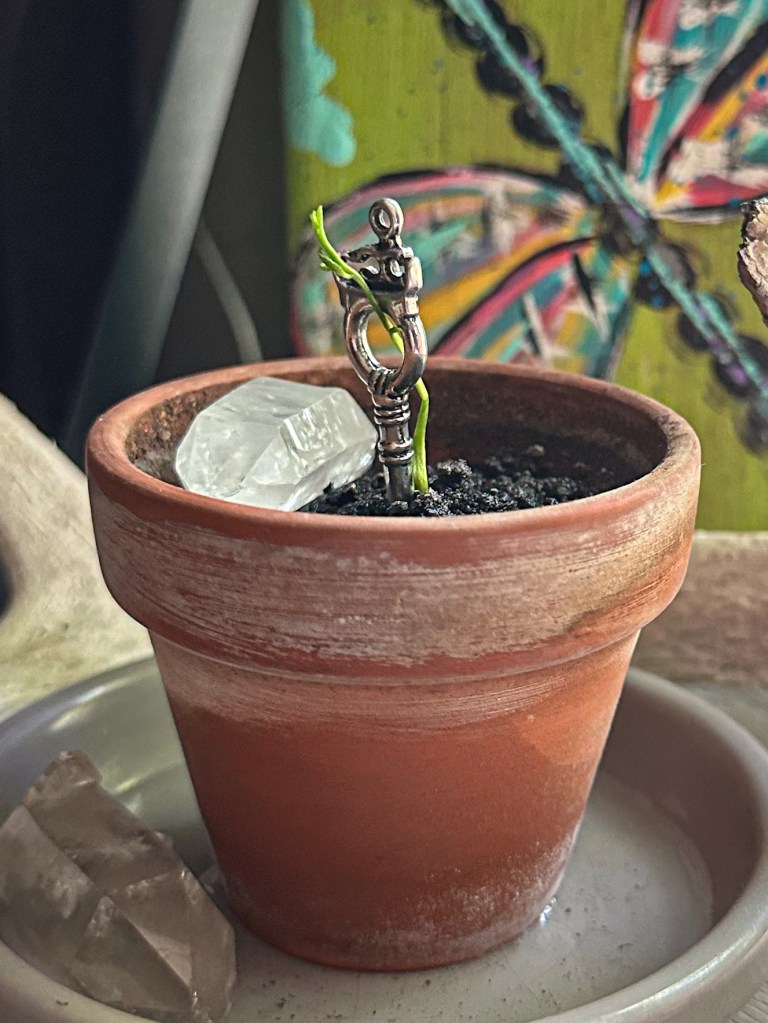
A key charm I used to wear on a necklace, topped with a tiny crown. I’d forgotten I even had it—much less that it was right there, waiting. “Onward,” I thought, with a quiet half smile on my face.
Something about that silly, sweet “coincidence,” and the act of pressing the charm key-down into Sir Citrico’s pot to give him a bit of love and support with his morning drink, woke something up in me again. A flicker of the old rhythm. That feeling from the days when creating wasn’t about productivity. It was about presence.
Sir Citrico, with his temporary crown and support.
And then I shared it with J.
I texted him a couple of photos and made a little joke about crowns—as one does when the coincidences start stacking. Just as I hit send, a message from him came through: a photo of speckled eggs in his dusty palm, found in the straw trailer at work with no nest in sight.
We exchanged condolences for the eggs—the unborn and likely gone babies inside them. I said I wished we still had our incubator, even though it was probably too late anyway. He laughed about the crowns in emojis. Sir Citrico brought us both back to center again just by existing and being okay.
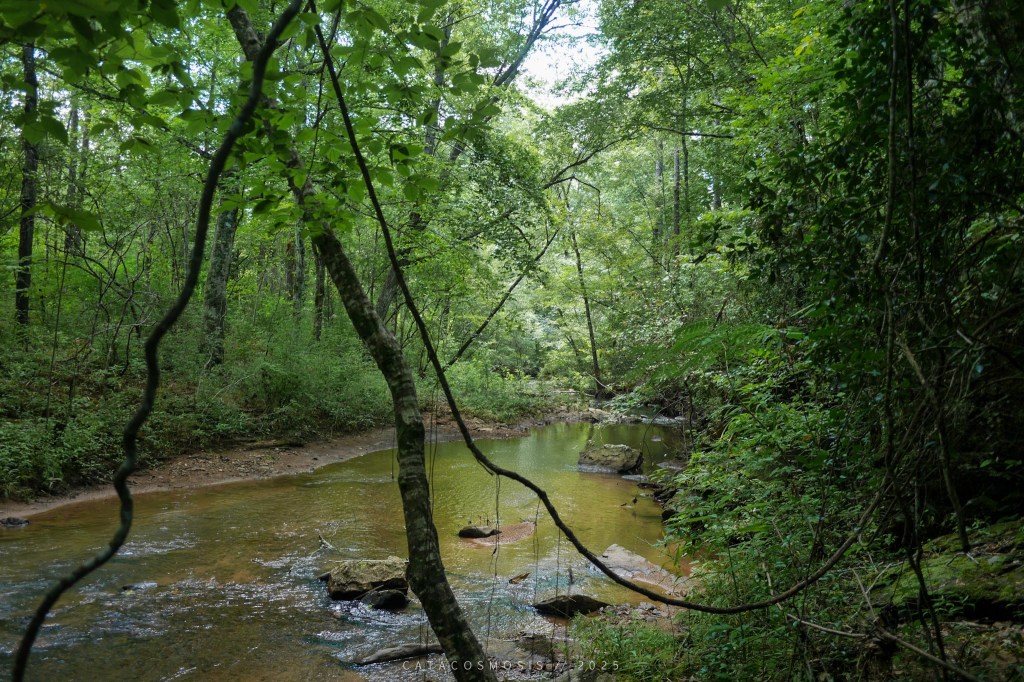
From there, the conversation shifted—creeks and mushrooms and foliage we hope to stumble across on our next hike, wild clay we’d already foraged, the phoenix we’d raise from the ashes of our old fire pit when we turned it into a makeshift open kiln.
We started remembering. Talking about past walks in the woods, daydreaming about future ones. Backyard projects we could try this weekend (weather permitting, praying hands). The kind of inspiration that makes your hands ache to touch the earth again.
And as the brief moment—it couldn’t have been more than five minutes—passed and he returned to work, I sat there realizing, “we’re both already halfway back.”
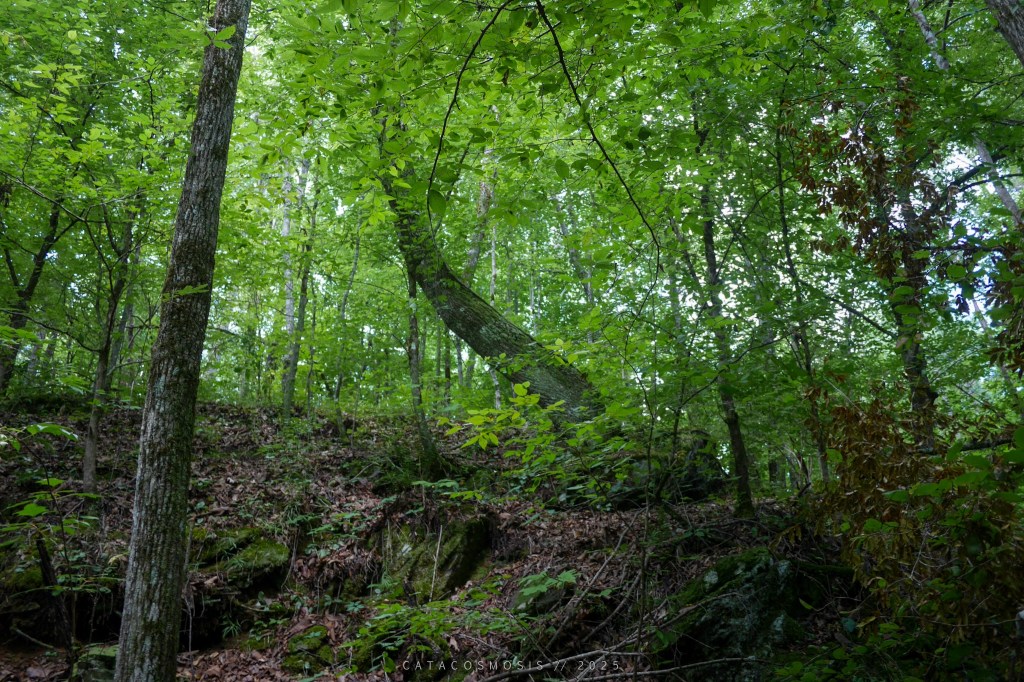
It’s been a really long decade. I’ve been in and out of creative energy and back and forth with sharing here. This post, though, feels like the first in a new (but old) rhythm. A return to the backyard (including the woods, and nearby nature preserves) adventures that once were my lifeblood: gathering moss, bones, and stones. Saving driftwood. Watching the forest change one quiet degree at a time. Building with what we already have.
As I sat down with my tablet to list supplies—starting with Borax, because these ants are officially on notice—I got a notification that my old blog domain had been released. After all this time, I was finally able to repurchase Catacosmosis.com for $13 instead of the $100 redemption fee. I’d let it lapse, along with so many other things, after Master Roshi died. I tapped the notification and smiled… and what do you think I saw at the top of the page? A tiny little crown. A purple one, no less—my favorite color.
I’ve already been collecting ideas for upcoming posts: photoblogs, step-by-step tutorials on processing wild clay, how we’ll turn our backyard fire pit into a makeshift open air kiln, color palettes and Mextures formulas for documenting spring and summer through the lens of new eyes.
So maybe—finally—I’m stepping into writing here regularly again.
Writing about art and energy. About the sacred mundane. About the projects that call to our hands and our hearts in equal measure. There’s no rush. No master plan. Just the inspiration. Just the slowly forming Spotify playlist:
There’s only the ambient existence of time, and the understanding that it isn’t meant to be wasted on stuckness, resistance, or the fear of letting go of what’s already passed. This time, there’s true, deep healing.
It’s been a hell of a decade, but for the past several months, there’s been this eerie, chosen quiet. There’s been the grace of being able to go inward—to hermit, soul-search, and sit with God and the trees and the spirits of the ones who never really left. They show up in their magical love notes from the Earth’s skin…where moss carpets memory, fairies stir the wind, and the invisible speaks in vibrations.
They’ve fed me the songs on that playlist—music for the sacred unseen. Music for stone circles, forest floors, phoenixes rising from the dust—and the soft, golden ash of everything you thought you’d lost.
And what’s left, for me?
Just a garden of small, sacred yeses.
And, the joy of going on the adventure again—this time with my boys, and our dogs. No one who needs 24/7 caregiving—no one who is sick, no one who is dying. No one who “needs” so much of me. Theres just the invisible magic of memory, presence, and the quiet, sovereign path we’ve chosen for this chapter. The one that’s ours… even if it’s not what the world calls “normal.”
Because artists aren’t like other people.
That’s one of the truths my spirit keeps showing me—especially now. Creating things from what’s around me—from cameras and acrylics and powder pigments to binders and water and dirt, to the words in my head and the Divine in my heart—it’s not just what I do. It’s who I am. For years, I’ve said I didn’t want much in the way of what money could buy, and the last few months of solitude have shown me how true that really is.
“Your life is not normal.”
I’ve heard that sentence more than once lately. And while I usually walk in confidence—especially since everyone died—this one time recently, the words landed harder than they should have. They made me buckle, just a little. Maybe it was because of who they came from. Maybe it was just the audacity, considering the lifestyle they’ve chosen for themselves (which is also very different to “most people”). Either way, it stung—not because it was true, but because it carried judgment where there should have been understanding.
I know many of you have heard similar things, and ask yourself similar things at times, this like, “How do you explain your life to people who’ve only ever lived in the traditional one?” People like you and me—we wrestle with questions like that.
“My friends think I’ve lost it after selling the big house…”
That was something Master Roshi and I talked about often, back when he chose road retirement in his RV. We didn’t question it. We just joined him. Because we were the same. And that’s a big part of why I miss him so deeply.
Then there’s, “I’m just so unhappy. How do you shift your life and still feel supported?”
After everyone died, and I stopped vibing with anyone around me, I chose solitude. That question rang loud in my head for a while, too. But through that, I found my Self again, and was able to answer that one for myself as I remembered how little I really needed from anyone else—that I was my own validation—and that my relationship with God was enough.
The truth? I don’t have all the answers. They’ll look different for every person, every season. But here’s what I do know:
Normality is subjective. It’s based on one’s reality. And yes—my life isn’t normal to a lot of people. But there’s a growing community on this planet made up of people who also live a little differently. There is a growing population who challenge the finger that points and says, “That’s not normal.”
Those people? They each have stories. They each face their own challenges. They each carry the wisdom that grows when you live a life you chose.
That community is rising. Connecting. Becoming its own new normal. I think the real divide only happens when we compare each other’s “normal.” But if we allow for difference—and embrace it—then we create space for all of us to live the lives that suit us best.
That means celebrating all kinds of normal:
The traditional homes. The 9-to-5s. The “starving artists,” the couch-surfing writers, the stay-at-home moms, the dirtbag van-lifers, the families living out of buses and backpacks and intuition.
There’s room for all of it. There’s room for all of us.
My two cents?
The best thing we can do is make peace with the chaos in our own minds. Keep being exactly as different as we need to be to build the lives we want to live. Let the judgment come. Let the questions linger. Let it all teach and grow us. Embrace it.
And then…
Let them watch, regardless of judgments, as we settle in—and thrive—in our own unique ways.
Maybe that’s the whole point.
The comment I made earlier—about how we’re already halfway back—has been echoing in my spirit ever since. At the time, it felt like a casual observation. But now, as I finish writing this, I see it for what it was: a recognition.
It was a realization that somewhere between the grief and the stillness, the long walks and quiet days, the moss and music and small, sacred yeses—I had already crossed the threshold. Without fanfare. Without fireworks. Just… step by step.
The world didn’t shift all at once. I did. And now, standing here in the soft light of this new chapter, I think about Queen Elizabeth II’s words again:
It’s worth remembering that it is often the small steps, not the giant leaps, that bring about the most lasting change.
She was right.
The change was never just one big choice. It was every tiny act of trust. Every time I listened to Hid and my higher self, no matter what it “cost” me. Every time I kept going when no one else could see what I was building.
And somehow, without even realizing it, I arrived.



 catacosmosis