
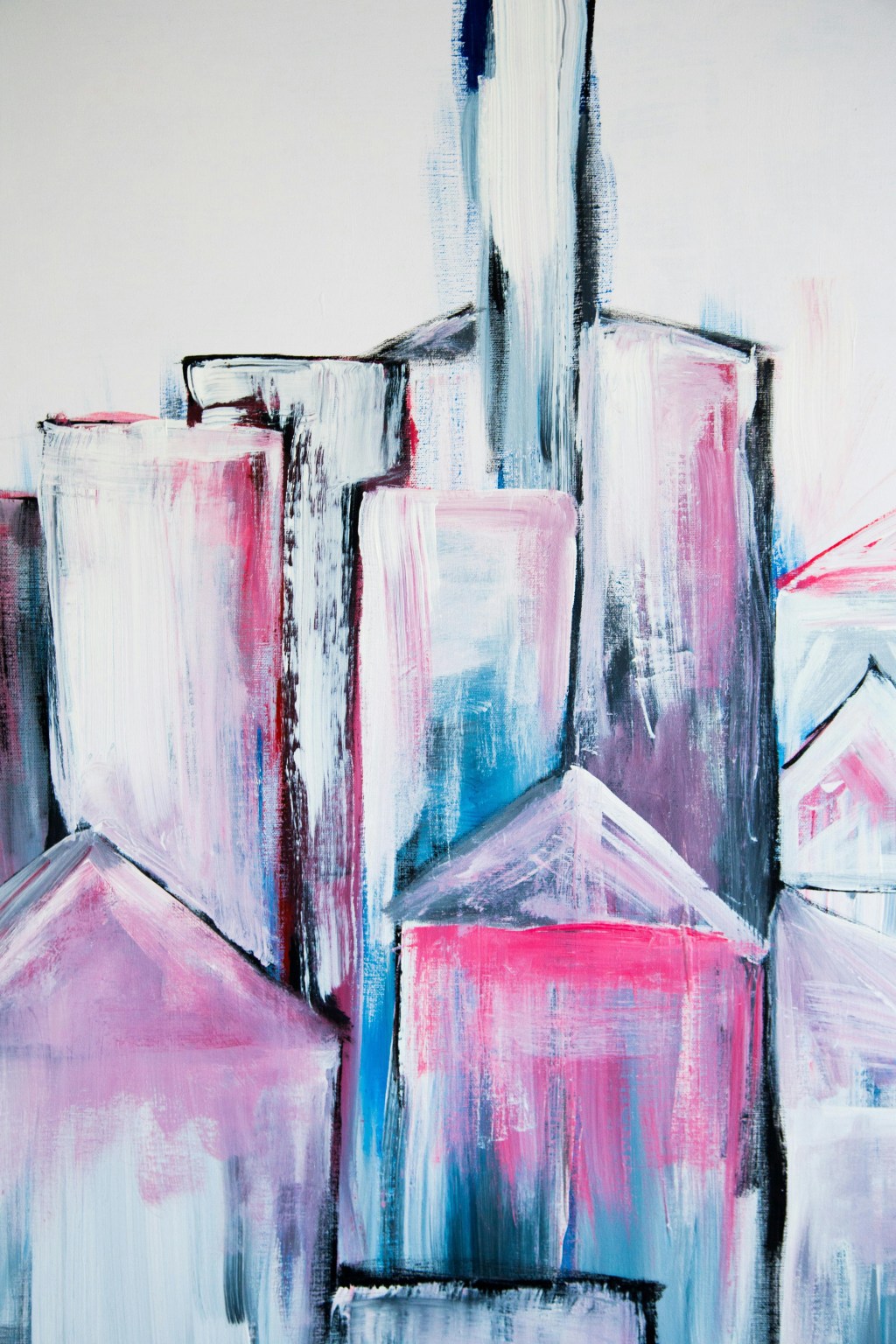
Every so often, I experience what I call the freeze.
Artists will know exactly what I mean. It is that moment right before you begin a new piece, canvas blank and supplies ready, when something inside you locks up. You want to move, but you don’t. You know what to do, but suddenly you can’t do it.
It’s not laziness and it’s not a lack of ideas. It’s more like a quiet paralysis, the sense that whatever you do first will somehow be wrong, wasteful, or irreversible.
I experienced that tonight, and it surprised me. I haven’t frozen like that in a long time.
Maybe it is holiday stress. Maybe it is the cumulative weight of life, reality, and empathy for a world that feels perpetually on edge. Maybe it is something smaller, or something that would sound completely absurd to anyone watching from the outside. But absurd does not mean invalid.
Any time we experience something like this, there is a reason… and I am the kind of person who looks for it. I look inward and outward, I sit with the discomfort instead of trying to bulldoze through it, and I pay attention to what is actually happening in my body and mind.
I find that process purposeful, and sometimes even enjoyable, not because it’s comfortable but because it gives me agency. When I understand what is happening and why, anxiety loses its grip. I can experience it and coexist with it at the same time. More often than not, that approach resolves the issue in a deeper and longer-lasting way than simply forcing myself forward.
So this is the internal conversation I had tonight, and how I talked myself through it once I reached a clearer understanding of what was really going on. This is where my professional training in psychology meets my self-taught training in art, I suppose.
If you have similar experiences to what I’ve described above, I hope some part of this is useful to you.

Step 1. Pause for a moment. Not to analyze or fix anything, just to name what is happening. Once something is named, it tends to lose a surprising amount of its power.
What you’re feeling when you experience “the freeze” as soon as you pick up a brush or a palette knife, or face whatever in life it is that makes you freeze in a similar way, is not a personal flaw. For artists and creatives, it’s not proof that you are bad at being creative.
It’s a very specific nervous-system response, and it shows up most often in people who actually care about what they are making. In psychology, this response is often described in a few overlapping ways.
It can be understood as a conditioned approach and avoidance conflict within you, where the part of you that wants to create is simultaneously held back by fear of loss or failure.
Funny story: I wrote an entire 23-page research paper on this in my junior year of undergrad. In my opinion, it was incredibly boring, personally insulting, and the worst three months of my life at the age of 21, but somehow I shockingly got an A.
I digress.
It can also appear as performance anxiety, though not in the social sense, more as an internal pressure to do it right. For me, it is absolutely perfectionism as a defensive strategy, a way of protecting myself from imagined mistakes or wasted effort (thanks, Mom, may you rest in peace). In many cases, it can even be the brain or your physiology responding to dorsal vagal activation, which includes fight, flight, freeze, or fawn, but we will not go that deep here.
To put it in easy, normal language, this reaction almost always appears right before commitment. Any commitment, but especially one that means “if it goes wrong it’ll really cost me.”
In the art scenario, up until this point, the work has existed only in imagination. In that space it is infinite, perfect, and safe. The moment you are about to touch the canvas, it becomes finite and real. Something is chosen. Other possibilities fall away. Your (my) system hears that as loss, and it tries to protect you by freezing you in place.
That feeling that it has to be a certain way to be right is not creativity. It is internalized surveillance. Somewhere early on, many of us learned that mistakes mean waste, mess means failure, and a wrong choice causes permanent damage. Even when those rules no longer apply, the body remembers them. So when you are free, your body does not quite believe it.
That is not weakness, or incompetence. It is conditioning that has simply outlived its usefulness.

At the center of this response is a quiet lie: “If this turns out bad, the supplies are ruined.”
That is just not true. Acrylic can be scraped, painted over, sanded, cut up, or turned into texture. A canvas can become a foundation rather than a final statement. Materials are meant to be used. That is their purpose. Paint that sits untouched out of fear is already wasted.
Canvas is not sacred. You are. Please remind yourself of that immediately, and lock it in.
Another lie slips in just as easily: “It has to be a certain way to be right.”
Right for whom? There is no audience in the room, no rubric, no grade. There is only motion, pressure, color, and the physical relief of making contact with the surface. Art does not exist to behave! Remember?
This kind of freeze does not happen to people who do not care. People who are shallow about creativity do not spiral like this. It tends to happen to people with depth and sensitivity, to people who were corrected more often than they were encouraged, and to people who learned how to perform before they learned how to play.
The nervous system is not sabotaging anything. It’s trying to protect something precious: the ability to feel and express. It’s simply using outdated rules.
Step 2. A small reframe helps here. You are not making a painting right now. You are making the first layer of a surface. Nothing more. Not meaning, not outcome, not art with a capital A. Just noticing what happens when color moves downward. That layer is allowed to be ugly. It is allowed to be scraped away. It is allowed to disappear entirely under the next thing. You are allowed to stop at any time.
There is one gentle but important rule I follow that can helps me quiet the pressure. Say out loud that nothing you do in the next fifteen minutes counts. Set a timer. When it ends, you can walk away with no obligation to continue, fix, or judge. This is not about pushing through fear. It is about making fear irrelevant.
And finally, this matters. The experience, the art, and your simply being. But also, the fact that you sometimes freeze. It’s not invalid. You do not need to get over it already. That voice was built over years. It softens through safe repetition, not self-attack. Every time you begin anyway, tentatively and imperfectly, you rewrite it.
You are not broken. You are unwinding.
I hope this helps someone…
xo.
c.

 catacosmosis